Some Views on Misting in Orchid Care
Misting orchids, that is, watering the foliage, means using a sprayer (spray bottle) to wet the upper and lower surfaces of the orchid leaves with water, and the water should flow into the heart of the new shoots. This practice is very common, but in fact there is a lot of nuance to misting. Let us take a look at what those nuances are below.
I. The timing of foliage watering
After the sun goes down, or when the orchid leaves are out of the sun, you can use a sprayer to wet the orchid leaves. The main function is to replenish the water the orchid leaves lost during the day. Depending on the situation, spray 1-3 times, such as at 17:00-18:00, 22:00-23:00, and 6:00-7:00. Of course, the times and number of times should be flexibly adjusted according to the growth of the new shoots. Foliage watering mainly imitates the night clouds and mist on the mountain, forming dew on the orchid leaves so the orchid leaves absorb water. This is the main reason orchids on the mountain can still survive when it has not rained for a long time.
II. Whether orchids must be given foliage watering
(1) To understand this question, you mainly need to look at whether the orchid lacks water, as well as the orchid's water-absorbing characteristics and environmental factors, to consider whether the orchid needs foliage watering.
Orchids mainly take in water through the roots, and only secondarily absorb through the leaves the water from dew formed by night clouds and mist. But because orchid species differ and their natures differ, foliage watering is not necessarily required. For example, Cymbidium faberi has many thick and strong roots and slender leaves, and is drought-tolerant; therefore, if the new shoots are growing normally, there is no need to water the foliage. However, Cymbidium sinense has broad leaves and fewer roots, and likes cool, shady, and humid conditions. If the leaves curl or the new shoots stop growing, then foliage watering is needed. So you must look at the orchid species and the growth of the new shoots to decide whether foliage watering is needed.
Cymbidium goeringii 'Tiancao' has small, slender leaves and is drought-tolerant; it can also grow in a high-temperature, dry environment. But if you water the foliage at night, more new shoots come and they grow faster; the leaves will become soft, so watering should be reduced.
(2) The length of orchid watering time depends on how the orchid's water evaporation is going. Watering too frequently and keeping the material too wet affects the exchange of water and air around the orchid roots and can cause root rot. If the interval between waterings is too long, it affects the growth of the new shoots. Therefore, as long as you control the watering time and the orchid can grow normally, foliage watering is not needed. If the orchid leaves turn yellow, curl, and the new shoots stop growing, then in addition to normal watering you must also add foliage watering.
The leaves of Wenshan Jialong and Wenshan Long are short and hard, and in a high-temperature, dry environment they easily form stunted buds that cannot grow large. This pot of Wenshan Long has been grown for 4 years. In the earlier years of watering, in summer it was watered once a week; because the new shoots were stunted, the watering interval was shortened to twice a day, but the new shoots still remained stunted and the hearts rotted. This year it was changed to watering the foliage 3 times at night, and the growth of the new shoots returned to normal. So every kind of orchid has different characteristics and different watering methods, and you must keep adjusting and changing.
(3) If the environment is humid and not ventilated, foliage watering is not needed, and ventilation should be strengthened. If the environment is dry, hot, and sunny, then you need to water the foliage 1-3 times at night to replenish the water lost during the day.
(4) Observe the growth of the new shoots to decide whether to water the foliage. If the new shoots are numerous and fast-growing, foliage watering is not needed, and attention should be paid to ventilation. If the new shoots stop growing and the leaves turn yellow and curl, then you need to water the foliage at night.
(5) It depends on the orchid species. If shortening the watering interval allows the orchid's new shoots to grow normally, then foliage watering is no longer needed. If watering cannot solve the problem of stunted buds, then you need to water the foliage at night as well. Whether foliage watering is needed depends on the growth needs of the orchid.
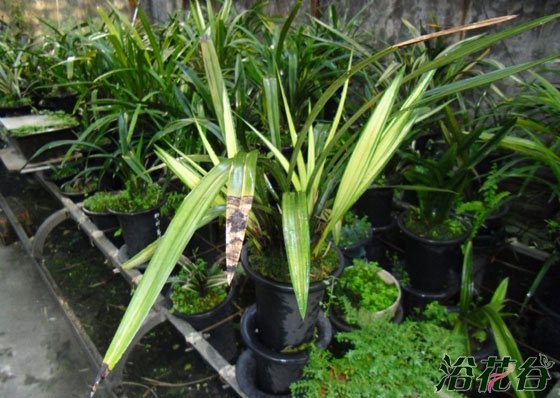
In summer, if shortening the watering interval allows the orchid to grow normally, then foliage watering is no longer needed. Last summer, this Cymbidium sinense was given a heavy watering twice a day, morning and evening. The material in the pot became too wet, which affected the exchange of water and air around the orchid roots. Black water-stain streaks appeared at the leaf tips, and the new shoots also stopped growing. This summer it was changed to watering the foliage 3 times at night, and the new shoots returned to normal growth.
III. Why foliage watering sometimes causes bud rot
(1) The water quality must be clean: unclean water contains bacteria, fungi, viruses, and nematodes. Therefore, frequent foliage watering easily causes infection of the orchid leaves and produces disease. So for foliage watering you can use tap water, cooled boiled water, or reverse-osmosis water. In addition, if you use homemade organic liquid fertilizer, it must also be sterilized with pesticide before use to avoid infection and disease.
(2) If the environment is humid, hot, and not ventilated, it is also unsuitable for foliage watering, because after watering the foliage it does not dry easily. Water forms a thin film on the orchid leaves, preventing water evaporation through the stomata, and the roots cannot absorb water either, forming a physiological disorder and causing root rot. Therefore, after foliage watering, observe the orchid leaves. If they dry within 10 minutes, you can water the foliage. If after 2 hours the orchid leaf moisture still has not dried, it means the environmental humidity is high and it is not suitable for foliage watering, and attention should be paid to ventilation.
(3) Different orchid species have different requirements for the various conditions of the environment. As long as the orchid can grow normally through watering, foliage watering is not needed. When you find the orchid leaves losing green and turning yellow, the leaves curling, and the new shoots stopping growth, then foliage watering is needed. After foliage watering for a certain period, if you find the leaves turning green again and glossy, it means this kind of orchid grows in a relatively humid place and likes foliage watering.
(4) In a place with high temperature, dryness, strong light, and good ventilation, orchids lose water quickly. If the water lost cannot be replenished from the orchid roots, the stomata of the orchid leaves close, the leaf temperature rises, and this causes physiological disorders such as black spots, scorched tips, and root rot, and the growth of the new shoots stops along with it. Therefore, foliage watering replenishes the water the orchid has lost. When moisture is normal, the orchid leaves also carry out photosynthesis normally, and naturally the new shoots can also grow normally.
But this kind of physiological disorder mostly occurs in the high-temperature, dry environment of summer. Once the high-temperature season passes and the temperature drops below 28 degrees, the water supply from the orchid roots to the orchid leaves returns to balance, the orchid can also grow normally, and foliage watering is no longer needed.
(5) If the orchid itself is infected by pathogens, foliage watering will make the condition more serious.
When orchids are grown in the open, rain brings pathogens, so some orchid plants will become infected. If the environment is dry, it will not spread, and there is no need to spray pesticide for treatment. But if the environment is humid and the orchid is found to be diseased, pesticide must be sprayed immediately for treatment; otherwise the pathogens will spread through the moisture to the entire orchid house.
IV. Details determine success or failure
(1) Growing orchids is a systematic project, with each link connected to the next. Failure in one detail will cause failure in growing orchids. For example, I once made my own organic liquid fertilizer to grow orchids, but after fertilizing, the orchids became diseased and the buds rotted. Yet I saw that Yunwei Orchid Garden also used organic liquid fertilizer and did not get disease, which was quite surprising. But after reading the posts I understood: it was because they sterilized it with pesticide before use. I learned another trick and also solved the problem that organic liquid fertilizer easily causes disease. So in the process of growing and cultivating orchids, many problems will arise. You must think about what problem has appeared in the orchid and how to deal with and solve it. Of course, the technical steps of orchid cultivation are as follows:
1. Growing orchids well = good environment X good technique.
2. Good environment (growth period) = appropriate (light × temperature × humidity × ventilation × day-night temperature difference) × (month).
3. Good technique = 1. temperature and humidity management × 2. shading management × 3. growing material × 4. watering management × 5. fertilizing management × 6. pest and disease management × 7. others (such as introducing varieties, etc.).
(2) Orchids are prone to the two rots, which are related to management. The summarized factor is that it is not clean and hygienic enough. In an open, dry environment, pathogens spread very slowly, but in a closed, humid environment, cleanliness and hygiene are very important. This refers to the orchid house, the growing material, the pots, and the water quality used for watering the orchids; none of them may contain viruses, fungi, nematodes, etc., otherwise the two rots are easily caused, and pesticide must be used to prevent and control them.
This Cymbidium sinense 'Tiger Stripes' is grown using the method of leaving water in the bottom of the pot, mainly to cope with a dry environment where the orchid loses water quickly, so the orchid roots can quickly absorb water and provide for the orchid's growth. Last year the new shoots grew normally, but this year the new shoots have very serious symptoms. Although the roots are still very good, it may be that miscellaneous bacteria bred in the water and infected the orchid. Therefore, if you place a water basin under the orchid, it is best to do so in summer. In spring, autumn, and winter, orchids need less water and should be kept relatively dry, otherwise it easily causes pathogen infection.
V. Improper watering will produce adverse consequences. Whether foliage watering is needed should be decided by looking at the growth of the orchid's new shoots. Of course, in a dry, high-temperature summer environment, the orchid loses water quickly, causing physiological disorders and stunted buds. The most effective method is to change the environment and adjust it to one suitable for orchid growth. If the environment cannot be changed, then the only option is to increase the watering frequency or water the foliage, but both carry risks. For example, increasing the watering frequency will make the growing material too wet, affecting the exchange of water and air and causing root rot. Therefore, if there is a watery black color at the leaf tips, that is root rot caused by overwatering. In addition, improper foliage watering can also cause bud rot. So you must look at the environment and the orchid species and keep adjusting constantly. As long as the orchid does not rot at the roots and the new shoots can grow normally, that is correct management.
VI. Conclusion
Watering orchids should be decided according to the environment, orchid species, growing material, and the seasonal changes of spring, summer, autumn, and winter. Watering methods can be divided into normal watering, foliage watering, soaking watering….. and other methods. The pace and interval of watering depends on the orchid's consumption of water and the size of the orchid pot. For example, in winter water consumption is low, so it may be watered once a week or once every half month; in summer the temperature is high and water evaporates quickly, so it may be watered once a day, or the foliage may be watered 3 times a night. Whether watering is appropriate will be reflected in the growth of the orchid's new shoots. If the new shoots can grow normally, grow large, and bloom, that is the correct watering method. Improper watering will cause the new shoots to stop growing or cause bud rot and root rot. Therefore, you must learn from failures in actual watering experience and adjust the watering method to grow orchids well. So there is no fixed model for watering orchids that can be followed; you can only find the right path through constant adjustment.
There is no fixed method for growing orchids. Orchids differ, environments differ, and management methods differ. As long as the orchid's new shoots can grow normally and it is not diseased, that is the most correct management method.