Key Points and Practical Experience Sharing on Orchid Summer Care and Management
It can now be said that summer has arrived. There is a lot of information online about the key points of orchid summer care and management. This article is a summary of summer orchid-growing experience by a flower enthusiast based on their own orchid-growing experience, covering ventilation, shade, watering, and more. It is a very good reference for beginner flower enthusiasts.
Getting orchids through the summer is a great test of an orchid grower's skill, because in the hot and humid summer, if management is poor, orchids are prone to disease. In mild cases, the orchids grow poorly; in serious cases, it causes seedling collapse. Therefore, when growing orchids in summer, I personally believe the following points should be noted:
1. Strengthen ventilation: In the hot summer, the only way to lower the temperature of the orchid growing environment is to strengthen ventilation. Of course, if air conditioning equipment is available, it can be used to cool things down, but ventilation is still indispensable; otherwise, a long-term enclosed space will instead make orchids more prone to disease. Moreover, after watering the orchids, strengthening ventilation will quickly dry the moisture on the leaf surfaces, especially the moisture in the center leaves of new shoots, trying as much as possible to prevent soft rot. I have always believed that what many veteran orchid growers say, that ventilation is the number one priority, is not idle talk, but a famous saying accumulated through their long-term orchid growing.
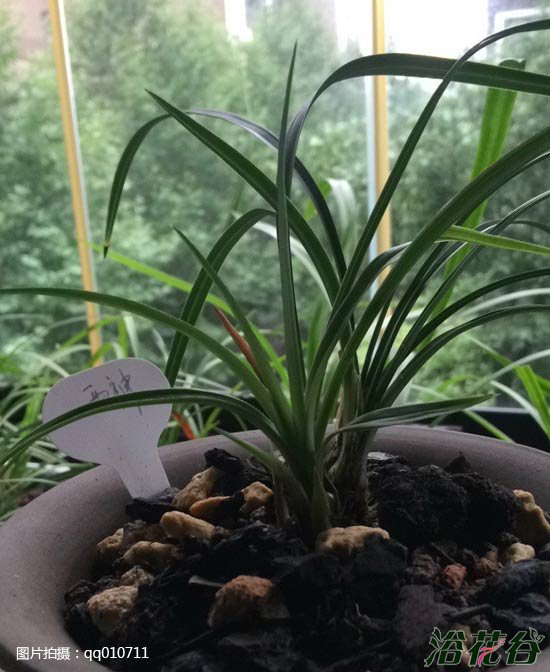
2. Provide appropriate shade from sunlight: In fact, many orchid growers in orchid-producing areas can notice that in summer, where orchids grow, the area above the orchids is already densely covered with tree leaves, and when a person walks in, it is incomparably cool. It can be seen that tree leaves not only block sunlight but also absorb a lot of heat. Therefore, for us orchid growers, simulating a natural shading method for orchids is a task that must be done. Because the shade nets we use now are black, although they can block sunlight, because they are black, they absorb even more heat, and under sunlight, the temperature near the shade net is relatively high. Therefore, when I personally shade orchids in summer, I use several layers of shade netting and leave a certain distance between them, so as to achieve the purpose of shading and cooling.
3. Pay attention and water carefully: As for watering orchids, I personally follow the principle of not watering if not dry, and watering thoroughly when watering. And after watering, strengthen ventilation to dry the moisture in the center leaves of new growth as quickly as possible. When watering, try to avoid the hottest time of day. Generally, it is best before the sun comes up in the morning or after ten o'clock at night www.yuhuagu.com.
4. Fertilize cautiously and avoid repotting: Fertilizing and repotting in summer are, in my personal view, major taboos in orchid growing. Because summer temperatures are relatively high, orchid roots are in a semi-dormant state. If fertilized, orchid roots will not absorb it and convert it into nutrients. It is easy to cause fertilizer damage and root burn, so fertilizing at this time is counterproductive. As for repotting, after orchids are repotted, the previous micro-environment has already been destroyed, and for the orchid roots to adapt to the new environment, that is, to settle into the pot, takes half a month to a month or even longer, and it is prone to stagnant buds and seedling collapse.
5. Observe more and pay close attention: As soon as signs of disease are discovered, handle them immediately; in this way, losses can be reduced to the lowest degree.