Cymbidium kanran cultivation methods and precautions
It is very difficult to introduce a cultivation method applicable to Cymbidium kanran in all regions. From ancient times to the present, when cultivation and management methods are described, Cymbidium kanran is rarely discussed separately. In many years of cultivating Cymbidium kanran, the author has gained some experience and worked out some cultivation and management methods. These are offered here to invite better ideas, and they may not be fully applicable to all regions.
In general, to cultivate and manage Cymbidium kanran well, one must satisfy the growing conditions it needs, and during cultivation create conditions suitable for its growth and development.
Cymbidium kanran grows in deep mountain dense forests. Its requirements for temperature, humidity, moisture, light and ventilation differ somewhat from those of other orchids. Cymbidium kanran grows in deep mountains. Although in winter it faces frost or short periods of snow cover, and in summer it endures high heat, the green shade of mixed broadleaf and coniferous forest or bamboo forest blocks the summer sun and high heat while also blocking the winter cold wind. In places covered with snow, the snow plays a protective role, and the ground temperature beneath the snow generally does not drop below zero degrees, so Cymbidium kanran chooses deep mountain old forests that are warm in winter and cool in summer.
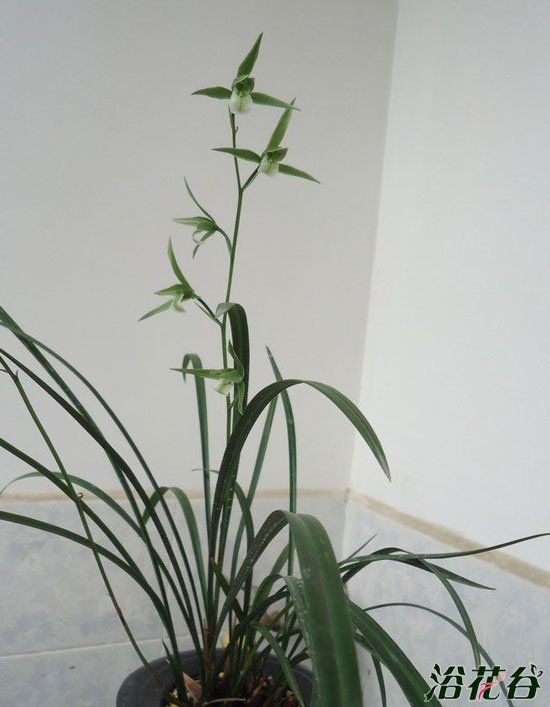
I. How to regulate temperature when cultivating Cymbidium kanran
Temperature regulation is mainly about preventing severe winter cold from freezing its orchid roots and preventing summer high heat from damaging its leaves, so that Cymbidium kanran can grow normally and have abundant flowers and lush leaves. Temperature regulation can also hasten or delay the flowering period. Temperature has a clear effect on the flowering period. Potted Cymbidium kanran flowers about twenty days earlier than under wild mountain conditions. Flowering is related to air temperature. In addition, temperature has a great relationship with the fragrance of Cymbidium kanran. When the air temperature is high, the flowers are less fragrant; when the air temperature is low, the flowers are strongly fragrant and the fragrance lasts long. Orchid greenhouse cultivation needs to consider increasing humidity and lowering temperature to regulate the temperature inside the orchid greenhouse. For an orchid greenhouse built on the ground, trees or vines can also be planted in or beside the cultivation area to regulate temperature and create growing conditions for Cymbidium kanran. Planting trees is a good method. Tree shade can block sunlight and reduce the radiant heat of strong sunlight. Under dense shade, more than 90% of light can be blocked. Tree shade can naturally regulate light and ground temperature. If the orchid greenhouse is on a high-rise balcony, frequent sprinkling or misting of the site can help prevent heat and lower temperature, because water absorbs a large amount of heat when it evaporates. Ventilation also needs to be strengthened so that air circulates, which can also lower temperature. While regulating air temperature, attention must also be paid to the temperature of the potting soil. If the potting soil is a coarse hard granular substrate, it will change greatly with rises and falls in air temperature, but its change process is relatively slow. Therefore, when watering, the water temperature must not differ too much from the potting soil temperature, otherwise many diseases will occur.
II. The humidity needed by Cymbidium kanran must be regulated
Generally, humidity refers to air humidity. Air humidity is also called relative humidity and is expressed in %. Cymbidium kanran requires relatively high air humidity for growth. In deep mountains, air humidity is relatively high. During the growing season it is often misty and rainy. The growing places of Cymbidium kanran are often filled with water mist, and relative humidity is around 90%. When air humidity is low, the orchid seedlings are yellow and thin, the leaves are rough, and there is no deep green gloss. When air humidity is suitable for its growth, the leaves are moist, clean, emerald green and glossy. Generally, the humidity required by Cymbidium kanran during the growing period must not be lower than 80%, and during the winter dormancy period it should also be 65—70%, while air humidity at night should be somewhat higher than during the day.
The growth of Cymbidium kanran also requires moist mist with air circulation. Therefore, in cultivating Cymbidium kanran, humidity and ventilation are two opposing and contradictory factors. More ventilation lowers humidity. In deep mountains this problem is less serious, because firewood, grass and trees are all around and maintain a certain humidity. But in an orchid growing site it is different. In order to maintain air humidity, orchid growers should ventilate less or ventilate appropriately. A slow oscillating air-blowing device can be set up, with a fine breeze blowing often to make the orchid leaves move slightly.
Besides ventilating less, methods for increasing air humidity include the following: plant flowers, grass and trees so that plant root systems can retain water and increase water evaporation into the air. Plant root systems can absorb large amounts of water from the ground and evaporate it into the air, increasing air humidity. Sprinkle water on the ground and all around. When the ground is dry, sprinkling or irrigating more can increase humidity. A small plastic water pipe can also be laid on the roof of the orchid greenhouse for drip irrigation, drilling one tiny hole every one meter, with the water inlet connected to tap water. If the orchid greenhouse is on a balcony roof, a mist sprayer or mist spray pipe can be added in the air, which can significantly increase humidity. Automatic-start misting for humidification can also be used, and it can also be used for cooling in summer. These methods can all increase humidity.
In addition, adding a water pool, water basins below the orchid rack, or opening water channels around it, and adding water jars, water buckets, water trays, etc., can also increase humidity.
III. Cymbidium kanran needs ventilation
In the south there are sometimes cloudy and rainy periods lasting ten days. Humidity then becomes too high. When humidity is too high, ventilation should be increased: use electric fans and exhaust fans to make air circulate so that water evaporates quickly. Cymbidium kanran likes moisture. When humidity is high and ventilation is good, Cymbidium kanran grows robustly. But under high temperature and high humidity without ventilation, the new shoots of Cymbidium kanran are harmed, and various fungal diseases and insect pests easily occur. Therefore, high temperature, high humidity and no ventilation should be avoided. To make cultivated Cymbidium kanran grow well, ventilation occupies an important place among cultivation conditions. Ventilation can promote the respiration of Cymbidium kanran, continuously supply fresh, clean air, promote its metabolism, promote photosynthesis, and increase the manufacture of nutrients. Ventilation can also regulate the temperature and humidity of the orchid room and shade shed, making it favorable for the growth of Cymbidium kanran. Ventilation can reduce the occurrence of pests and diseases, because most pests and diseases are caused by poor ventilation.
IV. Cymbidium kanran needs moisture
Like other plants, Cymbidium kanran cannot lack moisture. Cymbidium kanran is a mesophyte, and its roots do not need excessive moisture; only the leaf surface needs somewhat more moisture than other orchids. But exactly how much moisture does it need? When should it be watered and how should it be watered? Beginners in orchid growing are especially eager to know this, because its leaves are tall and large, and the leaves are somewhat thinner than those of Cymbidium sinense. For Yifeng, Cymbidium kanran has many leaf forms, possibly because there are many hybrid varieties, so in cultivating Cymbidium kanran they should be treated differently. Generally, Cymbidium kanran needs somewhat more moisture than other orchid species. Also, requirements for moisture differ according to the growing season, growth condition, and the texture and size of the orchid pot, and should be treated according to the situation. Generally, when beginners in orchid growing see signs of moisture shortage in Cymbidium kanran leaves, they fear the Cymbidium kanran will dry to death and water more, and the result is often root rot and death of the Cymbidium kanran.
What was discussed above about Cymbidium kanran needing leaf-surface humidification refers to adding moisture outside the roots to maintain its needs. In fact, the moisture needed by Cymbidium kanran roots is not very different from that of other orchids. Of course, because Cymbidium kanran leaves are thin and large, it needs somewhat more moisture; only the watering method is different. Cymbidium kanran can be drenched in summer and autumn, and should be drenched less in winter and spring. During the growing period and bud pregnancy period, Cymbidium kanran should be watered more to ensure sufficient moisture and nutrients during its growth period. During the dormancy period, Cymbidium kanran should be watered less or not watered. Cymbidium kanran with strong growth should be watered more; those with poor growth should be watered less; diseased plants should not be watered. When sprouts are growing, moisture can be greater; in the later stage of sprouting it can be gradually reduced; when new shoots gradually become mature plants, moisture should again be somewhat less. When flower buds appear, moisture should be slightly greater. During the flowering period, moisture should not be too much, so as to prolong the flowering period. After the flowers fade, watering should be stopped for about one week, allowing it to become slightly dry, letting the orchid plants rest slightly. In hot and dry weather, water more, especially drenching the leaf surface with more water. In low temperature, water less. Orchid growers should usually pay attention to weather forecasts: water more on sunny days, water less on cloudy and rainy days. When watering, attention must be paid to the difference in pot texture and size: water more in clay pots, water less in plastic pots; water frequently in small pots, water less in large pots; water more and frequently with hard granular substrate, water less with fine soft substrate.
Large-pot cultivation: For planting Cymbidium kanran, it is advisable to choose large pots for cultivation. Through many years of experiments, the author finds that group planting Cymbidium kanran in large pots is relatively good, because Cymbidium kanran leaves are larger and thinner than those of Cymbidium goeringii, and it usually needs high humidity; small pots do not retain moisture and dry easily. For people who often travel on business, this is even more suitable. Large pots retain moisture better, and the potting soil moisture can also evaporate to increase air humidity. Moreover, with a large pot and more soil, it is not easy to dry out, and there is no need to water every day. Large pots can allow orchid roots to grow on the soil surface as in the wild mountains, because a large pot has more nutrients and can satisfy the growth and development of Cymbidium kanran. If the substrate has sufficient nutrients and light is moderate, one seedling can produce two seedlings, and they will be strong seedlings, with more and larger flowers. With large-pot cultivation, there is usually very little watering. With a 60 cm pot for cultivation, it can go all year without watering. A large pot produces strong seedlings, and strong seedlings will have fewer diseases; with fewer diseases, less medicine is used, reducing costs and so on.
For large-pot cultivation, it is enough as long as the place where the orchid pot is placed has good ventilation and no air pollution, with medicine used three or four times a year for prevention. If it is a variegated-leaf orchid, using a large pot with a small pot inside for cultivation can keep its leaf tips from burning. As is widely known, orchid seedlings have two causes of burned leaf tips: one is dry air; the other is loss of nourishment in the roots within the pot, loss of control over moisture, either dry or wet, water stifling the roots and making them black, and poor air permeability in the pot affecting the physiological balance of the orchid root crown, causing root rot and affecting tip scorch. The author has tried group planting Cymbidium kanran in large pots for many years. After planting, they become stronger year by year. The original four leaves per seedling became five leaves on new seedlings the second year, and six leaves on new seedlings the third year, with the leaf surface clearly wider, and all three generations of seedlings had no burned leaf tips. To confirm that its growth is related to the pot, I planted it back into a small pot. This year the seedlings produced only five leaves, and several generations of old seedlings began to burn leaf tips, and the leaf surface also had less gloss, not glossy and bright as when grown in a large pot. According to the experiment, the growth of Cymbidium kanran not only requires moist roots, but also requires moist surrounding air to satisfy its physiological needs.
The following discusses the requirements for using large pots for cultivation. For large-pot cultivation, the substrates include the following: (1) 50% leaf mold, 40% crushed red brick, 10% rice husk or rice husk charcoal; (2) 40% coarse river sand, 20% shiitake substrate, 30% leaf mold, 10% loess granules; (3) 60% crushed shale, 30% leaf mold, 10% weathered soil.
When using large pots to plant Cymbidium kanran, the substrate in the pot should be divided into three layers, namely large, medium and small. Large particles the size of an egg are placed in the lower layer for drainage, aeration and moisture retention, filling to 40% of the pot height. Medium particles the size of a jujube are placed in the middle layer at 5%. Small particles are combined with the soil used for planting orchids. Before planting the orchid, first wash the orchid pot and the large and medium particles separately with water, then soak them thoroughly with clean water, place them separately as the bottom layer of the pot, and then plant the orchid.