Introduction to the Characteristics and Care Methods of the Chunlan 'Song Mei' Variety
The price of Chunlan 'Song Mei' is roughly between 20 and 100 yuan per seedling; those grown by orchid nurseries are cheaper, while balcony plants grown by individuals are more expensive! Song Mei is an orchid variety whose fragrance, leaf form and flower form can all be called perfect. If you only want to grow one pot of orchid, then choose Song Mei without hesitation! To this day, new flowers emerge endlessly. And which...
The price of Chunlan 'Song Mei' is roughly between 20 and 100 yuan per seedling; those grown by orchid nurseries are cheaper, while balcony plants grown by individuals are more expensive (less prone to rot, easy to grow)! Song Mei is an orchid variety whose fragrance, leaf form and flower form can all be called perfect. If you only want to grow one pot of orchid, then choose Song Mei without hesitation! Strong Song Mei seedlings (around 6 leaves) bloom easily, while small and medium seedlings are reluctant to produce flowers!
To this day, new flowers emerge endlessly. And which variety of flower can compare with this hundred-yuan Song Mei. Cultivating orchids is about pursuing good bloom presentation; it is not something you finish once and for all just by obtaining the variety. To achieve a visually pleasing and near-perfect orchid bloom presentation is not something that can be accomplished overnight. A Song Mei with two flowers on one stem is rarely seen, and the 'Crested Red' is even rarer. On the road of orchid cultivation, people of our generation still have much to do. Let the mind quiet down and the person settle down; orchid cultivation begins with Song Mei.
Song Mei, also known as Song Jinxuan Mei, is a traditional famous variety of Chinese orchid and a representative variety of the plum-petal flower. It is the first-choice variety of Chunlan. This flower was selected during the Qianlong reign of the Qing dynasty (1736-1795) by Song Jinxuan of Shaoxing; the flower name was formed by combining Song Jinxuan's surname with the plum petal of the flower. Its flower form is dignified and generous, and it is listed first among the four great famous varieties of Chunlan. Song Mei and the Chunlan 'Long Zi' are together called the "Twin Jades of Chinese Orchids." After more than two hundred years of history, although famous orchids have emerged repeatedly, no plum-petal flower has surpassed it, and it is the classic model of plum-petal flowers.
Song Mei leaves are bow-shaped, generally 25cm-30cm long and 0.5cm-1.5cm wide, with a bluntly pointed leaf tip. The leaf texture is medium-thick, the leaf color is deep green with good gloss, the midrib is hard and upright and highly elastic, the leaf posture is semi-pendant, and the leaf margin has fine teeth. Each seedling has around 5 leaves.
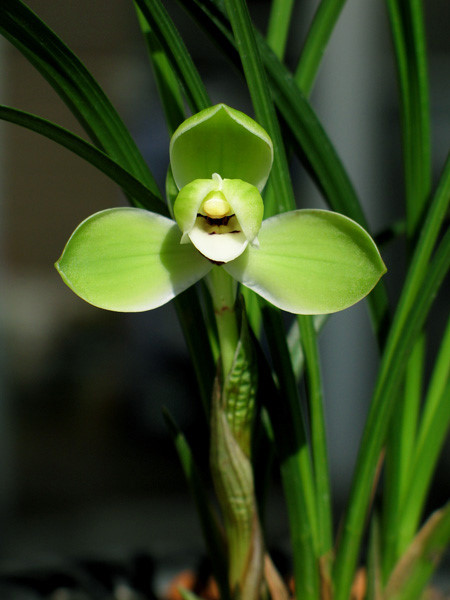
Petal type: due to differences in bud mutation from cultivation, plum-petal flowers can bloom as lotus-type narcissus and plum-type narcissus. The three outer petals are especially tight and round, just like plum blossom petals, with tight edges resembling a white border. The color is green, and the two petals form a pouch shaped like a silkworm moth, hence called silkworm-moth petals. The lip petal is short and round, slightly upturned. The tip of the lip forms a slight pouch, just like a child's bangs, hence called bangs lip, and the lip has irregular red dots. The bract leaves are pale red; when the orchid plant is strong it often produces double flowers, the flower scape is tall, the leaves are deep green, semi-pendant, with blunt leaf tips, relatively wide leaf width, and glossy leaf surface; the beauty of its leaf posture is hard to describe, making it an outstanding famous variety among Chunlan plum-petal flowers. Together with 'Wan Zi', 'Long Zi' and 'Ji Yuan', it is listed among the Chunlan "Four Great Heavenly Kings," and is promoted as first among the "Four Great Heavenly Kings."
The three outer petals sometimes bloom as lotus-form narcissus, or plum-form narcissus. When the orchid plant is robust, it readily produces double buds and twin flowers. The main petal is upright and perfectly round, the side petals are level-shouldered, the center is round and neat, and the flower appearance is very proper. The flower scape is tall and lofty, sometimes able to rise above the leaf surface. The bract leaves have two to three sheath shells, and the flower stem has two types, white and white with a slight red tinge, also caused by bud mutation. Because the time when Song Mei was discovered coincided with the perfection of Chinese orchid petal-form theory, Song Mei was used as the model to determine the definition of plum petals and to stipulate the conditions that plum-petal flowers should possess. Song Mei is the typical and representative plum-petal flower. Whether in flower appearance or in spirit and charm, over hundreds of years, among no matter which category of orchid, no plum-petal flower has been able to surpass Song Mei.
Some people in orchid circles divide "Song Mei" by leaf shape into "long-leaf Song Mei," "short-leaf Song Mei," "upright-leaf Song Mei," "curled-leaf Song Mei," "broad-leaf Song Mei," "fine-leaf Song Mei," and so on. In fact, these "changes" are merely caused by external factors such as cultivation management and environment, and cannot be called "mutations." At present, the only true natural "bud mutation" of "Song Mei" is the example of "Golden-edged Song Mei" in Chen Xuexiang's nursery. Through "directional cultivation," one line of the "golden edge" has become very stable, but it has still not yet flowered, so it is unknown whether there will be changes in flower artistry. I have also introduced all the various leaf-shape "Song Mei" mentioned above, among which some have leaves nearly 50 cm long, some have relatively upright leaves, and some have leaf width reaching more than 1.5 cm. However, these "Song Mei" from different sources gradually become consistent under the same cultivation conditions, and I believe that after another one or two years of growing they will be impossible to distinguish. Although the different changes in "Song Mei" leaf shape cannot be regarded as "mutated" varieties, they can let us understand its source and its original cultivation conditions and methods, and can be used to guide our purchasing intentions. Through observing these different leaf-shape "Song Mei," we can find that no matter how the leaf shape changes, its basic characteristics do not change.
1) "Song Mei" leaf posture: the leaf posture of "Song Mei" is generally the typical bow-pendant type, and there is also a relatively more upright semi-pendant type, but whether bow-pendant or semi-pendant, its arc is very smooth and full of strength, without a stiff or weak feeling.
2) "Song Mei" leaf length and leaf width: the leaf length of "Song Mei" is generally around 30 cm, but as the plant is strong or weak the leaf length will change relatively; I myself have grown "long-leaf Song Mei" with leaves reaching 50 cm. The leaf width of "Song Mei" is generally around 1.2 cm. Like leaf length, leaf width also cannot be determined; that is to say, the leaf length and leaf width of "Song Mei" cannot serve as criteria for determining the variety. But we should know that no matter how it changes, it is merely an enlargement or reduction of the "usual leaf."
3) "Song Mei" leaf texture and leaf character: the leaf texture of "Song Mei" is fine and glutinous, with moderate thickness, and the leaf character combines hardness and softness and is extremely elastic. However, it should be noted that the leaf texture of "Song Mei" grown naturally and forced in greenhouses will show certain changes.
4) "Song Mei" leaf color and luster: the leaf color of "Song Mei" is generally deep green, and the glossiness of the leaf surface is especially strong. However, in addition to its varietal characteristics, the leaf color of "Song Mei" is also related to differences in leaf structure and chlorophyll content caused by cultivation methods and environmental lighting, so the depth of "Song Mei" leaf color also cannot serve as a criterion for determining the variety.
5) Details of "Song Mei" leaf stalk, leaf tip, leaf surface, etc.: the leaf stalk of "Song Mei" is tightly contracted, the leaf width is medium-broad, the leaf tip is bluntly pointed, the leaf surface has longitudinal ridges, and the bottom leaves are boat-shaped. These characteristics are fixed and unchanging.
6) Overall plant type of "Song Mei": viewed as a whole plant type, the leaves of each plant are neatly arranged, either high-pendant or low-pendant, with smooth rounded arcs and elegant charm.
I have grown more than a dozen pots and over a hundred seedlings of Song Mei, and many pots have bloomed many times. The tongue of Song Mei varies; in the same pot, sometimes the tongue has red dots, sometimes it is a white tongue. I have also seen a single pot of Song Mei with one white tongue and one with red dots, which is related to the same environment, sunlight, and so on.
Song Mei, first among the four great heavenly kings of Chunlan, is the typical representative of plum-petal flowers. From ancient times to the present, orchid masters have praised it highly, and modern orchid writings describe it in detail. "Lan Hui Tong Xin Lu": "The five petals have tight edges, extremely broad and thick, with pointed tips. Bangs tongue, level shoulders, white stem, slightly purple below the shell, the upper three wrapping garments all green; a noble variety." Song Mei was discovered during the Qianlong reign, and for more than two hundred years, no existing plum-petal variety has been able to surpass Song Mei. Chinese orchid culture incorporates the connotations of Confucianism, Buddhism and Daoism. Song Mei's three outer petals are tight and round, green in color and glutinous in texture, with a prominent white edge and tight edge, a fine base, a round head with a pointed tip, level shoulders, silkworm-moth petals, and a bangs tongue. The center and outer ring are round, tight and proper, and the flower is flat or elevated above the leaves. The flower bud is short and round, with a rounded bulging middle and a hollow upper part; the bract leaves are pale red, turning green layer by layer, with purple veins reaching the top. The flower color is emerald green and delicate and beautiful, and the flower form remains unchanged for a long time after opening. Its subtle fragrance is rich, and its abundant spirit is unmatched, exactly serving as a personified representative, containing the essence of Chinese orchid culture and embodying people's pursuit of completeness, purity and ideals.