How to grow Chinese orchids? These experiences are worth referencing
There are flower enthusiasts new to growing Chinese orchids who do not know how to grow them. The Quancheng Chinese Orchid Farm, located in Yuemei Village, Shanlin Township, Kaohsiung County, Taiwan, China, is jointly run by Su Wuxiong and Su Liqiang, father and son. It covers an area of more than six hectares and grows various varieties of Chinese orchids such as cymbidium, Cymbidium sinense, four-season orchid, and Cymbidium goeringii, and also provides growing experience to orchid enthusiasts who love Chinese orchids. Besides flowers, the farm is also a professional lychee production farm, including varieties such as Yu He Bao and Hei Ye.
Their father and son have rich experience and methods for cultivating Chinese orchids. Here their insights are provided for readers to share:
◎When to water
Some people say that to learn to grow orchids, you must first learn to water for three years. This statement precisely points out that watering is the most important part of orchid growing. The amount of watering varies with the season, the location, and the condition of the orchid itself, so there is no fixed rule. It can be said that as long as the surface soil is too dry, it is time to water.
As for the time of watering, in summer it should preferably be at dusk, while in winter when it is colder, it should preferably be done in the morning when the sunlight has just appeared, and try to make the water droplets attached to the leaf surface dry in a short time; because water droplets attached to the leaves will form a lens effect that refracts sunlight and scorches the leaves, or stick to spores of harmful bacteria in the air and cause disease, and if water seeps into the pot in hot summer, it will rise with the temperature and cause the roots to rot. On the contrary, if watered at dusk in winter, the cold water at night will freeze and damage the orchid leaves or roots. Generally speaking, orchids do not like the inside of the pot to be dry for too long, and it is best to maintain a certain humidity in the pot. In addition, when watering, the sprinkler should preferably be more than 30 cm away from the orchid leaf surface (this allows part of the nitrogen in the air to dissolve into the water and become natural fertilizer), the water flow should not be too strong (to avoid shaking the orchid plant and washing away the growing medium), and try to water until water flows out from the drainage hole at the bottom of the pot, so that the stale air in the pot can be completely replaced.
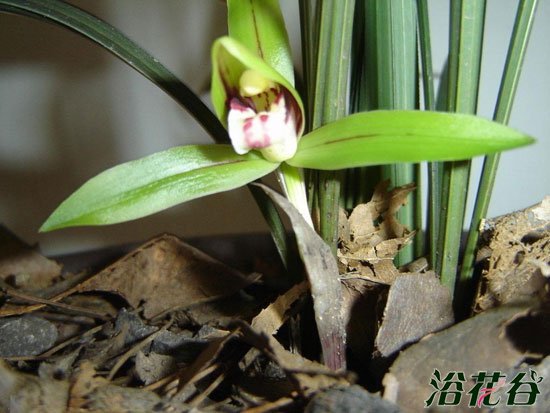
◎Suitable temperature
Chinese orchids can adapt to a wide temperature range, and the climate across the whole island of Taiwan, China is very suitable for cultivating orchids, so ordinary hobby growers do not need to pay special attention to the temperature factor... If speaking of the optimal temperature, the most suitable daytime temperature is around 23-28 degrees. When the weather is too hot in summer, it is best to add black plastic netting (about 50%-70% shading), to avoid direct sunlight burning the flowers and leaves. The most suitable nighttime temperature is around 15-20 degrees, and the best day-night temperature difference is no more than 10-15 degrees.
◎Suitable humidity
Wild Chinese orchids generally grow in mountain wilds with relatively high air humidity, mainly relying on the moisture of rain and dew and mist, and especially like to grow near clear springs or streams, where the relative humidity of the space generally reaches 80%-90%. Therefore, when growing orchids, it is best to imitate its original natural ecological environment and increase the spatial humidity as much as possible... The humidity in the orchid room is most standard at 70-90 (relative humidity). If the humidity is insufficient, an electric sprayer can be set up so that there is often moist air flowing in the space, to suit the growth of the orchids. For home orchid growing, water jars, water trays, water tanks, or sand and gravel spread on the ground can be placed in the orchid room to expand the water surface area and let moisture evaporate upward. In addition, water can also be sprinkled on the ground in the morning and afternoon on sunny days. But avoid large amounts of misting because it affects the transpiration of the leaf surface, and avoid mosquito breeding in water containers...
◎Sunlight brightness
Light is extremely important to whether the orchid plant grows well. Chinese orchids like the morning sun from the east. If the light is insufficient, the orchid plant will be weak and spindly; if the light or western sun is too strong, the leaves are easily yellowed or scorched by the sun, and the ornamental value is greatly reduced. Chinese orchids are semi-shade plants, but there should be more than 10000-15000 LUX of illumination every day, and it must not be too dark, that is, a shading rate of 50%-70%. In winter and spring, appropriately increasing the light amount by 20% is more favorable for orchid growth.
◎Ventilation conditions
When planting Chinese orchids, pay attention to the ventilation conditions of the site... If the orchid rack is too low, the shading is too much, the distance between flower pots is too close, or the number of plants in the pot is too large, causing the leaves to rub against each other, this poor ventilation condition easily invites pests and diseases and poor growth. To improve it, pay attention to the key points mentioned above, and fans and exhaust fans can also be used as remedies. If the wind is too strong on a certain side of the site, it can be blocked with loose netting or semi-transparent plastic sheets. And maintain smooth airflow in the orchid room and keep the air fresh.
◎Choosing orchid pots
For orchid pots, it is best to use tall unglazed pots. The advantage is good water drainage and oxygen permeability, and they are also easy to grow moss; the moss on the pot can weaken the heat-absorbing effect of the flower pot, avoiding the orchid pot injuring the orchid roots in contact with it due to strong sunlight, and it also has a moisture-retaining effect. Glazed pots are inferior, but more attractive; if the drainage hole is large and the stand is high, they can make up for it and can also be used. Although porcelain pots are beautiful, unfortunately their density is high; their air permeability and water drainage performance are poor, and they may damage the orchid roots, so it is best not to use them. Tall pots have a graceful shape, make planted orchids appear upright and spirited, and are favorable for orchid root growth. But in recent years, as the scale of orchid growing by enthusiasts has gradually increased, techniques have gradually matured, and due to cost considerations, orchid pots have also gradually been replaced by plastic orchid pots...
◎Growing medium
The best growing medium has a certain degree of moisture absorption, does not dissolve out chemical substances, and does not adsorb fertilizer on its surface. For home orchid growing, it is best not to use rice husks as a growing medium, otherwise it very easily creates ant nests (to prevent insects and ants, slaked lime can be sprinkled once every half a year as a preventive measure). The traditional method of mixing crushed stone with tree fern fibers is sufficient.
◎Division and transplanting
If in a greenhouse with heating equipment, division and transplanting can be done at any time except that it is not suitable in midsummer. In other environments, it is best to divide and transplant around the spring equinox or autumn equinox.
The order of division and transplanting:
Hold the pot with the left hand, and pat the left wrist with the right hand. In this way, the roots in the pot are shaken and easily come out. If the growth is too good and it cannot come out, carefully take out the stone particles, then take out the roots.
Before division, remove the rotten roots and carefully observe their condition, inspect and decide how to divide. After deciding where to divide, part this place with the left hand and carefully cut it open with a sharp blade (scissors can also be used, but if slightly careless they easily damage roots or growth points), and apply fungicide to the cut.
Before planting, remove the remaining rotten roots and clean up around the pseudobulbs... Rotten roots are weak and fragile, so they can be pulled up with just one pull.
Whether roots or leaves, they must be washed clean before planting, because the leaves may carry scale insects or dirt, and even the base of the leaves must be thoroughly cleaned.
New pots must be washed with water before use. If using old pots, they must be scalded with old boiling water and sun-dried before use, and before planting, put the roots into the pot and carefully consider the planting posture to decide the position of the roots.
Spread thumb-sized gravel at the bottom of the pot to one third of the way up, then add soybean-sized gravel to four fifths of the way up, pack it firmly and try not to leave spaces, and finally pour in bean-sized growing medium (or cover with sphagnum moss), to bury all the pseudobulbs in the soil.
After planting is completed, put the whole pot into water for one minute, then take it out and place it in a cool place for about one week before normal management.