A Detailed Guide to the Cultivation Methods and Precautions for Chinese Cymbidiums
For the cultivation methods and precautions for Chinese cymbidiums, we first need to understand the basic knowledge of Chinese cymbidiums. Chinese cymbidium orchids mainly include several major series: Chunlan (Cymbidium goeringii), Huilan (Cymbidium faberi), Jianlan (Cymbidium ensifolium), Hanlan (Cymbidium kanran), Molan (Cymbidium sinense), and Chunjian (Cymbidium tortisepalum). They have elegant forms and fragrant flowers. The leaves of orchids are an important part of their ornamental value. All orchid growers hope their orchid leaves are clean, emerald green, and free of scorched tips and disease spots. If the leaves are scorched and messy, the ornamental value is greatly reduced, the plants are weak, and the flowers do not bloom ideally. This article will discuss the experience gained over the years in caring for orchids other than Molan, to explore together with fellow enthusiasts, in the hope of jointly improving Chinese cymbidium care skills. Molan care can also be referenced.
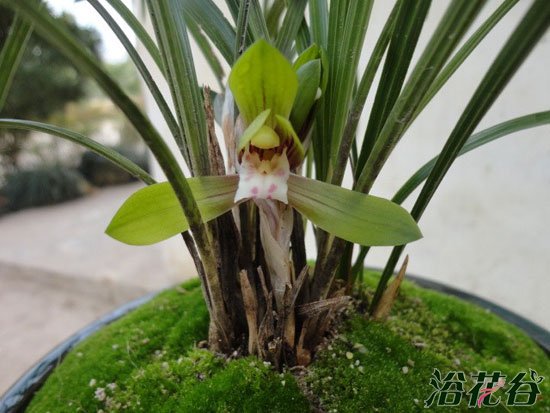
The main points to pay attention to in the daily care of Chinese cymbidiums are as follows:
1. The potting medium must be breathable:
Whether using hard potting medium or soft medium, the medium must be breathable from top to bottom. Especially for soft media such as peat, other ingredients should be added to keep it fluffy after watering. Otherwise, after watering it settles and breathability deteriorates. Orchid roots easily rot in a non-breathable environment. It can be said that "air" is the life of an orchid. If using completely hard granular media such as orchid stone, pumice, or Kanuma soil for planting, attention must be paid to watering. Otherwise, the medium becomes too dry and hollow roots easily appear. When planting orchids, do not press down on the medium like when planting other flowers. Instead, add medium while tapping the side of the pot, letting the medium settle naturally. Pressing will make the medium too compact and affect breathability. Sichuan orchid growers summed it up well: "If you want orchids to grow well, the wind should be able to blow them over."
2. Air-dry the roots before planting:
Whether they are newly collected from the wild, bought online, or divisions from your own old pots, before planting, first trim off rotten roots, hollow roots, and rotten leaf sheaths. Also pay attention to scraping off scale insects and other pests and diseases that may exist inside the leaf sheaths and in the leaf grooves. After washing the whole plant, soak it in a solution of Topsin at about 800-1000 times dilution for about 20 minutes. After removing, hang it upside down to air-dry until the fleshy roots become soft and white. The time should not be too long to avoid leaf dehydration. The purpose of hanging to dry is to let the wounds on broken roots and divisions form scabs so they are less likely to rot. After that, it can be potted.
3. Watering must be appropriate:
Orchids prefer relatively high air humidity, and the potting medium must have a certain moisture content, but the medium must not remain too wet for long periods, otherwise roots will rot. With coarse granular medium, watering frequency can be appropriately increased. With soft medium, just keep it consistently "moist" and do not water too frequently. No matter which medium is used, water thoroughly when watering. After watering, immediately turn on a small electric fan to blow dry any water accumulated in the leaf hearts. This is especially important not to forget when the temperature is above 15°C. Otherwise, new shoots will develop water-soaked damage or stem rot. The lower part of new seedlings begins to turn yellow-brown, progressing to the entire seedling rotting. In severe cases, the whole plant dies within about a week, and there is no cure.
4. Ventilation must be gentle:
The growing environment for orchids should have good ventilation. If it is too closed and stuffy, pests and diseases are more likely. A gentle breeze is most suitable. Avoid strong winds. If the wind is too strong, the fine serrations on leaf edges rub against each other and easily damage the leaves, and may also cause leaves to break. Leaf damage affects appearance.
5. Fertilization must be light:
"Clear for orchids, turbid for jasmine." Orchids have a small annual growth amount and do not need excessive fertilizer. Newly planted orchids with severe root damage do not need fertilizer for one year. For old pots, sprinkle a little slow-release fertilizer on the pot surface before spring sprouting, and sprinkle once more in early autumn. Do not fertilize frequently out of excessive enthusiasm for the flowers. In particular, do not apply liquid fertilizer to newly planted orchids with severe root damage. Fertilizing at this time will seriously affect wound healing. In overly fertilized medium, the crystal tips of new roots will shrink and turn yellow-brown or even black, losing their absorption function. Normally growing orchid root tips have white crystal tips and dense root hairs, with strong absorption capacity and vigorous whole-plant growth.
6. Light must be moderate:
Chinese cymbidiums should be appropriately shaded from early summer to mid-autumn, avoiding direct sunlight around midday. Too strong sunlight will scorch the leaves. From mid-autumn to early summer, full light can be received. Among them, Huilan can take a little more sunlight. Different regions have differences in light intensity, temperature, and duration, so shading time can be appropriately moved earlier or later. After flowers open, shading can extend the blooming period. Increasing shade during the flower stalk elongation stage can increase flower stalk height. For Chunlan with green petals, more shading makes the petal color more tender green.
7. Pest and disease control must be timely:
The main orchid diseases include anthracnose and black spot. In hot, stuffy, and humid weather, special attention should be paid to ventilation, and some fungicides should be sprayed for prevention. With good ventilation conditions, plants are also less likely to get sick. The main pests are scale insects and thrips. If a small number of scale insects are found, they can be scraped off. In May, pesticides can be sprayed during the nymph stage for control. Generally this can keep them under control and will not cause fatal harm to orchids. Thrips are more troublesome. They most easily bore into the leaf hearts to bite when new shoots open in early summer, forming strip-shaped yellow-brown markings, and bring in viral invasion, causing new seedlings to grow weakly or even die, thereby affecting the growth of the whole plant. In summer, they also harm the flowers of Jianlan (Cymbidium ensifolium), causing buds to stiffen and fail to open normally. Thrips cause serious damage, so pesticides should be sprayed promptly after new shoots emerge from the soil and before they open. Because they have wings and fly in from outside, spraying must be repeated. Pesticides can be purchased at agricultural supply markets, but drug safety must be strictly observed. In particular, they must not be used indoors. On balconies, drug safety should also be observed. Wear a mask when spraying, and promptly wash exposed skin after spraying to avoid harm to the human body. This must not be taken lightly.
The above brief experience is offered for discussion together with fellow enthusiasts. As the saying goes, "To kill a pig, kill its butt; each has their own way with the knife." Orchid-growing techniques differ by region. This one-sided view is only for fellow enthusiasts' reference.