What are the cultivation methods and precautions for Phalaenopsis?
Phalaenopsis is an important holiday flower, and many gardening enthusiasts are raising Phalaenopsis for the first time. This article on Phalaenopsis cultivation methods and precautions is more of a comprehensive growing guide. If you need other specific details, you can read the related articles below.
Phalaenopsis is native to the tropical regions of Asia. Its place of origin has high temperatures and high humidity. It prefers hot, humid and semi-shaded environments. The suitable growing temperature is 25-28°C during the day and 10-20°C at night. When summer temperatures exceed 35°C or winter temperatures drop below 0°C, Phalaenopsis stops growing. If low temperatures persist, the roots stop absorbing water, causing physiological dehydration, and the plant will die. However, Phalaenopsis flower bud differentiation does not require high temperatures; 16-18°C is suitable.
Phalaenopsis prefers environments with high humidity. Because it lacks thick pseudobulbs to store water, if the air humidity is low, it easily becomes dehydrated. Therefore, when growing Phalaenopsis, air dryness and dry winds are the greatest concerns.
The passage above covers the basic information about Phalaenopsis. Below we discuss Phalaenopsis cultivation methods from the perspective of practical growing.
Because Phalaenopsis is mostly sold as a holiday flower, when gardening enthusiasts buy it, it has just come out of a greenhouse. So enthusiasts must pay attention to the ambient temperature, and should not water or repot it immediately after bringing it home - that is a mistake.
After bringing it home, simply place the Phalaenopsis in a warm environment for care, give it appropriate light, mist it frequently, and water it sparingly.
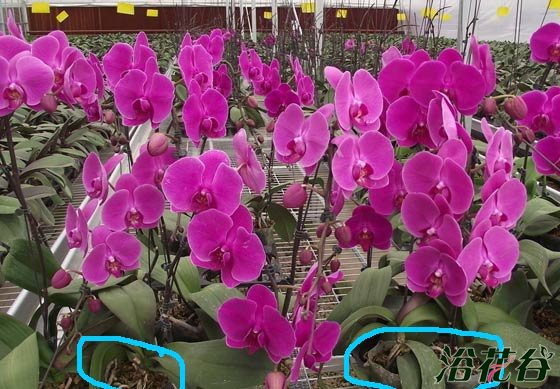
What enthusiasts need to note is that Phalaenopsis is an epiphytic orchid, and its roots can carry out photosynthesis. Therefore, most Phalaenopsis in greenhouses are planted in transparent plastic pots, with the roots on the outer edge where they can see light. So enthusiasts must remember not to think about repotting it into a fancy pot and burying all the roots in the soil - that is wrong. Phalaenopsis needs its roots partially exposed to the outside.
1. Overwatering: Friends growing Phalaenopsis always worry that the plant lacks water, and regardless of whether the growing medium is dry, they water it every day, causing severe root rot.
2. Temperature too low: Usually, flowering Phalaenopsis plants are mostly marketed in early spring, and after being brought home they are generally placed in the living room or similar places for appreciation. Although the daytime temperature in these places is sufficient, the nighttime temperature is somewhat on the low side. On the other hand, professionally cultivated orchids are mostly kept in well-equipped greenhouses. By comparison, the temperature and humidity at home are somewhat insufficient, causing the plant's growth to gradually weaken. Therefore, sometimes no matter how well the orchid is cared for, there are still times when it does not bloom.
3. Overfertilizing: Applying fertilizer whenever available, without paying attention to concentration, thinking that fertilizing will make it grow faster. You should know that Phalaenopsis should be given diluted fertilizer, applied in small amounts but frequently. Remember that "overfeeding" should not be excessive, otherwise it will backfire.
4. Planting a small plant in a large pot: Thinking that using a large pot can give the Phalaenopsis a more spacious environment with plenty of material. In fact, after using a large pot, the sphagnum moss does not dry easily. You should know that Phalaenopsis likes good ventilation, and with good airflow it thrives.