How should orchids be cared for in winter so they can survive the cold safely?
How orchids are cared for in winter has a very important effect on their growth the following year. When it comes to orchids, we cannot make sweeping generalizations; different management methods should be chosen according to different varieties.
Under normal circumstances, orchids should be moved indoors for the winter in winter, into a spot indoors with plenty of sunlight (such as a south-facing enclosed balcony). The wintering temperature for orchids in winter should be between 5°C and 15°C. If the room temperature is too low, it will not serve to protect against the cold and keep them warm; if the temperature is too high, it will also affect the orchids' dormancy.
Orchid growers should note that for Cymbidium kanran and Cymbidium sinense, the room temperature should be slightly higher, but still not exceed 15°C. If the room temperature is too high, the flower stems grow slowly, the flower buds develop poorly, and already-formed flower buds are prone to shriveling and even dying.
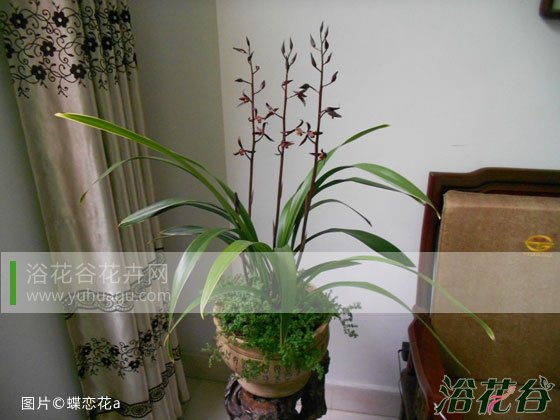
For the more cold-tolerant Cymbidium goeringii, a low-temperature period of about 0°C lasting 3 to 4 weeks is needed to help it complete vernalization. Only after vernalization can Cymbidium goeringii bloom. Therefore, the wintering room temperature for Cymbidium goeringii should be controlled between 3°C and 8°C, which is most suitable.
How orchids are cared for in winter——Watering
As the saying goes, “It must not be dry in summer and autumn, and must not be wet in winter and spring.” This is the orchid-growing experience summed up by predecessors. In winter, orchids are mostly in a dormant state, and at this time they need less water; the potting soil only needs to be slightly moist for them to overwinter safely. If the potting soil is indeed already very dry, then around noon on a clear, warm day, spray-water it with water at the same or a similar temperature to the room, just enough to make the potting soil slightly moist, and never use a heavy watering, to prevent the potting soil from freezing or becoming too wet and causing root rot. Rainwater or snowmelt is best for watering; freshly drawn tap water must not be used. If there is no rainwater or snowmelt and tap water must be used for watering, the tap water needs to be left to sit and aerate for one or two days before it can be used to water orchids. When watering, pour it in from the edge of the pot so that it gradually flows down to the flower roots and stops once the flower roots are moist. Never water toward the leaves or the center of the leaf cluster.
How orchids are cared for in winter——Controlling fertilizer and increasing light
Orchids generally do not need fertilizing during their winter dormancy. Generally, when orchids are repotted and the soil is changed every one or two years, the replacement soil already contains sufficient nutrients, so no fertilizing at all is needed in winter. However, for Cymbidium goeringii and Cymbidium kanran during their growing period, a small amount of phosphorus and potassium fertilizer can be sprayed on the leaves. In addition, indoors, orchids can be given more light; if there is insufficient light, supplemental lighting can be used. If orchids have sufficient light in winter, it benefits their sturdy growth and abundant, colorful blooming the following year. At the same time, it can also improve the orchids' cold resistance during wintering.
How orchids are cared for in winter——Ventilation and air exchange
Orchids like warmth and also need air circulation. Especially in northern regions, where there is heating indoors, never place orchids near the radiator. At the same time, around noon on clear, warm days, open the doors and windows for ventilation and air exchange. The pots can also be carried outdoors to a wind-sheltered, sunny spot to get some sunlight, so the orchid plants can absorb fresh air. For orchids placed on an enclosed balcony, the windows and doors should also be opened to allow air circulation. When the temperature drops, the doors and windows should be closed immediately and the pots carried back indoors, so as to prevent the orchid plants from suffering cold damage.
Preventing pests and diseases
If orchids are overwintered indoors or on an enclosed balcony, when the temperature and humidity are slightly high, once pest or disease damage is found, spray the appropriate pesticide promptly. Protective spraying should also be done routinely, for example, spraying the potting soil, the orchid plants, and the surrounding environment of the pots with Bordeaux mixture; this can prevent or reduce the occurrence of pests and diseases the following year.