Cymbidium goeringii 'Green Cloud': Cultivation Methods and Tips
Many orchid growers say that Cymbidium goeringii 'Green Cloud' is difficult to cultivate, but 'Green Cloud' is actually easy to grow too. You cannot rush orchid growing. As for Cymbidium goeringii 'Green Cloud', let us look at the cultivation tips of fellow orchid growers and learn from their experience, so that growers can avoid unnecessary detours.
First, you should carefully research the source of the plant material and choose naturally grown plants as much as possible. There is really no need to insist on whether it is an old clone.
Second, when buying 'Green Cloud', it does not have to be one pseudobulb producing many new growths; natural growth is fine. Do not be greedy for cheap deals. Although pies occasionally fall from the sky, they are caught by experts first, and ordinary people like us can only look up in admiration.
Third, after acquiring 'Green Cloud', try to find out clearly the previous owner's potting medium, environment and cultivation methods. Do not be impatient to divide the plant or change the potting medium. There is no noble or humble potting medium; the one it has already adapted to is the best, even if it is mountain soil.
Fourth, after an adaptation period of one to two years, if you want to preserve the clone, you may divide the plant, but you must pay attention to the timing and method of division.
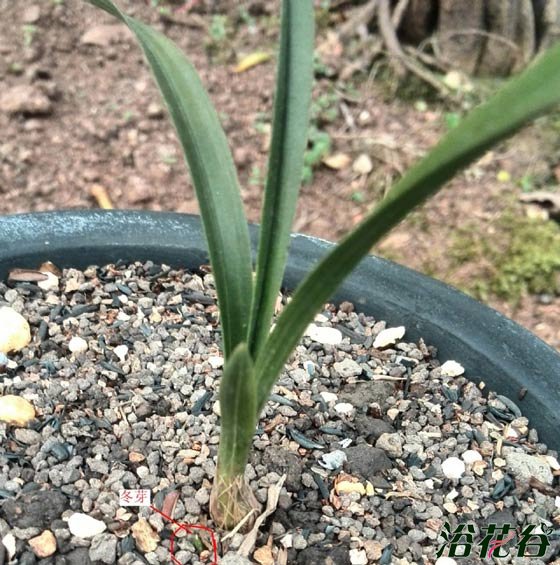
After introducing 'Green Cloud' and going through the adaptation period, you can try the following transitional approach. First, keep the potting medium on the lean side. I use aged Xiantu. What is aging? It means planting other plants in the Xiantu in advance or leaving it in an empty pot exposed to wind and sun, until it can be easily broken apart by hand and crushed into powder between the fingers. Then mix in Xiaojiangtu. This is because, strictly speaking, Xiaojiangtu has the nature of pond mud and is prone to being too rich or turning to mud.
In recent years, orchid growing in Jiangsu and Zhejiang has favored pure Xiaojiangtu. However, without experimenting and with an uncertain soil source, it is advisable to mix in the above-mentioned Xiantu. If you want to be even safer, you can add a large proportion of Kanuma soil or large-particle vermiculite.
To preserve the clone, if division into single growths is absolutely necessary, I personally think it should be done in October, when the new growths are about 80 percent mature, choosing a season with little rain, and the plant should be removed from the pot. Then use a toothpick to pry loose the orchid's pseudobulbs, and twist clockwise and counterclockwise along the rhizome until they separate.
Then dry them in the shade, let them air-dry without touching water, and do not rub the roots; try not to damage the root skin.
Then pot them up, water thoroughly half a day later, and place them in a ventilated spot. After they have settled, water thoroughly once more and return to normal care. But do not move the pot around casually; let them rest quietly!
In the remaining time, the orchid after division into single growths will have the illusion that it has not produced any new growths. It will therefore quickly sprout again. The new growths, having to take charge early, will also mature quickly and produce their own next generation! They will even break the usual pattern and sprout in winter. When the first rays of spring sunshine warm them, they will rapidly mature into growths, and in June or July they will emerge from the soil again with new shoots.
In summary, choose the right timing, keep your hands off, and do not dig at the shoots, especially not with your hands. The harm that the miscellaneous bacteria on the human body cause to it and to the recovery of orchid fungi is immeasurable!
Appendix: After potting 'Green Cloud', water thoroughly and place it in a shaded spot. In early spring and winter, keep it indoors; at other times, place it under a shade canopy. In summer, shade it from 8 a.m. to 6 p.m. In summer, the shade level for 'Green Cloud' should reach about 90%. In spring and autumn, about 70% to 80% is sufficient.