What Are the Eight Classic Old Varieties of Chinese Cymbidium (Chunlan)? An Appreciation of Classic Cultivars
This article, titled "An Appreciation of the Eight Classic Old Varieties of Chinese Cymbidium (Chunlan)," introduces fellow flower enthusiasts to information about the eight classic old varieties of Chunlan. Since the Qing Dynasty, the orchid circles of Jiangsu and Zhejiang have classified famous Chunlan varieties into five categories: plum petal, lotus petal, narcissus petal, plain heart, and rare types (including butterfly petals). By the early years of the Republic of China, the “eight classic old varieties of Chunlan” were selected: Song Mei, Ji Yuan, Long Zi, Wan Zi, Wang Zi, Xiao Da Mei, He Shen Mei, and Gui Yuan Mei (the orchid circles of Japan call the first four the “Four Great Kings of Chunlan”). Each is now appreciated one by one:
An Appreciation of the Eight Classic Old Varieties of Chunlan 1 [Song Mei]
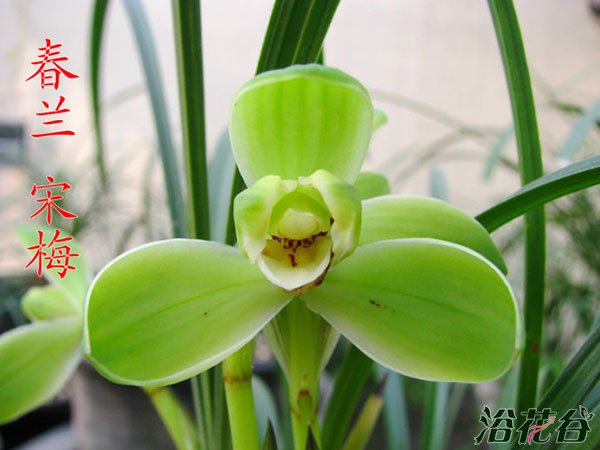
During the Qianlong era of the Qing Dynasty (1736-1795), it was selected by Song Jinxuan, a native of Shaoxing, Zhejiang. Because it is a standard plum petal flower, it was named Song Jinxuan Mei, abbreviated as Song Mei.
The new shoots are light purple. The leaves are 20-30cm long and about 1cm wide; the leaf texture is thick, and the leaf color is emerald green and glossy. The old leaves are bowing and drooping in shape, and the plant form has graceful curves. The flower scape is slender and long, 12-15cm high. The bracts are pink at the base and light purple, and the top node of the flower stem turns green. The three outer petals have rounded tips and tightly rolled edges, and the petal bases taper narrowly. The main petal is cap-shaped, courteous, and the two lateral sepals form a straight-line shoulder. The petals are silkworm-moth pollinia, guarding the fragrant column. The lip is short and perfectly round, a typical Liu Hai tongue, often with one or two small red dots on the lip surface, and it can also produce a "white-tongue Song Mei" without red dots. Song Mei has high quality without arrogance, and its shoots emerge relatively high. The flower form also has magical variations: when the orchid leaves are short and sturdy, it often produces typical plum petal flowers; when the plant is robust, one scape can produce double flowers (the flower form is plum-form narcissus petal). Song Mei is the "personality flower" with the most human spirit, which is why it has been passed down for two hundred years and has always been loved. Even the orchid circles of Japan revere it as the first of the "Four Great Kings" of Chunlan.
An Appreciation of the Eight Classic Old Varieties of Chunlan 2 [Ji Yuan]
At the end of the Daoguang era of the Qing Dynasty (1850), it was dug up by a wandering eminent monk. By the second year of Xianfeng (1852), Zhang Shenglin of Yuyao, Zhejiang, obtained this flower. Because the bases of the three outer petals gather at the meeting point into a spherical shape, it was named Ji Yuan, also called "Shi Yuan" or "Lao Shi Yuan."
The new shoots are purple-green. The leaf shape is quite similar to Song Mei. The leaves are 25-30cm long, with slightly blunt leaf tips, and the leaf color is deep green. The new leaves are glossy, and the old leaves slant and droop. There are often 1-2 narrow slender leaves in the middle, and the leaf texture is thick yet glutinous and moist. The flower scape is about 15cm, and the bracts have purple-red vein patterns within the green. The flowering period is a few days later than Song Mei. The three outer petals have rounded tips, tightly rolled edges, and narrow bases. The two lateral sepals form a straight-line shoulder. The flower color is tender green, the petals are thick, and the flower appearance is upright and beautiful. The flower form is plum petal, and sometimes it also produces plum-form narcissus petals, often with variation within stability. Even the flower stem can be divided into red-stemmed and green-stemmed types. The flower shape closely resembles Song Mei. As long as you grasp three points, it is not difficult to distinguish: 1. The top node of the flower stem is still purple-red, unlike Song Mei, which has "the top node turning green"; 2. The three outer petals are slightly longer than those of Song Mei, and the bases gather into a spherical shape; 3. The lip is a small Liu Hai tongue, clearly smaller than the lip of Song Mei. Ji Yuan has vigorous growth, reproduces quickly, and is a robust flower form. Among the "Four Great Kings" of Chunlan, it is a relatively widely spread treasure.
An Appreciation of the Eight Classic Old Varieties of Chunlan 3 [Long Zi]
During the Jiaqing era of the Qing Dynasty (1796-1820), it was discovered at the "Thousand Cliffs Dragon Vein" of Gaomiao Mountain in Yuyao, Zhejiang. Because the flower form is large and it is the crown of lotus-type narcissus, it was named "Long Zi," also called "Yao Yi Se."
The new shoots are green with purple. The leaves are 30-40cm long and 1-1.2cm wide. The old leaves have a leaf stalk of about 10cm at the base, the middle section is broad, the leaf tips are slightly pointed, and the leaf posture is semi-drooping. The flower scape is slender, upright, and tall, 15-20cm high, and the bud sheaths are rose red. The three outer petals are broad and large, with a flower diameter reaching 7cm, tightly rolled edges, narrow bases and rounded angles, and the two lateral sepals form a straight-line shoulder, full of spirit. The petals are soft Guanyin hood pollinia, with the five petals in separate segments. The lip is a large spread tongue, and the lip surface is adorned with red dots in an inverted triangular arrangement of two long and one short. It is like the auspicious star shining high, heralding good fortune. The flower color is fresh and tender emerald green, and the flower character is dignified and richly beautiful. Together with Song Mei, it is called the "Two Jade Walls of National Orchids," and among the "Four Great Kings" of Chunlan it has the largest and most gorgeous flower form.
An Appreciation of the Eight Classic Old Varieties of Chunlan 4 [Wan Zi]
During the Tongzhi era of the Qing Dynasty (1862-1874), it was first cultivated by Wan Zi Garden in Hangzhou, Zhejiang, hence the name "Wan Zi." Because this flower was discovered beside Yuanhu Lake in Jiaxing, Zhejiang, it is also called "Yuanhu Di Yi Mei."
The new shoots are light green with a slight purple tinge. The leaves are 25-28cm long, broad in the middle, and the leaf color is deep green. The new leaves are glossy, the leaf texture is thick, the leaf veins are deep, and the leaf posture is slanting and upright with some semi-drooping, with graceful curves. The flower scape is rounded and upright, reaching 16cm high. The bud leaves are light purple with a sense of transparency. The three outer petals are short, round, broad, and large, and the two lateral sepals extend horizontally, full of brilliance. The petals are thick and fleshy, glutinous, moist, and dignified, as silkworm-moth pollinia. The lip is a small Ruyi tongue, and the flower appearance is dignified and elegantly beautiful. It has won the admiration of the orchid circles of Japan and is listed among the “Four Great Kings” of Chunlan. At one time in the orchid circles of Jiangsu and Zhejiang, some people passed off Rui Mei as Wan Zi. The flower artistry of the two is now distinguished as follows:
1. The flower scape of Rui Mei is shorter than that of Wan Zi, about 10CM high. The top node of the Wan Zi flower stem turns green, while the top node of Rui Mei appears redder.
2. The flower form of Rui Mei is somewhat smaller than that of Wan Zi, at most 4cm, while Wan Zi can reach 5cm.
3. The inner whorl petals of Wan Zi are soft silkworm-moth pollinia, round, neat, smooth, and firm, with a slight red dot at the front of the pollinia petals. Rui Mei has semi-hard silkworm-moth pollinia, with no red dot at the front of the pollinia. This is the obvious difference between the two.
4. The lip of Wan Zi is a small Ruyi tongue, often not hanging down, while Rui Mei has a Liu Hai tongue, clearly larger than the lip of Wan Zi, and it can spread and open.
An Appreciation of the Eight Classic Old Varieties of Chunlan 5 [Wang Zi]
During the Kangxi era of the Qing Dynasty (1662-1722), it was selected by Wang Keming of Fenghua, Zhejiang, and was named “Wang Zi” after the surname of the breeder. Its breeding history ranks first among the eight classic old varieties of Chunlan.
The new shoots are purple. The leaves are 25-35cm long and 0.9cm wide. The leaf color is deep green and lacks gloss. The leaf surface has a “V”-shaped deep groove, the leaf tips are sharp, and the leaf posture is strongly upright. The flower scape is slender and long, reaching 15-20cm high, and the flower stalk is light purple. The three outer petals have long bases and rounded tips, narrow bases, and tightly rolled edges. The main petal tilts slightly forward, neither haughty nor humble, and the two lateral sepals form a straight-line shoulder, full of spirit. The petals are hood-shaped pollinia, milky white, short and soft, guarding the fragrant column. The lip is a round tongue, and the lip surface is adorned with faint red dots. The flower color is emerald green, the flower character is upright, and it is full of sinew and bone. The flowers are long-lasting and easy to produce. It can be regarded as the model of narcissus petals among the eight classic old varieties of Chunlan.
An Appreciation of the Eight Classic Old Varieties of Chunlan 6 [Xiao Da Mei]
During the Daoguang era of the Qing Dynasty (1821-1850), it was selected in Suzhou, Jiangsu. Legend has it that the two brothers Da Hu and Xiao Hu once “quarreled and fought” all the way to the county yamen hall over this flower, hence the name “Xiao Da Mei.”
The new shoots are purple-green. The leaves are 20-28cm long, relatively fine in shape, and only 0.7cm wide. The leaf color is emerald green, the new leaves are glossy, and the old leaves are sickle-shaped. The flower scape is slender, round, and upright, about 12cm high. The five bud sheaths are purple-red, each with seven vein patterns, all running through to the top (a mark of a good flower). The three outer petals have rounded tips, thick petal flesh, tightly rolled edges, and a glutinous texture. The main petal is in a “shade-like” form, and the length-to-width ratio of the two lateral sepals is 1.88:1. The shoulders are slightly level. The petals are semi-hard silkworm-moth pollinia, with “white heads” at the pollinia tips. The lip is a round tongue, and the lip surface is adorned with light red spots. It is truly a superior plum petal variety of Chunlan.
An Appreciation of the Eight Classic Old Varieties of Chunlan 7 [He Shen Mei]
In the early years of the Republic of China (1912 was the first year of the Republic), it was produced in Yingge Mountain, Yuyao, Zhejiang, hence it is also called “Yingge Mei.”
The new shoots are light purple-red. The leaves are 0.8cm wide and about 20-30cm long. The leaf color is deep green, and the leaf posture is slanting and upright. The flower scape is slender, round, and upright, about 12cm high. The bud sheaths are rose red, the flower stem is light purple, and the top node turns green. The three outer petals have short bases and rounded tips, tightly rolled edges, and narrow bases. The main petal has a beautiful posture, in a “shade-like” form, and the two lateral sepals extend horizontally left and right, appearing full of vigor, occasionally in a “flying shoulder” form. The inner whorl petals are thick and substantial, as Guanyin hood pollinia, with radial red stripes inside the pollinia. The lip is round and upright, a Liu Huo tongue, spreading and opening, and after full bloom the tongue curls slightly. In recent years, because many people seek to buy this flower in the Jiangsu and Zhejiang orchid markets, its price has unexpectedly surpassed that of Lu Yun, the “queen” of Chunlan.
An Appreciation of the Eight Classic Old Varieties of Chunlan 8 [Gui Yuan Mei]
In the early years of the Republic of China, it was selected by Zhu Xiangbao of Shaoxing, Zhejiang. It is also called “Sai Jinxuan,” meaning it can compete with Song Mei.
The new shoots are purple-green. The leaves are 25-30cm long and 0.9cm wide, and the leaf color is deep green. The new leaves are glossy, the leaf texture is thick, and the leaf posture is semi-drooping, with a beautiful plant form. The flower scape is slender and long, at the same height as the leaf framework. The five silver-red bud sheaths have a sense of transparency, and the flower stalk is emerald green, but the internodes have a red tinge. The three outer petals are short and round, pure green in color, with flat edges, and the two lateral sepals are level-shouldered. Sometimes it produces split-head, closed-back semi-hard hood pollinia. The lip is a small Liu Hai tongue, and the lip surface is adorned with several bright red dots. Because the close-fitting bud sheaths tightly wrap the petals, and the three outer petals have hooked sharp tips, when the petals open one must gently perform an opening operation to make the flower appearance upright. After flowering, it should be placed in a sunny place, otherwise it will be difficult to produce flowers.