Wang Xizhi's Love of Orchids: The Eternal Bond Between the Sage of Calligraphy and the Orchid
Wang Xizhi, the Sage of Calligraphy, courtesy name Yishao, traced his ancestry to Linyi in Langya. In the final years of the Western Jin, he moved south with the Jin imperial house, and after being appointed General of the Right Army and Interior Minister of Kuaiji in the first year of the Yonghe era, he settled in Kuaiji. Shaoxing was Wang Xizhi's second hometown. Wang Xizhi placed great importance on calligraphy theory; his father Wang Kuang carefully guided him from childhood in studying the "Discourse on the Brush," and he was skilled at...
Wang Xizhi, the Sage of Calligraphy, courtesy name Yishao, traced his ancestry to Linyi in Langya. In the final years of the Western Jin, he moved south with the Jin imperial house, and after being appointed General of the Right Army and Interior Minister of Kuaiji in the first year of the Yonghe era, he settled in Kuaiji. Shaoxing was Wang Xizhi's second hometown.
Wang Xizhi placed great importance on calligraphy theory; his father Wang Kuang carefully guided him from childhood in studying the "Discourse on the Brush," and he was skilled at absorbing the theories of the "Discourse on the Brush" into his own calligraphic practice. Moreover, he learned from many masters and intensively studied all the script forms. More importantly, he also created the flowing running script.
Wang Xizhi's creation of running script and cursive script was closely tied to his hobbies. Wang Xizhi loved orchids first and geese second. The story of his love of geese originated when he wrote the "Huangting Jing" for a Daoist priest at Shanyin and "carried the geese away in a cage," and when he also made a rubbing of the character "e" (goose), making the tale known to every household. Yet the more charming love of orchids has been overlooked by people. On the third day of the third month in the ninth year of Yonghe, Wang Xizhi gathered with friends for a purification ceremony and chose the Orchid Pavilion as the site, not only because "this place has lofty mountains and steep ridges, lush forests and tall bamboo, and again clear streams and rushing rapids, mirroring and winding around both sides," but also because wild orchids bloomed abundantly here, their fragrance filling the air. The famous scholars who accompanied him thus left behind celebrated lines in praise of orchids, such as "Bending down we stir the white waves, looking up we pluck the fragrant orchids," "Faint notes choose to swim, fragrant as orchids," and "Swimming upward we scoop the lingering fragrance, delighting the spirit and savoring the deep abyss."
In his intensive study of calligraphic form and momentum, Wang Xizhi benefited from raising geese, and even more from his love of orchids. The goose with its curved neck singing loudly and red feet paddling the water brought Wang Xizhi inspiration; from then on he stretched out his arm to wield the brush with even greater freedom and ease. And the orchid leaves fluttering in the wind, graceful and full of varied poses, inspired him even more to create a new calligraphic style that was elegant, flowing, beautiful, and vigorous yet refined. Orchid leaves are so green they seem about to drip, plain and neat, appropriately sparse or dense, flowing and elegant. Wang Xizhi applied the various postures of orchid leaves to his calligraphy, bringing his mastery of calligraphic structure, brushwork, and composition to a highly refined level. His calligraphy, with orchid painting reflected in plain silk, has a continuous flow of energy, graceful letterforms, and natural irregularity; moreover, forms arise from characters, beauty arises from forms, momentum arises from beauty, and momentum guides the way, reaching the highest realm of vivid spirit and doing as one pleases.
The story of Wang Xizhi's love of orchids has been widely celebrated throughout history.
Xizhi Copying Orchids
On the third day of the third month in the ninth year of Yonghe, Wang Xizhi gathered with friends for a purification ceremony and chose the Orchid Pavilion as the site, not only because "this place has lofty mountains and steep ridges, lush forests and tall bamboo, and again clear streams and rushing rapids, mirroring and winding around both sides," but also because wild orchids bloomed abundantly here, their fragrance filling the air. The famous scholars who accompanied him thus left behind celebrated lines in praise of orchids, such as "Bending down we stir the white waves, looking up we pluck the fragrant orchids," "Faint notes choose to swim, fragrant as orchids," and "Swimming upward we scoop the lingering fragrance, delighting the spirit and savoring the deep abyss."
In his intensive study of calligraphic form and momentum, Wang Xizhi benefited even more from his love of orchids. Orchid leaves are so green they seem about to drip, plain and neat, appropriately sparse or dense, flowing and elegant. Wang Xizhi applied the various postures of orchid leaves to his calligraphy, bringing his mastery of calligraphic structure, brushwork, and composition to a highly refined level. His calligraphy, with orchid painting reflected in plain silk, has a continuous flow of energy, graceful letterforms, and natural irregularity; moreover, forms arise from characters, beauty arises from forms, momentum arises from beauty, and momentum guides the way, reaching the highest realm of vivid spirit and doing as one pleases.
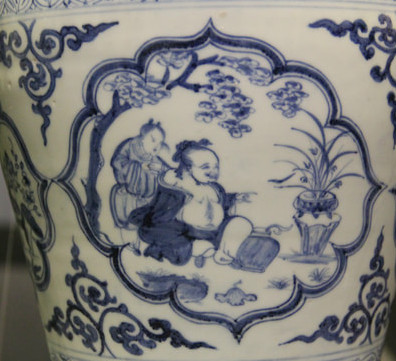
A rare and celebrated porcelain piece from China's Yuan dynasty, a blue-and-white meiping vase depicting the Four Loves, features four scenes: "Wang Xizhi's Love of Orchids," "Zhou Maoshu's Love of Lotuses," "Meng Haoran's Love of Plum Blossoms," and "Lin Hejing's Love of Cranes." This shows how profound and far-reaching the influence of Wang Xizhi's love of orchids has been.