How Can You Tell if Orchid Roots Are Healthy? An Illustrated Guide to Judging
Quite a few orchid growers want to know what makes orchid roots healthy. It happens that a fellow orchid grower has put together an article based on their own experience, and with the pictures in the article, growers can fairly easily judge what healthy orchid roots look like. The grower looked at root photos of Liumei and Old Shanghai, because the peak season for introducing new plants is approaching, and based on their own experience they discuss with everyone the characteristics of healthy plants.
1. Observe the root system. The roots should be complete, with no black tips or few black tips, moderate in length, and fairly spread out. If they are tightly packed together, it may affect the growing space for new shoots. Depending on the specific season and temperature, check whether there are crystal tips.
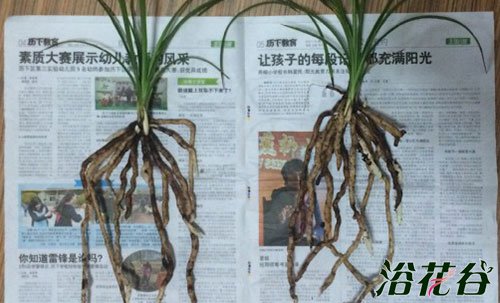
2. Observe the leaf base. During the sprouting season, a normal leaf base gradually turns yellow, so that after drying out it keeps a normal leaf-base shape. With some unhealthy plants, the leaf base turns brown in a short time and clasps tightly onto the new leaf.
3. Observe the new shoots. If the position of a new shoot is too high, the new plant will generally be weaker than the mother plant. If it is a submarine shoot, the new seedling will be sturdier than the mother plant, but when it later sends out growth, because the position is too low, there is a risk. It is best if the new shoot's position is slightly lower than the mother plant, so there is more room for development and it will also be easier to divide the plants in the future. Based on my growing experience over the past two years, from the bottom of the pot up to two-thirds of the orchid pot, use medium-grade Zhilanbao, and above that use small-grade Zhilanbao. Water a bit more in autumn and the following spring, and you can better avoid submarine shoots.
4. Observe the cut. Treating the cut is a key step in preventing pathogens from entering the orchid and causing the plant to collapse. When introducing plants, try to choose plants with small cuts; a small cut also shows that the orchid is already mature, with a complete growth cycle.