How should hollow roots on orchids be dealt with?
Hollow roots on orchids are quite common. This article starts with how to deal with hollow orchid roots, then moves on to the causes of hollow orchid roots, as well as prevention methods, so that orchid growers can avoid detours in their future orchid care. I have seen many online articles that only discuss the causes of hollow orchid roots without saying what to do about them, so in this article we will first discuss the treatment methods, then the causes.
For hollow orchid roots, we first need to find the cause of the hollowing, for example whether it is inadequate watering or potting medium that does not sit snugly enough. Once the cause is found and corrected, simply cut off the hollow roots and repot the orchid.
ps: There is another method here that has not been verified and is for orchid growers' reference only. Some growers believe that when there are few roots, you do not have to cut off the hollow roots; just remove the outer skin and keep the inner strand, on the grounds that it can still absorb water. As for whether it works, growers can give it a try!
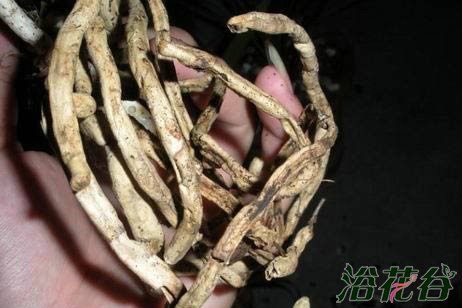
Analysis of the causes of hollow orchid roots:
1. Long-term water shortage causes hollow orchid roots.
Water thoroughly and avoid “half watering”. Watering orchids is a basic skill in orchid care and also a difficult one to master; the difficulty lies in watering not penetrating fully, resulting in the “half watering” phenomenon. So-called “half watering” means that the upper part of the potting medium in the orchid pot is moderately moist while the lower part is dry. This is the crux of hollow orchid roots. There are two ways to avoid this phenomenon: first, water orchids repeatedly several times, and do not stop watering as soon as you see water flowing from the bottom of the pot. In fact, sometimes when you give the orchid just a little water, water flows out from the bottom of the pot while the medium inside is still dry. Therefore, water repeatedly several times to ensure the medium is fully moistened. Second, use the “sit-pot” (soaking) method of watering. That is, place the orchid pot in a container of water so that the surface height of the potting soil is basically level with the water surface in the container, allowing water to slowly seep up from the bottom of the pot and fully moisten the medium. This method gives the most even and thorough watering.
2. Poor contact between the medium and the roots, and lack of nutrients, lead to hollow orchid roots.
The medium must be mixed evenly to ensure full contact between the potting soil and the orchid roots. An old treatise says, “If one root does not touch the soil, that root will become hollow.” This is indeed the voice of experience. Practice has shown that if the potting soil and orchid roots do not make full contact, over time the orchid roots will hang suspended and lose water, and hollow roots will certainly appear. Based on this, orchid growers must mix the medium thoroughly and evenly when planting orchids, adding it in order of large, medium and small particles. With each layer of medium added, tap the pot wall lightly so that the potting soil makes full contact with the orchid roots. After potting, water thoroughly using the “sit-pot” (soaking) method; this further increases the contact surface between the orchid roots and the medium. Then bring the plant into routine management. If managed properly, this can effectively prevent hollow orchid roots from occurring.
3. The medium is not breathable, causing orchid roots to rot and then become hollow.
Orchid growers should find this easy to understand, so we will not say more about it!