The correct methods and precautions for pruning orchids
Many flower enthusiasts need to know a few things about orchid pruning. Pruning orchid leaves is actually very important. During cultivation, pruning must be done continuously. When there are old leaves and yellow leaves, they should be cut off promptly to improve ventilation. Some leaves have dry tips, which should also be cut off. Leaves with pests or diseases must be cut off promptly to avoid spreading.
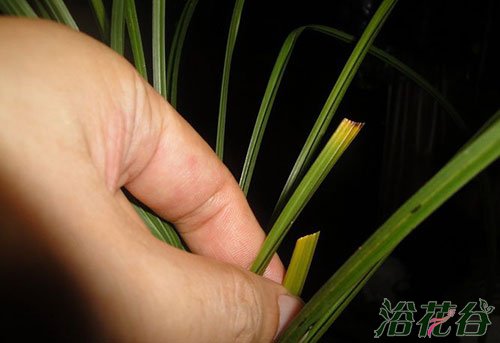
Before pruning orchid leaves, we must disinfect the scissors with medicated solution or alcohol. When pruning yellow leaves (because yellow leaves have died of old age, so there are no pathogens), there is no need to disinfect after each leaf cut; you can prune continuously. When pruning black leaves (the general term for several diseased leaves of orchids), many orchid growers are now very careful and disinfect after each leaf cut. The effect is very good, but it is very time-consuming. The pruning method is to also cut off about 1 cm of green leaf at the boundary between the black leaf and the green leaf, because the green leaf area has not yet been affected, so there are no pathogens there and it will not become infected. If you are not at ease, after all pruning is finished, disinfect the entire orchid with a sterilizing solution. To achieve a beautiful effect, when pruning, try to place the scissors at an angle and cut diagonally, making the tip as pointed as possible, the sharper the better, so that it resembles a natural leaf.
During orchid pruning, the author thought of another issue. Most plant leaves are green, and leaves appear green because chlorophyll covers them. Chlorophyll is a complex organic acid that can carry out photosynthesis to produce nutrients. Chlorophyll itself also contains rich components of various nutrients. For perennial deciduous plants, in late autumn and early winter, the leaves turn yellow or red and then fall off. Why is this? Plants have an instinct to protect themselves. Before the leaves fall, they transport the chlorophyll in the leaves back to the roots for storage, to be used the following year for the growth of new shoots. Because the chlorophyll in the leaves is transferred away, decreases, and finally disappears, the xanthophyll and carotene (that is, carotene) in the leaves become visible. Old leaves turning yellow or red indicates that the nutrients in the leaves no longer exist, that they are truly old and should come to a natural end. Orchids are the same. When old leaves turn yellow, they can be cut off. Some of our precious varieties often grow poorly, have low reproduction rates, and have only a few sparse leaves. If old leaves are pruned too early, the loss of nutrients is very regrettable.
Leaves with pests or diseases should not all be cut off either. Some pests and diseases are not very harmful and can be effectively controlled, so there is no need to cut off the entire leaf. For example, for scale insects, spraying with medication is very effective, and they can also be removed manually. Another example is black spot disease, which initially appears as brown spots and gradually expands into oval or semicircular patches. But the disease progresses slowly, and there are ways to control it. When spots are found, burn them with charcoal fire (a match will do) and it will be fine. For large-scale cultivation, chemical control can be used. However, the following orchid diseases are dangerous in onset and have no specific cure, so diseased leaves should be cut off quickly. For example: First, black rot, which first causes purple-brown lesions on the leaves, gradually expands in a water-soaked manner, and after several days the whole leaf becomes soft, black, rots, and dies. Second, brown rust, which begins as light brown or orange-yellow fine spots, gradually becomes black patches, and finally the whole leaf dies. Third, bacterial soft rot, which first causes small water-soaked spots on the leaves, gradually changing from dark green to brown to dark brown, and soon wilts. Fourth, leaf spot disease, which mainly harms new shoots, beginning with lesions at the base of leaf buds that look as if scalded by boiling water, rapidly spreading and causing the entire shoot to rot and die.
Of course, cosmetic pruning during orchid exhibitions is necessary.