Post-bloom care methods and key maintenance points for Phalaenopsis orchids
If you want your Phalaenopsis orchid to bloom again the following year, post-bloom care is very important, as it directly affects both safe overwintering through summer and blooming the next year. After many years of practice, the author has summarized a set of post-bloom care methods, presented below:
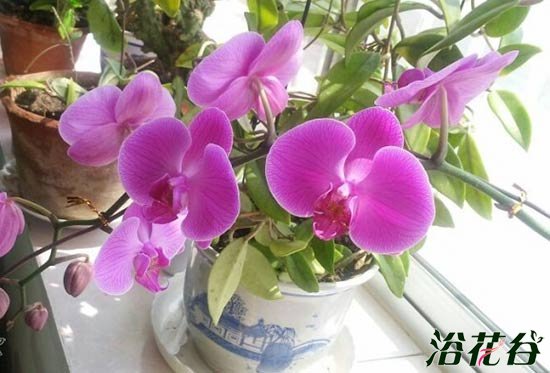
1. Removing the flower spike:
After all the flowers of the Phalaenopsis orchid have faded, the flower spike should be cut off promptly from the base to reduce nutrient consumption. Some people keep the flower spike to let it bloom a second time; this approach is highly inadvisable. This is because the chance of a second bloom is not high, and even if flowers appear, their quality is poor, with small flowers in small numbers. Moreover, Phalaenopsis orchids that bloom a second time produce poor-quality blooms the following year, or may not bloom at all, so the flower spike should be cut off promptly.
2. Keeping warm:
Not long after the Phalaenopsis orchid finishes blooming, heating is turned off in northern regions. Tropical flowers are very sensitive to low temperatures, so they should be kept warm. Cover the flower and pot with plastic film, withhold water and stop fertilizing, and place the film-covered pot in a sunny spot indoors, using light to raise the temperature of the microclimate.
3. Repotting early:
After blooming, the Phalaenopsis orchid should be repotted promptly, no later than mid-April. When repotting, knock the plant out of the pot, cut off dead roots, and remove rotted substrate, but be careful not to damage the roots. Use broken pot pieces or expanded clay pellets to make a drainage layer at the bottom of the pot, and prepare a growing medium by mixing coarse river sand, leaf mold and vermiculite in a 1:1:1 ratio, then mix in 15 to 25 grams of decomposed and fermented sesame paste residue and 10 grams of sulfur powder. Mixing in sulfur powder both sterilizes and disinfects the soil and lowers the pH. When repotting, be sure not to press the potting soil too hard, to prevent the roots from breaking and being damaged.
4. Watering skillfully:
Watering is crucial in Phalaenopsis orchid care. From the time the spike is removed after blooming until before "May Day," the potting soil should be kept moist, generally with one thorough watering per week. Too dry easily causes the plant to die from dehydration, while too wet easily causes root rot from excess water. After "May Day," water thoroughly once every four or five days, and you can also mist the leaves at noon when the temperature is high. Water in the north is highly alkaline, and long-term watering can easily cause the potting soil to become alkaline, so a little ferrous sulfate should be applied about once a week.
5. Sufficient light:
Providing sufficient light is very necessary in post-bloom care of Phalaenopsis orchids. Before mid-May, it can be placed in a spot with ample light. After mid-May, because the temperature gradually rises and ultraviolet radiation is stronger, direct strong midday light should be avoided, and in summer semi-shading should be provided.
6. Preventing pests and diseases:
Spring is a season when Phalaenopsis orchids are prone to pests and diseases. Common pests and diseases include leaf spot, leaf soft rot, scale insects and aphids. If they occur, in addition to strengthening water and fertilizer management and ensuring good ventilation, leaf spot can be controlled with broad-spectrum fungicides such as chlorothalonil. Soft rot should be treated differently: bacterial soft rot can be controlled with a 1000-fold dilution of 72% agricultural streptomycin, while fungal soft rot can be controlled with chlorothalonil, carbendazim, thiophanate-methyl and the like. For scale insects and aphids, when there are few, they can be caught by hand; when there are many, a 1000-fold dilution of 40% omethoate emulsifiable concentrate can be used for control.