Habenaria radiata potted plant pictures and growing methods
Many flower enthusiasts who have seen the Habenaria radiata cannot help but praise it. So having a Habenaria radiata potted plant means you can see it often at home, and this is not impossible. Some enthusiasts are already growing Habenaria radiata at home. Habenaria radiata is a perennial orchid plant, and its seeds are spherical. Generally, potting is done in March (at a temperature of around 20°C), usually using fine akadama soil as the medium. To increase the organic matter in the growing soil and boost fertility, the medium can use a ratio of 50% Sendai soil + 50% akadama soil. Sendai soil contains a variety of trace elements, and with its own binding capacity, it does not loosen, has good water retention and air permeability, does not compact, is free of bacteria, does not tangle roots, and promotes multiple sprouts. No fertilization is needed within two years, and after 3-5 years a light fertilization can be applied. Both media use the finest grade. When planting, place the end with the bud point facing up. After covering with soil, gently tap the pot on the ground to firm the soil so that the soil fits closely around the seed.
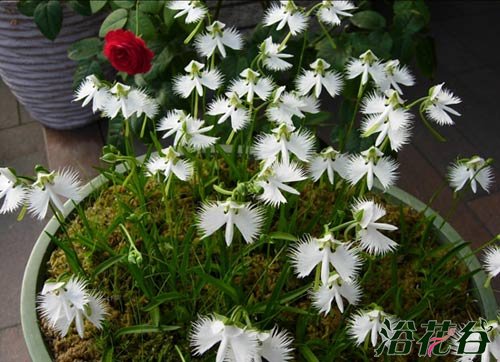
Cover the pot surface with a thin layer of sphagnum moss to retain moisture. Water using a spray mist. Habenaria radiata, like Acorus calamus, prefers a humid environment. From April to May, the seeds begin to sprout, the seedlings gradually grow larger, and flower spikes emerge.
The flowering period of Habenaria radiata is summer. During this time, attention should be paid to shading and moisture retention. After the flowers fade, cut off the flower spikes with sterilized scissors. In autumn, the leaves will gradually turn yellow. In winter, attention should be paid to frost protection. The leaves will wither, but the seeds in the soil do not die, and new bulbs will grow.