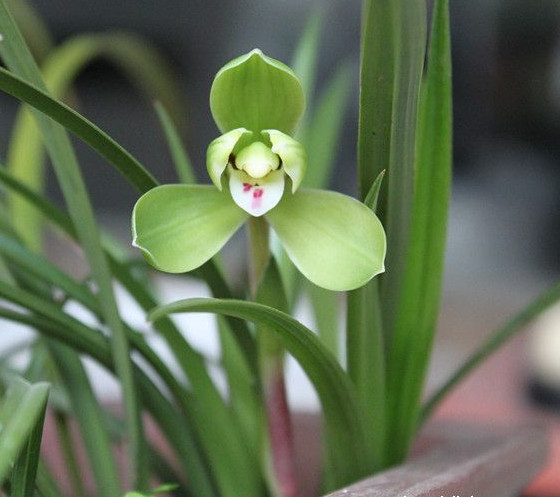
Naming Analysis of Chunlan 'Nianqi Mei' and 'Erqi Mei'
Douban Suhe, a classic famous cultivar of Douban Lan, also known as Qingguo Qingcheng, with first-class flower quality, can be called a classic! It is a fine flower that can be passed down through generations! It is a supreme grade among Yunnan Douban Lan, small in quantity and very worth treasuring. This plant was discovered in Yunnan, with leaf height of about 15-30cm, leaf width of about 0.6-0.9cm, and flowers held above the foliage. It is very difficult...
First, let us discuss the historical records of the two:
In 1978, it was selected by the elderly orchid grower Sun Nianqi of Jiashantou Village, Shaoxing, Zhejiang, from Dayinling Mountain in Lizhu, and named "Nianqi Mei," which some people also call "Erqi Mei."
In 1980, it was selected by Zhu Erqi of Tangdi, Shaoxing, Zhejiang (in fact, from this origin and selector one can see that it is erroneous; carefully compare the 1978 record!), and named "Erqi Mei," which some people also call "Ye Mei."
Since there is no way to verify who is correct, I will research it from the names!
First, let us discuss "nian"!
1. Nian Yi Shi niàn yī shǐ ㄋㄧㄢˋ ㄧ ㄕㄧˇ
That is, the Twenty-One Histories. Qing dynasty, Kong Shangren, "Peach Blossom Fan - Arresting the Society": "You see the Thirteen Classics, the Twenty-One Histories, the nine schools and three teachings, the hundred schools of thought, rotten examination essays, novel fiction, filling boxes and shelves above and below, arranged in shops and linked buildings high and low." See "Twenty-One Histories" for details.
2. Nian Ba Chan niàn bā chán ㄋㄧㄢˋ ㄅㄚ ㄔㄢˊ
Refers to the stars such as the twenty-eight lunar mansions whose positions lie along the celestial sphere near the ecliptic and equator. Qing dynasty, Zhao Yi, poem "Climbing the Three-Story Tower at Xuanmiao Temple in Suzhou": "The eyes encompass three thousand worlds, the breast holds the twenty-eight lunar mansions."
3. Nian Si Dui niàn sì duī ㄋㄧㄢˋ ㄙㄧˋ ㄉㄨㄟ
The burial ground of palace ladies of the Southern Song dynasty. Qing dynasty, Liang Shaoren, "Random Notes from the Twofold Autumn Rain Hut - Nian Si Dui": "By the shore of Xihu in Yuezhong, beside Shishan, commonly called Nian Si Dui, all are tombs of Southern Song palace ladies."
4. Nian Si Qiao niàn sì qiáo ㄋㄧㄢˋ ㄙㄧˋ ㄑㄧㄠˊ
Located within the borders of Yangzhou City, Jiangsu. Qing dynasty, Li Dou, "Record of Yangzhou Painted Boats - Gangxi Record" states: "Nian Si Qiao is Wujia Brick Bridge, also named Hongyao Bridge, located behind Xichun Terrace." One theory says it refers to twenty-four bridges. Qing dynasty, Zhao Yi, poem "Chen Shengwu Sima Invites Chunong to the Yu Studio for a Banquet and Records the Scenic Splendor": "Spring feelings overflow, the night is long, occupying all the misty flowers of Nian Si Qiao." See "Twenty-Four Bridges" for details.
5. Nian Si Feng (Nian Si Feng) niàn sì fēng ㄋㄧㄢˋ ㄙㄧˋ ㄈㄥ
Abbreviation of "the twenty-four flower-signal winds." The ancients divided each of the eight solar terms from Xiaohan to Guyu into three pentads, twenty-four pentads in total, each pentad lasting five days, each corresponding to one flower, beginning with plum blossom and ending with chinaberry blossom, making twenty-four flowering periods in all. The winds come according to the flowering periods, and are called "flower-signal winds."
Now let us discuss "er." I think not many people use "er" in personal names, especially since "erqi" has the same meaning as "nianqi." I believe it is merely a later convenience for remembering, and some people habitually read "nian" as "er," so I believe the correct name is Nianqi Mei. http://www.yuesha.com/article-1733-1.html