How to grow Phalaenopsis (moth orchid) at home? A detailed guide to home cultivation methods
The home cultivation of Phalaenopsis is actually not complicated; as long as it is cared for properly, a Phalaenopsis can easily live for several years, and does not necessarily have to be thrown out the same year. In this article, a flower enthusiast shares their own experience and tips on caring for Phalaenopsis in terms of pot selection, medium choice, fertilizing, watering, and more.
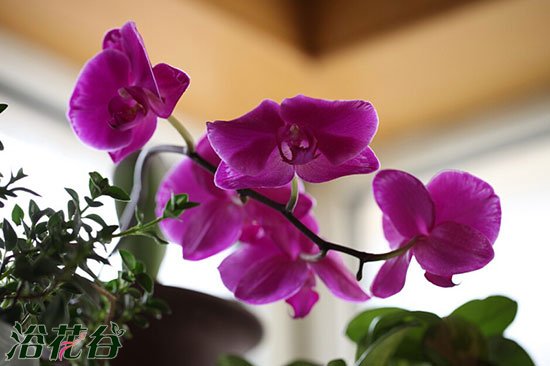
First, the pot for planting Phalaenopsis should be chosen with a certain depth. The roots of Phalaenopsis are very similar to those of Clivia (kaffir lily), with a strong fleshy quality. Personally, I feel that when choosing a pot for Phalaenopsis, you should still base it on the length to which its roots grow and choose a slightly deeper pot. The pot does not have to be very large, but a pot with a certain depth allows the roots of the Phalaenopsis to fully spread out, gives the roots somewhere to grow, and makes it easier for them to absorb nutrients.
Second, the choice of growing medium. For a newly purchased Phalaenopsis, after letting it sit for two days to get used to your home environment, it generally needs to be repotted with fresh medium. Phalaenopsis is an epiphytic orchid, so a breathable medium such as sphagnum moss is enough. Generally, sphagnum moss older than one year no longer has high nutritional value, and at this point it can be replaced. Remove the old sphagnum moss, trim away the decayed roots of the Phalaenopsis, and if conditions allow, soak the roots of the Phalaenopsis in a water solution of “carbendazim” to sterilize and disinfect them. Then, repot with fresh sphagnum moss.
Third, necessary fertilizing. At first, I fertilized the Phalaenopsis by adding a few drops of a Phalaenopsis-specific liquid fertilizer to the water each time I watered, but the effect was not obvious. Later, I simply gave up this special fertilizer and directly used “monopotassium phosphate”, which I used for other flowers at home, as the nutrient fertilizer for the Phalaenopsis, and the effect was immediately apparent. The increase in trace elements such as phosphorus and potassium made the flower spikes that the Phalaenopsis put out thick and strong, and the flowers that bloomed on the flower branches were both numerous and long-lasting. A single flower spike blooming for several months also became an ordinary occurrence, with butterflies to admire every day, which is truly delightful.
Finally, let's talk about watering Phalaenopsis. The roots of Phalaenopsis are thick and strong, and excessive water is undoubtedly disastrous, causing root rot. Generally, watering can be guided by two points: when the sphagnum moss medium of the Phalaenopsis has dried out, and when you insert your hand into the bottom of the moss and it also feels dry, then it is time to water; if you are still not sure, you can pinch the leaves of the Phalaenopsis with your hand, and at this time they will certainly feel soft, so go ahead and water without hesitation. Add a little “monopotassium phosphate” fertilizer to the water, and then either use the soaking method or repeatedly pour water through the sphagnum moss in the Phalaenopsis pot until all the moss has absorbed enough water. Usually, you can mist the leaves of the Phalaenopsis, especially in the hot summer. Of course, in midsummer you should still pay attention to giving the Phalaenopsis appropriate shade and strengthening ventilation. Generally speaking, Phalaenopsis has almost no common pests or diseases. However, under poor ventilation, the occurrence of pests and diseases cannot be ruled out, and this is especially important to watch for in summer.