In which month does the Tiegu Su orchid usually bloom?
Tiegu Su is a solid-color variety of Cymbidium ensifolium (Jianlan), with pure white, spotless flowers and a very fragrant scent. However, some orchid growers are unsure in which month Tiegu Su blooms. Tiegu Su's blooming season is in summer and autumn, and it blooms at irregular intervals. But although Tiegu Su is easy to grow, getting it to bloom is not very easy.
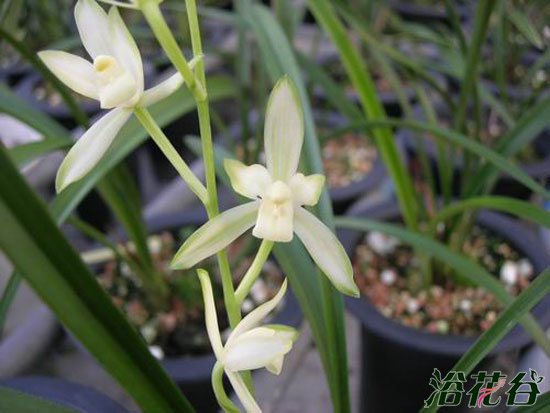
Below are some key points about getting Tiegu Su to bloom, for orchid growers' reference.
To get Tiegu Su to bloom, you must first cultivate strong, mature plants so that they meet the basic standards of the Tiegu Su variety: more than three leaves, over a chi in length, and a plump, firm pseudobulb that has accumulated and stored enough nutrients to meet the consumption needed for blooming. This is the most important basis for Tiegu Su being able to bloom.
Through several years of cultivation and observation, the author found that weak plants, diseased plants and immature plants do not bloom. For example, the pseudobulbs of that year's new growth and two-leaf plants cannot produce flower spikes.
1. Appropriately increase light
Orchids are shade-loving plants, but that does not mean they do not need sunlight. Light is divided into direct light and diffused light, and orchids prefer to grow under diffused light (this is the basis for growing orchids indoors and on balconies). Light is a necessary condition for the chlorophyll in orchid leaves to carry out photosynthesis and accumulate nutrients. Appropriately increasing light can promote flower bud differentiation.
Based on the principle that Cymbidium goeringii (Chunlan) prefers shade while Cymbidium ensifolium (Jianlan) can take slightly more sun, the author, when arranging the pots, placed Tiegu Su in a more sun-exposed position so that it receives more sunlight (note: this means giving appropriate light, not full sun). As a result, about 80% of the pots bloomed, and one pot of 30-40 Tiegu Su plants could produce 4-5 flower spikes.
2. Reasonably increase phosphorus fertilizer
In order to promote better growth of Tiegu Su and cultivate strong plants that bloom more, in addition to suitable light, moisture and ventilation, appropriate fertilizer must also be supplied. A complete fertilizer containing nitrogen, phosphorus, potassium and trace elements is best.
In using fertilizer, the author targeted Tiegu Su's weakness of being difficult to bloom. Phosphorus can promote well-developed roots and the development and formation of reproductive organs; potassium is an important element for making plants upright, supporting regular activity, and resisting disease. On the basis of applying a fully decomposed, complete liquid fertilizer, reasonably increasing phosphorus and potassium fertilizer produced certain results.
Around Grain Rain and around Mangzhong, the author twice applied additional decomposed rapeseed cake (which contains more phosphorus) fertilizer water to Tiegu Su, and from Qingming to before Frost's Descent, sprayed the leaves once every 20 days with 2% potassium dihydrogen phosphate. Through experiments in the three years 96, 97 and 98, Tiegu Su bloomed more: not only did the number of blooming pots increase, but the number of bloomings and the blooming time also lengthened. In one pot, flowers bloomed twice, and sometimes by November and December flower spikes still appeared in the pot, but the later it got, the shorter the flower spikes. There were also cases of single pots with four or six plants blooming.
In summary, Tiegu Su likes to grow in clusters, and being difficult to bloom is part of its varietal nature, but being able to bloom and be divided is also its internal factor. We should fully mobilize its positive factors for blooming and regulate Tiegu Su's natural ecological environment, such as appropriately increasing light and reasonably adding phosphorus fertilizer and many other external factors, so as to promote the internal factors that enable Tiegu Su to bloom and make them develop actively and by leaps and bounds, from being difficult to bloom to being able to bloom, bloom more, and bloom well.