What are the pros and cons of some Cymbidium ensifolium varieties?
There are quite a few orchid enthusiasts who love Cymbidium ensifolium, but for flower lovers who are new to the hobby, understanding the pros and cons of some Cymbidium ensifolium varieties is very important. This article compiles the pros and cons of 15 Cymbidium ensifolium varieties, hoping to help novice orchid enthusiasts!
Mayor Red
Pros: The new shoots are beautiful, the flower color is stable and charming, and the fragrance is strong. Cons: During cultivation, patches resembling thread-like streaks often appear, strong light easily scorches the leaf tips, and the growing environment needs slightly higher humidity.
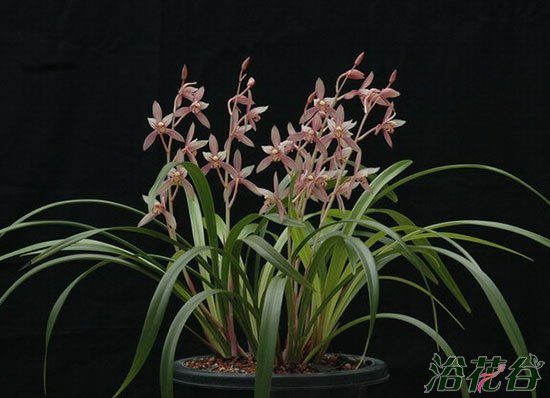
Taolin
Pros: The leaf color is charming, the pink patches do not fade even when the plant matures, the flower color is stable, and it is fragrant. Cons: The leaf tips are extremely prone to scorching, and the rate of marketable plants is very low.
Hongniang
Pros: The plant shape is beautiful, the flower form is well-proportioned, the flower color is gorgeous, and it is fragrant. Cons: The sprouting rate is moderate; if the potting medium is not kept moist during the sprouting period, it easily causes black root tips, leading to stalled growth or poor development, and cultivation is most difficult especially in the first year after being reintroduced.
Green Bird's Beak Pros: The new shoots are beautiful, cultivation is easy, the flowers have a peach-red base with green tips, and the flowers are fragrant. Cons: The contrast between peach red and green is not vivid enough, and the flowering rate is not high enough.
Caifeng
Pros: The new shoots have beautiful variegation, which gradually fades as the plant matures, cultivation is easy, the propagation rate is high, and it is fragrant. Cons: No obvious shortcomings.
Qingshan Yuquan
Pros: A snow-white solid-color flower with blended colors, easy to cultivate, high propagation rate, and fragrant. Cons: The blended colors of the flower tend to be less striking due to changes in the growing environment.
Yellow-Bud Iron Bone
Pros: A beautiful solid-color flower with blended colors, stable blended coloration, easy to cultivate, high propagation rate, strong resistance, and fragrant. Cons: It does not bloom easily.
Baodao Rouge
Pros: The new shoots show snow-white swept-tip variegation, the flower buds are attractive in color, and it is fragrant. Cons: The swept-tip variegation is prone to scorched tips, and the outer petals are somewhat narrow.
Seven Fairies
Pros: The flowers are large, fragrant, and very floriferous; mine bloomed 4 times last year. Cons: The leaves are tall and large, and the plant shape is not good.
Lüguangdeng
Produced in Rong County, Sichuan, it is still the leader among four-season plum-petal orchids! The flower form is well-proportioned, the flower color is verdant as if about to drip, the center is neat and rounded, the outer petals open and close properly, and the leaf shape matches the plant comfortably! The bloom performance is relatively stable! At its best it is quite beautiful! However, the shoot production is not very high, and exceptionally strong plants are rarely seen! The characteristics on the plant are not obvious, making it relatively inconvenient when selecting and introducing plants!
Xiahuangmei
The flower form is well-proportioned, the flower is tender yellow, the center is neat and rounded, the outer petals open and close properly, and the leaf shape matches the plant a bit less well! The bloom performance is quite stable!! However, the shoot production is not very high, and exceptionally strong plants are rarely seen! The characteristic on the plant is medium-soft drooping leaves; on close observation there are wavy undulations, with faint snake-skin mottling, and it is very hard to identify without having grown it!
Cancongmei
Large-flowered type, well-proportioned, the flower color is tender yellow like jade, the center is extremely rounded, known as the "peerless center"; when the bloom performance is good, the outer petals open and close properly, and the leaf shape matches the plant comfortably! Along the coastal areas the bloom performance is considered stable! In Sichuan the bloom performance is seldom like it was when first collected from the wild!! However, the shoot production rate is considered moderate, and exceptionally strong plants are rarely seen! The characteristics on the plant are not obvious, slightly fish-belly shaped, the leaf tips lack a blunt-rounded feel, making it relatively inconvenient when selecting and introducing plants!
It should also be noted that this plant came from Xinjin and was first named "Baby Face," because both its color and center are like a baby's round face, so soft it seems it would break at a touch! We call it "Xianhe"! When a friend from Qingshen sent it to an exhibition, it was named "Cancong"! That is why I know so much about it!
Gaimei! (Yipinmei)
The flower form is well-proportioned, the flower color is verdant as if about to drip, the center is neat, the outer petals open and close properly, and the leaf shape matches the plant comfortably! The bloom performance is moderately stable! At its best it is quite beautiful! However, the shoot production is considered high, and exceptionally strong plants are rarely seen! The characteristic on the plant is dark green (for those cultivated in Sichuan), the leaves are arranged in a V shape, the leaf-base ring is obvious, the leaf tips are slightly blunt, often with a twisted turn, and the leaves are broad and thick! Growing Yipin is not considered difficult, but making it strong is not easy! I have seen a Yipin 2.2CM wide with 6 leaves! Only once!
Hewang (are there two kinds of Hewang?) There are not two kinds, because in the early years a Hong Kong, China orchid enthusiast took half of this plant away, and that line is called "Hong Kong-produced Hewang"; possibly due to external factors such as growing conditions, the bloom performance of this line is mostly not as good as that of the Sichuan line! As for how to make it bloom better, according to Elder Deng Yuanxing of Mount Emei, the potting medium should be changed once every 3 years, and it is best to add loess, as this is what makes the shoot production and flower color good! This is the secret of why the Sichuan Hewang has relatively tender white flower color and strong shoots!
This variety is a large-flowered type, well-proportioned, with a tender white flower color, a neat and rounded center, outer petals that open and close properly, and a leaf shape that matches the plant comfortably! The bloom performance is considered moderately stable! At its best it is quite beautiful! However, the shoot production is not high, and exceptionally strong plants are rarely seen! The characteristics on the plant are: broad and thick leaves, fish-belly shaped, medium-soft drooping, with others not obvious, making it relatively inconvenient when selecting and introducing plants!
Red Yipin
Produced in Mingshan, Sichuan, the flower form is well-proportioned, the flower color is yellow with red, quite beautiful, the center is neat and rounded, the outer petals open and close properly, and the leaf shape matches the plant comfortably! The bloom performance is quite stable! At its best it is quite beautiful! The shoot production is high, and exceptionally strong plants are rarely seen! The plant type is soft drooping leaves, not very tall! The flowers are medium in size! The characteristics on the plant are not obvious, making it relatively inconvenient when selecting and introducing plants!