Phalaenopsis, Chinese orchids, and tropical orchids: care tips for beginners
For beginner flower enthusiasts, growing orchids may involve quite a few detours. Whether it is Chinese orchids, tropical orchids, or even Phalaenopsis, although you give it your all, it is hard to avoid going astray. This article is a flower enthusiast's experience of growing orchids, and is especially suitable for beginner flower enthusiasts to refer to, from nothing to something, from few to many.
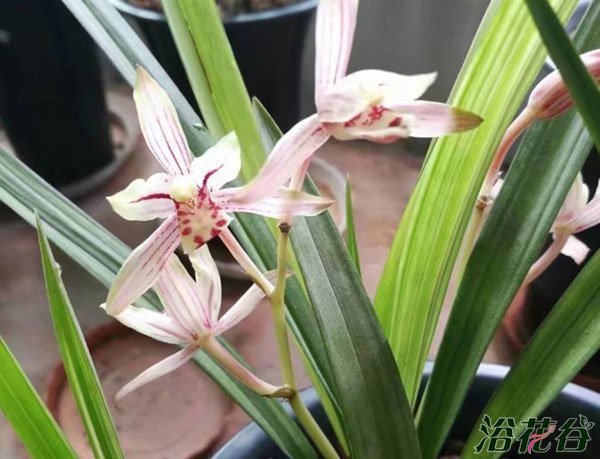
1. Environment. Flower enthusiasts in orchid-producing areas can skip this part. As long as you choose the right species, let nature take its course, and water reasonably, you should all grow them well. Do note that most tropical orchids are afraid of freezing and are only suitable for natural cultivation in the Guangdong and Guangxi regions.
The environment I am talking about here is aimed at flower enthusiasts like me who are located in the northwest border region. The natural climate north of the Qinling Mountains does not produce orchids, so the first thing is to create an environment suitable for their growth according to the orchid variety. In this regard, in the northwest region, heating in winter keeps room temperature at around 20 degrees, which is relatively favorable for the growth of tropical orchids. However, because the room temperature is too high, Cymbidium goeringii and Cymbidium faberi do not get the low-temperature stimulation for vernalization, so they often find it hard to bloom. Therefore, it is generally recommended to focus on tropical orchids. Cattleya, Phalaenopsis, and Dendrobium are all considered easy to grow. For Chinese orchids, you can choose Cymbidium ensifolium and Cymbidium sinense. Generally, having a south-facing balcony at home is enough. The area depends on local conditions. It is best to grow more plants, which can create a local microclimate more suitable for orchid growth.
2. Choice of pots. The pots I have used here include everything: ceramic pots, purple clay pots, tile pots, plastic pots, and porcelain pots.
For Chinese orchids, plastic pots are the best to use. Yes, you read that right, the black, slender plastic orchid pots. When your flower-growing scale exceeds 100 pots and the number of orchids is around 50 pots, you will realize how heavy the workload of watering and repotting is. At this time, the advantages of lightweight, sturdy, and inexpensive plastic pots are really too obvious. Reasonably designed plastic orchid pots all have very good breathability, and because of the chimney effect of root transpiration, the moisture and humidity inside the pot are consistent from top to bottom, which is more favorable for orchid growth. Purple clay pots are the most expensive and the least easy to use, but they are beautiful, so you can prepare a few for displaying pots and taking photos. Tile pots are actually very suitable for growing orchids, but they are too bulky, ugly, and prone to crumbling and shedding debris, needing replacement after about 3 years.
For tropical orchids, I generally use dedicated ceramic pots, preferring smaller over larger. Whether the pot wall has holes or not is fine. Dedicated plastic pots for tropical orchids are also okay. Logistics is very developed now, and the shipping cost for ceramic pots is getting lower and lower. It is recommended to get it right in one step and avoid detours. At least in my place, in an indoor balcony growing environment, ceramic pots are breathable and drain water well, and the wet-dry cycle is very fast, which is very suitable for the development of tropical orchid roots.
3. Soil selection. When I first started growing orchids, I mainly focused on Chinese orchids. I tried every kind of soil and used every kind of formula, making it like preparing Chinese medicine. The actual results were barely satisfactory. Because my setup is mainly indoor cultivation, evaporation is slower, and soil that is too fine and dense is not suitable for orchid growth. Moreover, with high summer temperatures and poor ventilation, the two rots occur frequently. Later I switched to some branded orchid-specific soil, and it gradually improved. To avoid any suspicion of advertising, please consult Taobao yourself; I do not recommend any brand here. Also, the fertilizer ratio in specialized soil is relatively appropriate, which avoids improper fertilizing and damage to orchid roots. Personally, I think that when the orchids you grow are relatively expensive, it is best to choose branded orchid soil with guaranteed quality, saving worry and effort, once and for all, and making it easy for beginners to get started quickly and accumulate successful experience. Once you have experience, you can naturally make your own orchid soil with a reasonable ratio according to the condition of the seedlings, the size of the pots, and the climate conditions. For new students who are just playing around with orchids casually, then do as you please and use whatever is on hand, but you need to pay attention to watering.
For tropical orchids, I have always used only 2 formulas: either all sphagnum moss or all bark. Based on personal experience, the northwest region is actually more suitable for growing tropical orchids with the method of sphagnum moss plus ceramic pots. Bark really dries too fast. During the high-temperature period in summer, I was almost collapsing from watering in the morning and evening. The main advantage of bark is that it is not easy to cause root rot, while sphagnum moss requires some experience with watering. In addition, whatever soil the original pot used when you bought it, use that same soil to grow it at first. After about a year, once new shoots and new roots have grown well, then repot and change the soil. The sphagnum moss that comes with market Phalaenopsis is quite good. Change it after 2 years. If conditions permit, you can use Chilean sphagnum moss. You get what you pay for; expensive goods definitely have a reason for being expensive.
4. Watering. Whether orchids live or not depends on watering; whether they are grown well or not depends on fertilizing. For beginners, in the first month after arriving at your home, watering is crucial. Because orchid roots are fleshy roots, they are extremely drought-tolerant and convenient for long-distance transport. Therefore, it is recommended that when buying Chinese orchid seedlings, it is best to choose bare-root seedlings so you can observe the root condition. If the roots are not good, do not buy them. Then, if you do not know how to plant them yourself, you can ask the seller to plant them for you. Take them home and wait one day, until the root wounds are dry and healed, then water thoroughly until water flows out of the bottom hole. After that, you can insert a toothpick into the pot to make it easier to observe soil moisture. Generally, you should wait until the toothpick basically no longer sticks to moist soil and has dried at least more than half a finger deep before considering the second watering, and so on afterward, postponing on rainy days. After one month, when the leaves begin to have luster, new shoots begin to sprout, and the leaves begin to grow, then you can manage them normally. Less experienced flower enthusiasts can find a notebook and record the watering times. Experienced flower enthusiasts can directly weigh the pot to know whether it is time to water. The general principle is to prefer dry over wet. If orchids are watered too little, at most the roots become hollow, and there is still room to save them. But once there is too much water and roots and shoots rot, it spreads quickly, and if you do not cut the seedlings in time, it means total loss. Remember this, remember this.
For watering tropical orchid seedlings, beginners are advised to go to the market and find those Phalaenopsis that have already bloomed. Post-bloom plants are generally very cheap. Use these to practice first. Once you can master the watering method for market Phalaenopsis and can get them to rebloom, then you can take on other tropical orchid varieties. Sphagnum moss + a transparent plastic pot is very easy to use. Do not rush to change to some pretty pot. A transparent pot is very convenient for observing moisture conditions. Generally, if there are small water droplets on the pot wall, there is no need to bother. Only when the roots turn white and the sphagnum moss has no moisture vapor at all should you water. If it is not dry, absolutely do not water. You must control your hands. If you can master the watering method, then you have basically got started with growing orchids.
5. Fertilizing. Orchids generally do not need much fertilizer. Tropical orchids generally prefer more fertilizer. For Chinese orchids, remember that fertilizer must not be excessive. After orchids are burned by too much fertilizer, the root tips become carbonized and they are extremely difficult to grow, and they may not recover for several years. For various fermented organic fertilizers, beginners are advised not to use them. Growing flowers at home, the smell is too strong, and the concentration is hard to control. Generally, I only use granular slow-release fertilizer. For tropical orchids, you can appropriately add a little water-soluble fertilizer during regular watering, preferably 3 fertilizings to 1 watering, to avoid inorganic salt accumulation causing root shrinkage. Orchids with proper fertilizing grow robustly, have well-developed roots of moderate length, and the root skin color is basically white or pale yellow. Beginners should use fertilizer cautiously. Finished orchid soil generally already contains fertilizer, so just use it according to the instructions. Do not use strong fertilizer to force growth, as it leaves endless trouble.
This is as much as I can remember. I hope it is of some help to beginners. The beautiful pictures everyone sees were taken by stepping over the corpses of countless orchids, and experience also needs to be accumulated repeatedly before it can be mastered. I suggest everyone communicate more with local orchid growers and reasonably adjust methods according to your own situation. Orchids are actually easier to grow and tougher than most flowers. It is just that to get them to bloom, you need to put in some thought. When growing orchids, do not be impatient. Once the seedlings are grown strong, they will naturally send up flower spikes. It is best to let everything take its natural course.