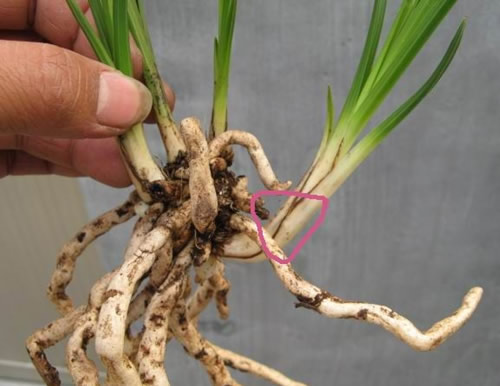
How to Handle Submarine Buds in Orchids? A Detailed Guide to the Method
Brother Liu's submarine buds - my understanding is that when an orchid bud sprouts from the bottom of a large clump of orchids, it can be called a submarine bud. But this name seems to have been coined by Dayong, so I'm borrowing it! I prefer to call it a hook bud. Because submarine buds sprout deep and emerge late, on one hand they easily rot and trigger the two rots; on the other hand...
Submarine buds - my understanding is that when an orchid bud sprouts from the bottom of a large clump of orchids, it can be called a submarine bud. But this name seems to have been coined by Dayong, so I'm borrowing it! I prefer to call it a hook bud. Because submarine buds sprout deep and emerge late, on one hand they easily rot and trigger the two rots; on the other hand they also affect the overall appearance of the orchid, because submarine buds may emerge from the pot surface and grow horizontally. So once I find a submarine bud appearing, I immediately cut the clump and divide the seedlings, manually correcting the orchid bud, and the results from my experiments have been quite good! Of course, an extreme approach is to just remove the submarine bud, but generally orchid lovers can't bear to do that!
As for the causes of submarine buds, I personally feel there are several reasons: First, the orchid is too vigorous and its root system is overly developed, blocking normal sprouting points and inducing the bud point at the very bottom of the pseudobulb to sprout, so I think it is necessary to appropriately thin the roots of vigorous orchids! Second, one's own growing environment also has a certain relationship - low humidity, strong light, and relatively dry watering while the orchid grows weakly, causing orchid buds to sprout lower with each generation, eventually producing submarine buds; third, variety characteristics also have a certain relationship - generally submarine buds tend to appear easily in Cymbidium faberi, but some old varieties of Cymbidium goeringii also have this characteristic, such as the Cymbidium goeringii 'Huanhe', which is prone to submarine buds.
My method for manually correcting submarine buds is simple, and that is one word: cut! Cut open the large orchid clump, thin out the blocking orchid roots, and when potting, lay the orchid down so the orchid bud is positioned upright for growing! Generally the effect shows within one year!