Introduction to the overseas-returned variety of Cymbidium faberi 'Fengqiao' (Tianyuehe)
There has never been a definitive conclusion about the claims regarding Fengqiao, and the origins of this overseas-returned Fengqiao are equally unclear. However, the flower is indeed a good flower. Below is an account provided by a netizen, for everyone's reference only! This cymbidium was brought to China in 2011 by Ogawa Masuhiro and Sumida Takeo of Fukuoka, Japan. The company's salesperson was engaged in seafood trade in Japan...
The overseas-returned Fengqiao is Tianyuehe, discovered in the mountains in 2003, originating from Henan!The discoverer Wang Jun, when asked about the ins and outs of the "overseas return," received a definitive answer: the "overseas return" is none other than the former "Tianyuehe."
This cymbidium was brought to China in 2011 by Ogawa Masuhiro and Sumida Takeo of Fukuoka, Japan. The company's salesperson was engaged in seafood trade in Japan. This cymbidium had been known for several years, but one could never even catch sight of the plants. Now that this flower has been obtained, the wish is fulfilled. In Japan this flower is named "Lao Fengqiao." Ten years ago these two men purchased the only two seedlings from Hirami Kazushi. Hirami Kazushi is now eighty years old. Due to the Japanese earthquake, the economy was greatly affected, and the two men decided to transfer all the seedlings. The characteristics of this flower are: green cymbidium, dengcao stem, square-notched tongue, fine-wrinkled flying shoulders, cat-ear petals, brilliantly colored tongue, long flower stalks, and good inflorescence. These characteristics are consistent with descriptions in cymbidium history. The only thing is that when seeing the real flower, the emulsification on the petals is not very obvious, but considering that this cymbidium's bloom is a forced bloom, and the variation in cymbidium blooms is still very great, it was still decided to accept all of these flowers. This post may step on some people's toes; please forgive any offense. The name is not very important; the key is that the flower must be a good flower.
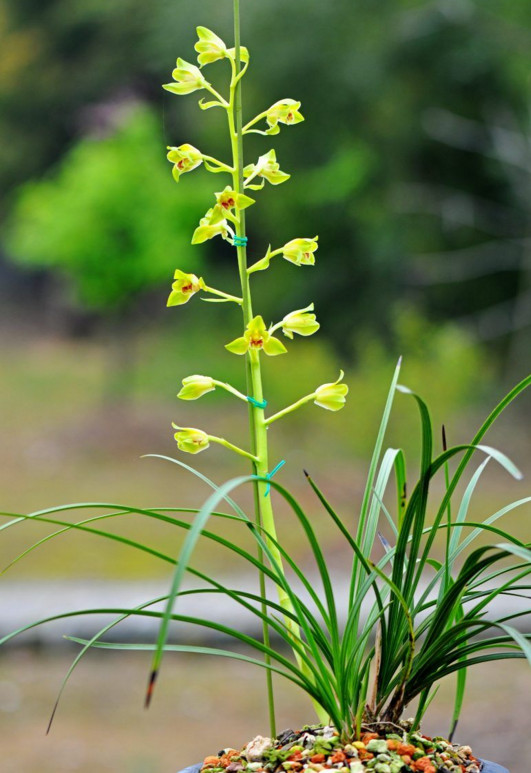
Chu Ren Xiao lifts the mysterious veil of the "overseas-returned Fengqiao"! Setting the record straight, changing course, and restoring its true identity as a newly discovered green cymbidium from the mountains [Longfengqiao]! In early April 2011, photos of a flower resembling the traditional classic old cymbidium variety [Lao Fengqiao] (also known as: Fengqiao Mei) were first exposed on the internet by Mr. Liu, a cymbidium enthusiast from Shandong. According to his own account, it was purchased in late March of that year by his company's salesperson from Japanese individuals, more than thirty seedlings in total, large and small. Once these flower photos appeared, they shocked the entire Chinese cymbidium world, and very quickly caused tremendous response and controversy among the broad community of cymbidium enthusiasts... Some believed it was the old cymbidium variety "Lao Fengqiao," some believed it was a newly discovered cymbidium from the mountains, and still others believed it was a cymbidium technological "hybrid plant"... Opinions varied, and debate raged on. Because the holder claimed the flower had returned from overseas Japan, cymbidium enthusiasts jokingly called it "overseas-returned Fengqiao" (later, some also mistakenly spread it as "sea-turtle Fengqiao"). The flower photos released by Mr. Liu of Shandong (downloaded from internet sources). In mid-April 2011, Chu Ren Xiao, through the renowned cymbidium master Mr. Chen, met Mr. Liu who held the flower, and personally flew to Shandong to introduce at a high price four strong seedlings with two buds back to Wuhan. At the time, Chu Ren Xiao's basic judgment about this flower was... first, that it is a top-grade good flower, namely a standard-petal-type flower of the green cymbidium flying-gate category, and clearly pointed out: if it is the old cymbidium variety "Lao Fengqiao," then it would be a "dream come true"; if it is a newly discovered cymbidium from the mountains, then it would be "hope"! In any case, it is a rare good flower, worth collecting and cultivating. In early April 2012, the flower introduced by Chutian Lanhui [Wuhan] bloomed for the first time, and was submitted under the flower name "Lao Fengqiao" to the 4th Cymbidium Exhibition in Huangyan, Zhejiang, where it won the "Special Gold Award" in one stroke. This was the flower's first public appearance at a domestic cymbidium exhibition, and its fairly good, stable bloom received high praise from the vast majority of viewers. However, afterward, the debate among cymbidium enthusiasts over whether this flower was an old variety or a new flower did not stop, and even triggered broader and more intense controversy, which continues to this day. April 2012, the flower submitted by Chutian Lanhui [Wuhan] to the 4th Cymbidium Exhibition in Huangyan, Zhejiang. In order to clarify the flower's "true identity," set the record straight... give the flower "justice," give cymbidium enthusiasts "peace of mind," and give "Lao Fengqiao" "innocence." At the same time, it is also an attitude of responsibility toward Chinese cymbidium culture and Chinese cymbidium history. In recent years, Chu Ren Xiao has done a great deal of follow-up investigation, visits, and data collection and organization, and finally at the end of 2014 clarified the flower's true ins and outs, lifting the mysterious veil that the "overseas-returned Fengqiao" had worn for many years, which could be called earth-shattering. Now it is truthfully announced to all, to clarify right and wrong and set the record straight! Whether to "accept" it is up to the reader! (1) This flower was dug from the mountains in 2003 by two cymbidium farmers from Xin County, Xinyang, Henan, located in the Dabie Mountains. Three residual plants with one scape of flowers were purchased by Wang Jun, a cymbidium enthusiast from Tongbai, Henan (younger brother of cymbidium enthusiast Wang Kui), who afterward sold one of the slightly better residual plants with flowers to Taiwan cymbidium enthusiasts Mr. Zhong Longwang and Mr. Jian Xudong for USD 5,000 (equivalent to more than forty thousand yuan at the time), and they brought it back to Taiwan for cultivation that same year. The remaining old residual stumps were kept by Wang Jun himself for cultivation, but later due to poor management, all the residual plants died. (2) After the one residual plant was brought back to Taiwan by Mr. Zhong and Mr. Jian for joint-stock cultivation for more than three years, the plants were divided, and the two men each continued to cultivate them separately, and they were successively introduced and planted by several Taiwan cymbidium merchants. In September 2004, "Zhonghua Zhi Yi" (The Art of China's Orchids), published by Zhejiang University Press, compiled by Jian Xudong, with a preface by Mr. Zhong Longwang, published on page 156 the flower photo of this flower when it was discovered in the mountains. At that time it was named green cymbidium [Tianyuehe], and it briefly introduced the flower's origins and characteristics... describing its floral appearance as follows... the three outer petals are emerald green, 1:1.7, with a glutinous texture, contracted base, rounded corners, cat-ear petals, thumb-head shape, with bright red tongue markings about the size of a grain of rice scattered in the center, white edges forming a large white border, characterized by a square-notched tongue and an especially good contracted base. In addition, the description of the flower stem was... emerald green, normally reaching about 60 cm. (3) In order to verify the flower's true origins, Chu Ren Xiao repeatedly telephoned Mr. Zhong and Mr. Jian separately. Mr. Zhong very affirmatively said that "the so-called 'overseas-returned Fengqiao' currently circulating in mainland China is exactly the newly discovered green cymbidium that he and Mr. Jian jointly purchased back then, and is not the old cymbidium variety 'Lao Fengqiao.'" After this flower was divided from Mr. Jian and cultivated separately for several years, seedlings were successively sold to Taiwan cymbidium enthusiast He Yuyuan and several others. The current "overseas-returned Fengqiao" in mainland China is exactly what he sold to mainland cymbidium enthusiasts in early March 2011 through an intermediary. This matter is no secret within Taiwan's cymbidium enthusiast circles; quite a few people are aware of it. It was absolutely not resold back to mainland China from Japan. As for Mr. Jian, after dividing and cultivating this flower, because it was not cultivated well, the plants died. Regarding the purchase process and origins of this flower, Chu Ren Xiao once telephoned Mr. Jian Xudong. Mr. Jian stated that it was already written very clearly in the book "Zhonghua Zhi Yi," that he did indeed purchase this flower in mainland China back then, and that he had no more content to add; because in recent years he himself has been living long-term in mainland China in places such as Hangzhou, he did not inquire about exactly who in Taiwan later sold the flower to mainland China. At the same time, Chu Ren Xiao also repeatedly sought out the flower's original purchaser, cymbidium enthusiast Wang Jun, to verify. He recalled that he did indeed sell one newly discovered green cymbidium plant to Taiwan cymbidium merchants Jian Xudong and Zhong Longwang back then, and later even saw the flower photo in a cymbidium book written by Jian Xudong. He remembered that in the second half of the year when he sold the flower to them, he specifically sought out Mr. Jian wanting a flower photo, because at the time he had no way to take and keep a flower photo himself, but Mr. Jian kept refusing to give him one. The two sides had a rather unpleasant falling-out over this matter, and afterward had no further contact. At the time, the two old stumps he kept himself were not cultivated well and died.
(4) After the flower was purchased and brought to Taiwan that year, it happened that Mr. Jian was compiling the book "Zhonghua Zhi Yi," so a name was temporarily given to the flower called "Tianyuehe." In order to verify this matter, Chu Ren Xiao specifically visited Mr. Wu, a Zhejiang cymbidium master who had been on good terms with Mr. Jian back then and was knowledgeable about the matter. Mr. Wu recalled that he remembered Mr. Jian and the others bringing flower photos and flower evaluations to discuss with him... At the time I pointed out that this flower could not be called a lotus, so I had a deep impression of this flower. Later, Chu Ren Xiao learned through Mr. Zhong that after obtaining his share of the seedlings and cultivating them separately, through careful observation and research he found that the flower's three outer petals indeed did not have tightly rolled edges, and calling it a "lotus" was somewhat far-fetched. Seeing that this flower's appearance was too similar to the circulating old cymbidium variety "Lao Fengqiao," he therefore used another flower name, calling it "Longfengqiao." He also recounted to Chu Ren Xiao in detail the origin and meaning of the flower having once been named [Longfengqiao]... The reason it was named [Longfengqiao] at the time was that it was associated with how this flower's appearance indeed had many similarities or close resemblances to the old cymbidium variety "Lao Fengqiao," while one character "Long" from his own name "Zhong Longwang"... in Mandarin also carries the meaning of gratitude for the emperor's "profound grace"... plus, according to folk legend, the name "Lao Fengqiao" was bestowed by the Kangxi Emperor, so at the time he simply chose a name called... "Longfengqiao"! However, cymbidiums are very difficult to bring into bloom when cultivated in Taiwan, so there was never an opportunity to publicly submit it to an exhibition, and therefore at the time not many people truly knew the flower name "Longfengqiao."
(5) Exactly how many seedlings of this flower currently exist in the world? This is a question that many cymbidium enthusiasts care about and worry about. This flower first flowed back to mainland China from Taiwan cymbidium enthusiast He Yuyuan in 2011. At that time, Mr. Liu of Shandong obtained more than thirty seedlings in one go, of which the four strongest with two buds were bought by Chu Ren Xiao; Jiangsu cymbidium enthusiasts Mr. Xu and Mr. Liu successively introduced it twice for more than ten seedlings in total; Huangyan, Zhejiang cymbidium master Mr. Lu successively introduced it twice for seven or eight seedlings in total; the remainder were respectively introduced by Guangdong cymbidium master Mr. Chen and others. In the three years afterward, cymbidium enthusiasts Mr. Huang of Fuyang, Zhejiang, Mr. Fu of Shaoxing, and Mr. Zhang and Mr. Lai of Fujian successively introduced from Taiwan cymbidium enthusiast He Yuyuan and two other Taiwan cymbidium enthusiasts a total of more than ninety seedlings back to mainland China, and this was the main channel for the return of the "overseas-returned Fengqiao."
Apart from introducing four seedlings with two buds from Mr. Liu of Shandong four years ago, Chu Ren Xiao also successively introduced more than ten strong seedlings from cymbidium enthusiasts in Shanghai, Jiangsu and Zhejiang, and Fujian over the following four years. In April of this year he again introduced more than ten strong seedlings from cymbidium enthusiasts in Guangdong and Fujian. At present there are only fewer than one hundred seedlings of this flower. Recently, according to disclosures by Fujian cymbidium enthusiasts Mr. Lai, Mr. Zhang, and others who have frequent contact with Taiwan cymbidium enthusiasts, this flower is now already very difficult to find in the hands of Taiwan cymbidium enthusiasts; the fewer than one hundred seedlings that existed previously have almost all been collected by them, and even those still available now are only a few old stumps and small plants. On the whole, it is estimated that the total existing quantity in both mainland China and Taiwan combined is no more than four or five hundred seedlings (including old stumps and new buds). Recently more and more cymbidium enthusiasts have wished to introduce this variety, and its price has risen considerably, but apart from keeping one or two pots of seedlings for themselves, they have all sold out. Selected bloom photos of this flower held by several mainland cymbidium enthusiasts during the period from 2013 to 2015 (many of which are blooms that were not fully vernalized)
(6) When this flower first appeared, many cymbidium enthusiasts were perplexed by the beautiful story, mistakenly spread at the time, of its "return from overseas Japan," which gave rise to much discussion. To this day, a small number of cymbidium enthusiasts still suspect that this flower may be a technological plant! In response, Chu Ren Xiao and some cymbidium enthusiasts who are deeply aware of the "mysterious and fascinating details" unanimously believe that the large amount of facts and historical materials now presented can completely rule out this possibility, and that it is time to lift the lid. If we assume this flower is a technological hybrid plant, then who are the female parent and male parent? Let us ask: among the new and old cymbidium varieties already on the market, which flying-type flower surpasses or approaches this flower's actually fairly good floral quality (unless Lao Fengqiao is still alive)?! If it were indeed a new technological hybrid variety, then in the course of four or five years the developer could not possibly have released fewer than one hundred seedlings (note: referring to direct resale from Taiwan). Moreover, at present those holding cash and hoping to introduce this variety find it very hard to obtain strong seedlings of this variety even at a price of forty to fifty thousand yuan per seedling, and they do not even know from whom to introduce it... Just think: in the cymbidium market downturn of a few years ago, even at twenty to thirty thousand yuan per seedling few were willing to buy, and Taiwan cymbidium enthusiasts were willing to release this flower. So now, with the cymbidium market picking up and this flower's price rising along with it, its price has doubled or tripled. If a large number of hybrid plants truly existed, who would believe that Taiwan cymbidium merchants would "forgo profit" and dump them?! In other words, if this flower were a technological hybrid plant, then the current release volume and existing quantity would not be possible.
Postscript... A genuinely authentic newly discovered green cymbidium from the Central Plains region of mainland China has been jokingly described by people as "returned from overseas Japan," and has all along been mistakenly spread as the classic old cymbidium variety "Lao Fengqiao" risen from the dead. This is truly lamentable and both laughable and exasperating! This may be truly helpless, or perhaps ignorance is no fault... But after all, it was artificially tying such a top-grade Chinese art cymbidium together with the completely unrelated "little Japan," which cannot but make one feel humiliated and even ashamed! Moreover, the original breeder once had a provisional name for this flower, [Tianyuehe], and it was later named [Longfengqiao] - this fact... also failed to receive the cymbidium world's long-tacitly-accepted "unspoken rule," namely that the flower name first given by the breeder should properly be widely respected by those who introduce the variety, and instead, muddle-headedly (including Chu Ren Xiao himself), it was misattributed as "Lao Fengqiao" or "Fengqiao Mei" for four or five years, causing many low-level jokes and making it the "laughingstock" of the Chinese cymbidium world!... Now, the truth is finally revealed to all, and it is high time to change course! We should restore to the newly discovered green cymbidium [Longfengqiao] its original innocent identity and the dignity of a top-grade good flower!... The debate on this topic may continue endlessly. Chu Ren Xiao only wishes to state the facts and the truth, aiming to correct two points... First, this flower never went to Japan in the first place, much less is it the so-called "Lao Fengqiao" plundered by little Japan during the Japanese invasion of China, and it cannot even be spoken of as having returned from overseas Japan. This is an objective fact that admits no doubt or debate, and no one can overturn it now or in the future. Second, since it did not return from overseas Japan, then, for the purpose of safeguarding the self-respect of the Chinese nation and the sense of honor and mission of Chinese cymbidium growers, there is a strong call for the Chinese cymbidium world and cymbidium masters to change course and resolutely abandon the insulting flower name "overseas-returned Fengqiao," and either formally name it [Longfengqiao] or give it another flower name (note: perhaps the author's good wish is naive or futile). ... In short, as far as its floral quality is concerned, this flower is indeed a standard-petal-type flying green cymbidium that is extremely rare in recent decades or even the past hundred years, with a dignified and alluring floral appearance and bearing, elegant and lively... its color emerald green; its petals are classic cat-ear petals, upright but not flying; its three outer petals are short and broad, refined in their flying rather than martial, flying but not twisted; its tongue is an elegant square-notched tongue, with brilliantly colored markings on the tongue; its column is small and exquisite. It can be called absolutely beautiful! Therefore, the broad community of cymbidium enthusiasts who love Chinese cymbidiums, especially cymbidiums, should set aside past grievances and have the courage, responsibility, and duty to pass it on forever and carry it forward! Finally, a friendly reminder to the broad community of cymbidium enthusiasts and the cymbidium enthusiasts involved in this article: please do not take it personally. This article is not aimed at anyone; it merely discusses the flower for the flower's sake, clarifies the truth, and sets things right, with no other intent, still less any malice. If there is any unintentional offense or impertinence, please forgive it.