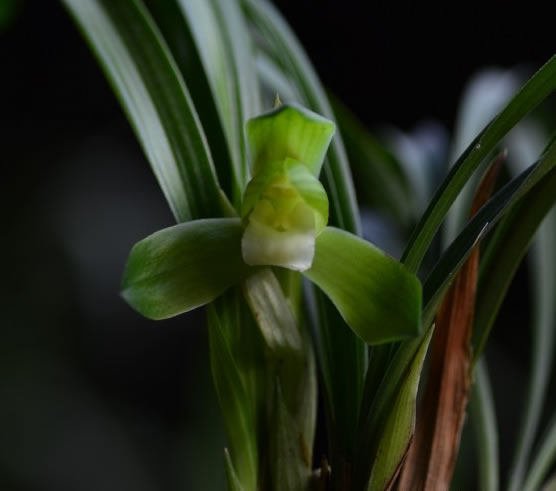
Introduction to the Kuihousu (Tonghesu) Orchid Variety
Petal type: Lotus-form plain (su). History: Selected in 1915 (some records say 1916, the 5th year of the Republic of China) by Lin Taihe of Ningbo. Characteristics: The three outer petals have contracted bases and flared corners, thick petals with tightly rolled edges, clasping mussel-shell-shaped sepals (holding petals), a large white round tongue that curls, and jade-green flowers of thick substance. The leaves are thick and semi-arching, with a broad central section. Mr. Mou Anxiang's supplement to "A Brief History of Orchids and Huis" -- (continued, ninety...
Petal type: Lotus-form plain (su)
History: Selected in 1915 (some records say 1916, the 5th year of the Republic of China) by Lin Taihe of Ningbo.
Characteristics: The three outer petals have contracted bases and flared corners, thick petals with tightly rolled edges, clasping mussel-shell-shaped sepals (holding petals), a large white round tongue that curls, and jade-green flowers of thick substance. The leaves are thick and semi-arching, with a broad central section.
Mr. Mou Anxiang's material in "A Brief History of Orchids and Huis" supplement -- (continued ninety-seven: Kuihousu. Cuihesu) is organized more completely:"A Brief History of Orchids and Huis": "In the 5th year of the Republic of China, produced by Lin Taihe of Ningbo. Jointly cultivated by Chen Qianshou and Tong Youxiang." A single photograph remains (see attached figure 1).
In Wang Shuping's "Fifty Years of Orchid Growing Experience," he says of this variety: "petals short, tongue round, shoulders drooping."
"The Spring Orchid Register" contains a color photograph and a variety description of "Kuihousu." It is also recorded in "Shaoxing Orchid Culture," "Nai'an's Orchid Growing Notes," and "Three Hundred Questions on Chinese Orchid Culture," with "Three Hundred Questions on Chinese Orchid Culture" giving the most detailed account: "Selected in 1916 by Lin Taihe of Ningbo. Leaf habit semi-arching, leaf tips long and pointed, leaf width relatively broad, leaf substance extremely thick, leaf color jade-green and glossy, leaf groove U-shaped, with wavy ridges (xinglong), leaf form elegant. The three outer petals are thick in substance with tightly rolled edges, contracted bases and flared corners with sharp tips, mussel-shell-shaped sepals (holding petals), and a large round curled tongue that is pure white with no red spots. The flower form is well-balanced; when first open it has level, single-line shoulders, and after being open a long time the shoulders droop slightly. The flower color is jade-green; it is a well-balanced variety among lotus-form plain (su) orchids."
There are very few records about "Tonghesu." A line of plants called Tonghesu that came from Mr. Zhou Huan'gen, an orchid grower of Shengzhou origin, circulated many years ago within a small circle in Shengzhou at a high price as a scarce old variety (around 2000, about 10,000 for 3 plants). Judging comprehensively from flower quality, leaf form, and so on, it is almost exactly identical to Kuihousu. I once asked Mr. Zhou about this in person, and Mr. Zhou believed that these two flowers might be the same variety under different names, or it might be a misreport; for a flower like this, there was no need to investigate deeply, and so on. The implication was that some things simply cannot be clearly explained. At the 2006 Hangzhou Spring Orchid Famous Variety Exhibition, a "Tonghesu" submitted by the Hangzhou Flower Nursery won a silver award; judging from the flower quality and the texture of the flowers and leaves, it is the same variety as the Tonghesu circulated in Shengzhou. The Hangzhou Flower Nursery has a long history, and this is a very strong piece of evidence: Shengzhou's calling it "Tonghesu" is not groundless, but has a lineage.