Scallion Prices Buck the Trend, Nicknamed "Forward Scallion"
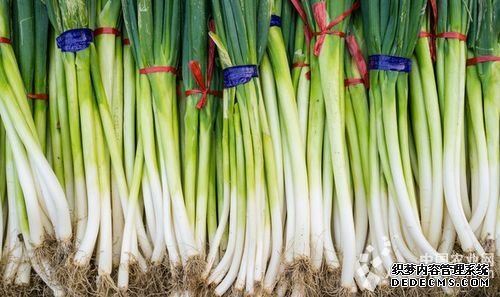
Right now, prices of various winter vegetables are fairly stable, but scallions have stood out from the crowd, carving out a soaring path as the “forward scallion.”
As the weather gradually turns colder, scallions are one of the indispensable side vegetables on the winter dining table. In most parts of northern China, people still keep the custom of stockpiling 40 to 50 jin of scallions to get through the winter. How big an impact does the rise in scallion prices have on market fluctuations? Can the growers get through a profitable, warm winter?
Right now is exactly the time when autumn scallions from the main producing areas of Henan, Shandong and Hebei are hitting the market in large quantities. These past few days, scallions in the producing areas are being harvested, and because prices are very high, many farmers are reluctant to sell.
Data from the Ministry of Commerce shows that among 110 wholesale markets across the country, more than 60% saw scallion prices rise in November, with an average increase of 15%. By December, the average scallion price in wholesale markets nationwide remained above 1.8 yuan/jin, up about another 19% from November. Scallions from different producing areas vary in quality, and prices fluctuate slightly up and down, but overall they are all on an upward track. Zhang Yuejiao, a market analyst at Yimutian, brings a set of data.
Currently, prices at the producing areas are also relatively high, and the scallion price in Henan is higher than in Shandong. Right now, the loading price of iron-stalk scallions (unwashed) in the Xinye area of Henan is 0.9-1.05 yuan/jin, which is relatively high. Shandong mainly grows iron-stalk scallions and long-white scallions, with prices generally around 0.6-0.8 yuan/jin. Long-white scallions in Wanrong, Shanxi are currently around 0.85-0.95 yuan/jin. Scallion prices are currently relatively high, and goods are moving quickly in the market.
This round of scallion price increases has undoubtedly given scallion growers a positive boost. As is well known, in February and March this year, severe unsalable scallion incidents occurred in many places across China. In many producing areas, scallion prices fell all the way from an already low 0.6 yuan/kg to below 0.2 yuan/kg. Because hiring people to dig up scallions costs money, and even when dug up they could not be sold, some growers actually used herbicides to clear the scallions from their fields. Yimutian analyst Zhang Yuejiao analyzed that one very important reason for the current rise in scallion prices is that growers in the producing areas suffered heavy losses in the depressed market at the start of the year, which reduced the planting area this season and led to a relatively tight supply.
This round of unsalable produce had a very big impact on the seedling cultivation of summer and autumn scallions. Summer scallions are raised in spring, right when market prices hit their low point, and many scallion farmers pulled up the seedlings even after planting them. For autumn scallions, the planting area was reduced across the board. Main producing areas such as Tengzhou and Anqiu in Shandong reduced planting, while Xinye in Henan, Pingdu in Shandong and Dongchangfu in Shandong basically cut their planting area by 1/3, and other producing areas in Shanxi, Hebei and Henan nearly halved it. So the current surge in scallion prices this season is almost entirely caused by reduced planting and supply shortages.
It can thus be seen that the rise and fall of agricultural product prices are mostly determined by production in the producing areas. The trigger is still that farmers mostly use the current season's prices to guide the current season's planting, always lagging behind market changes. Some growers report that growing vegetables is like gambling, and it is hard to know before planting how the returns will turn out. These past few days, prices in various producing areas have been rising, farmers have a slight reluctance to sell, and in many producing areas it is hard to hire workers, making it difficult to get goods.
As the weather gets colder, demand is gradually increasing, but since the reduction in scallion planting area this season is already a foregone conclusion, Zhuochuang Information market analyst Liu Shuai analyzes that scallion prices may rise further before the end of the year.