-

Is the five-needle pine easy to grow? Solutions for yellowing and withering leaves
In recent years, a kind of bonsai plant has become very popular among young people: the five-needle pine, which has been well cultivated in Japan. Among five-needle pines there are many varieties, and those with short needles and tight branches are considered the best in appearance, so their prices rise accordingly, and a pot selling for 5-8 thousand is also common. Throughout the whole care process, the five-needle pine counts
-

What are the latest cultivation methods for Japanese white pine?
Japanese white pine gets its name because its five needles grow in clusters; it is also known as Japanese five-needle pine, five-fork pine, and Japanese white pine. It is an evergreen coniferous tree of the genus Pinus in the family Pinaceae. The plant is relatively short, grows slowly, has short needles and dense branches, an elegant posture, and a beautiful tree shape, and is considered a superior tree species for making bonsai.
-
A Detailed Guide to the Latest Methods for Making and Caring for Five-Needle Pine Bonsai
The five-needle pine gets its name from its five needles growing in clusters. It is an evergreen coniferous tree of the genus Pinus in the family Pinaceae, native to Japan. It has a long history of introduction in China and is widely cultivated in various places, mainly distributed in the middle and lower reaches of the Yangtze River in China, the eastern and southern warm temperate deciduous broad-leaved forest region of the southern warm temperate deciduous broad-leaved forest zone, and the northern subtropical deciduous and evergreen broad-leaved mixed forest region.
-
How to Grow a Potted Five-Needle Pine? A Detailed Guide to the Latest Care Methods
The five-needle pine is also known as the Japanese five-needle pine, five-fork pine, and Japanese white pine, among other names. It is an evergreen coniferous tree of the genus Pinus in the family Pinaceae, named for its five needles growing in clusters. The plant is relatively short, grows slowly, has short needles and dense branches, an elegant posture, and a beautiful tree form. It is often used as a superior tree species for making bonsai. Its
-
How much does a five-needle pine sapling cost per plant? Detailed guide to bonsai care
The five-needle pine gets its name from its needles growing in clusters of five. It is native to Japan, and China introduced it long ago for growing as potted plants. So, how much does a five-needle pine sapling cost per plant? How do you care for a five-needle pine bonsai? Let's find out together! 1. Five-needle pine saplings
-
What are the propagation methods for the five-needle pine?
The five-needle pine generally refers to the Japanese five-needle pine, an elegant tree species. It is native to Japan, and is now widely cultivated in the Yangtze River basin of China. So what are its propagation methods? What are the propagation methods for the five-needle pine? 1. Grafting (1) Selection of rootstock: choose an old potted black pine stump that already has the beginnings of a bonsai form. For the branches on the rootstock that receive the graft, those under six or seven years old that have not yet developed scales are generally best. The best time for grafting is generally from mid-February to early March, before the buds have sprouted but are about to.
-
What soil is best for growing five-needle pine? Soil selection and soil mixing methods
The five-needle pine is a tree of the genus Pinus in the family Pinaceae. It has been widely introduced and cultivated in major cities along the Yangtze River basin in China and in places such as Qingdao, Shandong. The five-needle pine has gnarled trunks and vigorous branches, with a very elegant charm and character, embodying the essence of the qi, bone, color and spirit of pines, and is a precious tree species for landscaping.
-
-
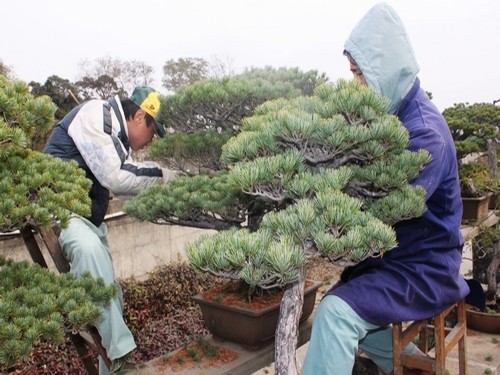
A Complete Guide to Pruning Methods and Techniques for Five-Needle Pine Bonsai
The styling techniques for five-needle pine bonsai share common ground with those for other tree bonsai, yet they also have their own particular characteristics. They should feature naturally adopted forms and well-judged choices of what to keep and what to remove; pruning and branch training should achieve a balanced layout, with an elegant and classical, understated tone. The artist's creative range must be broad: first comes artistic conception, then working out the draft in mind, and determining the theme
-
How to shape a five-needle pine bonsai? A detailed guide to practical methods
The five-needle pine is a sun-loving tree species that prefers fertile, loose, acidic soil. It is widely cultivated, with fine, dense, deep-green foliage. It is suitable both for garden accents and group plantings, and is also an important tree species for potted cultivation or bonsai. Shaping the five-needle pine should begin from the young tree stage and be carried out in winter
条件筛选