-

Detailed Explanation of Mushroom Topdressing Methods and Technical Key Points
During the peak fruiting stage and late growth stage of mushrooms, if the nutrients in the compost are insufficient, deformed mushrooms are easily produced, seriously affecting yield and quality. Timely topdressing can help mushrooms achieve high quality and high yield. When topdressing, alternating organic fertilizers and inorganic fertilizers gives better results. However, it is advisable to apply frequently in small amounts; generally, 2-3 topdressings can be applied per flush, carried out in conjunction with watering, with 250-500 milliliters per square meter. After fertilizing, spray clean water once to wash off the fertilizer solution on the mushroom bodies, and wait until the water droplets on the mushroom caps have dried before closing doors and windows. This method can avoid the occurrence of yellow spots,
-
After the Beginning of Autumn, cotton needs even more attention to foliar topdressing
Cotton foliar topdressing, commonly known as leaf spraying fertilizer, means spraying a fertilizer solution onto the stems and leaves of the cotton plant so that the stems and leaves absorb nutrients, thereby nourishing the whole plant (including the root system). It has the advantages of saving fertilizer, taking effect quickly, and not being limited by soil conditions. It is an important yield-increasing measure for quickly supplementing nutrients to the cotton plant in the late growth period, especially after the "Beginning of Autumn." Why is this said? Many studies have proven that nutrients absorbed by the leaves, like nutrients absorbed by the roots, can be transported
-
Do cotton plants still need topdressing after the flowers have opened all the way to the top?
In early August, we went to some concentrated cotton-producing areas to investigate and found that some cotton plants had already bloomed all the way to the top of the plant, and the color of the cotton main stem had also turned red up to the top. Farmers asked: Can cotton like this still be topdressed? Faced with such a question, the specific situation must be analyzed specifically. Generally speaking, if cotton has bloomed to the top in early August and the cotton stalks have also turned red to the top, it indicates that the cotton plant itself is suffering from malnutrition. Either the cotton field's fertilizer supply is insufficient, causing the cotton to suffer from fertilizer deficiency, and vegetative growth and reproductive growth have been inhibited; or fertilizer has already been applied but the cotton plant has not yet absorbed it; or early vegetative growth was
-
Topdressing Methods and Technical Key Points for Cotton During the Flowering and Boll Stage
Cotton fields are currently entering the flowering stage one after another. After this, cotton will enter the flower and boll stage lasting more than 50 days, which is the peak period of fertilizer demand for cotton. During the more than 50 days of the flower and boll stage, cotton continuously flowers and sets bolls, and its demand for nutrients is continuous and uninterrupted. Therefore, except for particularly fertile soil, topdressing is necessary to supplement nutrients. Topdressing during the flower and boll stage is an important task in the management of cotton during the flower and boll stage. 1. For plots short of fertilizer, increase the amount of topdressing. In areas where the per capita cotton planting area is relatively large, some villages still maintain a state of low input and low output
-
How to mix topdressing for oyster mushrooms? 6 practical formulas to share with everyone
1. Chicken manure water: Use 5 kg of chicken manure, add 20 kg of water, boil and filter, then add water to dilute to 100 kg, spray 0.5-1 kg per sq m, which can promote thick and strong mushroom growth. 2. Plant ash liquid: Use 5 kg of plant ash, add 20 kg of water and soak, take the filtrate and add water to dilute 5-10 times, spray 0.5-1 kg per sq m, which can effectively promote mycelial growth. 3. Rice washing water: Use 5 kg of rice washing water, after settling take the upper clear liquid, then add 100 g of glucose to make a mixed liquid, after picking
-
Detailed Guide to Lily Planting Methods and Topdressing Techniques
Planting: (1) Digging trenches: the direction of the trench should be perpendicular to the direction of the bed, with a trench depth of 5-10 cm. (2) Placing the bulbs: be careful to protect the newly grown tender roots. (3) Covering with soil: the soil cover should be slightly higher than the bed surface to help preserve moisture and drainage. Topdressing: (1) Mainly use chemical fertilizers containing mainly nitrogen and potassium; some liquid organic fertilizers such as soybean cake water can also be used. Lilies generally do not need phosphorus fertilizer; phosphorus can be provided by organic fertilizer. (2) Fertilization timing. One month after emergence, apply soybean cake water and 0.5% ammonium sulfate; apply a mixture of 0.2% potassium nitrate plus 0.2% ammonium sulfate. After flower buds appear, foliar
-
Correct methods for winter topdressing of edible mushrooms
(1) Crush poultry manure, add 1.5 times its volume of water, ferment for 10 days, boil for 10 minutes, then dilute with 3 times the amount of water and spray. (2) Boil 10%-30% human or livestock urine or 1% glucose to sterilize, filter, and pour onto the bed surface. (3) Spray with 1% superphosphate, 0.5% urea, 0.2% ammonium sulfate, or compost extract. (4) Chop carrots and cabbage leaves, add water and boil until soft, filter, then dilute with 4-5 times the amount of water and spray. (5) 500 grams of soybean flour, add 25
-
Detailed Explanation of Traditional Topdressing Techniques for Edible Mushrooms
1. Soak 0.5-1 kg of fresh soybeans, grind into a slurry, filter out the residue and take the juice, dilute with 50 kg of water and spray; this can increase yield by 10%-15%. 2. 40 g of monosodium glutamate + 1 kg of sugar + 100 kg of water, sprayed during the young mushroom stage, has an obvious yield-increasing effect. 3. Boil mushroom roots and broken mushrooms for 10 minutes, dilute the liquid with water, and apply it together with watering (decoction:water = 1:10). 4. Soak 3 kg of plant ash + 50 kg of water, then take the filtrate and spray. 5. Spray after diluting rice-washing water or tofu water. 6. 20% carrot juice. New
-
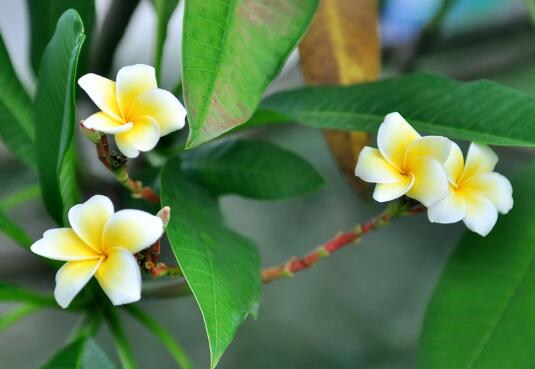
Why are the leaves of frangipani (Plumeria) turning yellow? Pay attention to topdressing and control the amount of watering
Frangipani is a highly ornamental flower, and it can be seen in many gardens in our country. However, with such a beautiful flower, if yellowing occurs, it will also affect its overall beauty. As for why frangipani leaves turn yellow, the editor below will take everyone to learn about it
-

条件筛选