-

When do Horse Teat grapes hit the market? An introduction to their ripening time
Xinjiang is the main grape-producing region in China; the grapes here taste excellent, which is what made the region famous. The Horse Teat grapes grown here are also very well known. So when do Horse Teat grapes hit the market? When do Horse Teat grapes hit the market? Generally in
-
What month is best for transplanting a wild-collected Vaccinium bracteatum stump so it survives? A detailed guide to the best transplant time
Abstract The best time to transplant Vaccinium bracteatum is between February and March. It likes sunlight, tolerates drought, and is fairly cold-hardy, with a wide growing range. Vaccinium bracteatum is basically transplanted to be grown as a potted plant. It stays evergreen all year round, occasionally taking on a slight reddish tint in autumn, giving a serene and antiquely elegant feeling.
-
Is the wild Vaccinium bracteatum easy to grow? A detailed guide to bonsai cultivation techniques
Vaccinium bracteatum, also known as Nanzhu or Wufanzi, is verdant and elegant, carrying a distinctive scholarly charm, and is especially well suited to bonsai. It must be said that for netizens who love plants and flowers, this is a great boon. Recently, quite a few netizens have been gathering information on Vaccinium bracteatum bonsai cultivation
-
What are the natural predators of the giant anteater? A comprehensive guide
In the Americas, there is an animal that feeds exclusively on ants, with a tongue that can reach 60 cm long, larger than a domestic kitten. This animal is the giant anteater. Here we introduce some knowledge about the anteater. 1. What is a giant anteater
-
How many teats does a sow generally have? An explanation of the normal number
There are various pigs in a herd, and the sow holds an important place among them, with every farmer focusing on its health. How many teats does a sow have? 1. How many teats does a sow have? Generally 8-16, with the number varying between different breeds. Xiang
-
Is the anteater viviparous or oviparous? The South American animal that eats ants and termites
The anteater is distributed across the forests, grasslands, deciduous forests and rainforest areas of Central America and South America, from the southernmost tip of Mexico to the vast regions of Brazil and Paraguay. So is it viviparous or oviparous? According to South American animal records, the anteater is a mammal, and each year
-
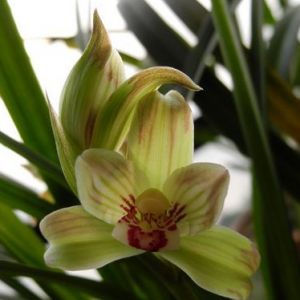
Cymbidium goeringii var. longibracteatum 'Cai Baihe' Orchid Variety Characteristics Introduction
A newly prized bicolor variety of Cymbidium goeringii var. longibracteatum. The petals are relatively thick, with very good color, though unfortunately the brightness is somewhat lacking.
-
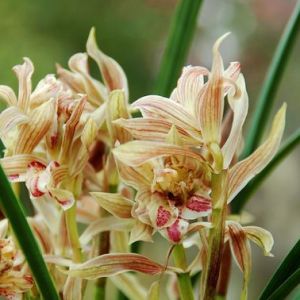
Introduction to the Chun-jian Orchid (Cymbidium goeringii var. longibracteatum) 'Western Red Peony' (Tianwaitian) Variety
The traditional celebrated cultivar Tianwaitian, also known as Western Red Peony, produces a tree-shaped exotic flower that is extremely spectacular and has won awards many times. A red-flowered tree-type peony-petal form, formerly known as Mudan Die, Tianwaitian.
-
What is the difference between Cymbidium tortisepalum and Cymbidium goeringii var. longibracteatum?
You cannot distinguish them by leaf width. Neither has a leaf stalk scar. Both have broad-leaf and narrow-leaf varieties. Both bloom with multiple flowers. Both have a very good fragrance. The germination rate of Cymbidium tortisepalum is much higher than that of Cymbidium goeringii var. longibracteatum. Most of its flower colors are more vibrant than those of Cymbidium goeringii var. longibracteatum. The root system of Cymbidium tortisepalum is more developed than that of Cymbidium goeringii var. longibracteatum. The leaves of Cymbidium goeringii var. longibracteatum are relatively rough. Those of Cymbidium tortisepalum are more delicate. There are many other differences as well. Once you have seen enough of them, they become obvious at a glance....
-
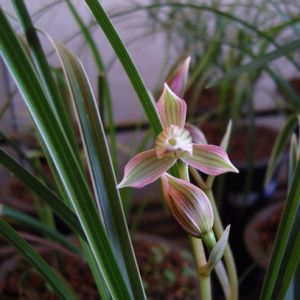
An Introduction to the Cultivar Characteristics of Crystaline Red Wheel Cymbidium tortisepalum var. longibracteatum
Crystaline Red Wheel is an excellent cultivar of Cymbidium tortisepalum var. longibracteatum that excels in both foliage and flower. The leaves carry silver margins, and the flowers carry a picotee edge. The flower is slightly green with a ring of crystal-like picotee edging, which is how it got its name.
条件筛选