-
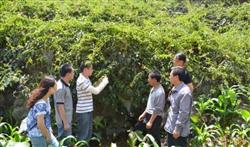
How to manage honeysuckle after harvesting? A full breakdown of the key technical points
How should honeysuckle be managed after harvest? What should be noted? We hope experienced readers can help explain. Post-harvest management of honeysuckle mainly includes pruning, garden clearing, fertilizer and water management, and pest and disease control. For detailed operations, refer to the following introduction. 1. Honeysuckle pruning: Pruning method one, thinning: Thin out severely...
-
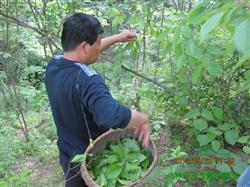
What are the harvesting methods for Eucommia bark and leaves?
How are Eucommia bark and leaves harvested? Please describe the methods. Eucommia bark and leaves can be harvested by referring to the following methods: 1. Bark harvesting. For Eucommia trees planted for 10-15 years, the bark can be harvested for medicinal use. There are 2 methods of peeling bark. (1) The felling and peeling method, also called the complete peeling method. Every year in April-May, when the tree sap begins to flow...
-
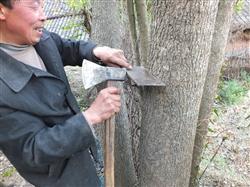
What are the harvesting and processing methods for Eucommia ulmoides?
How is Eucommia ulmoides harvested and processed? Please explain the methods. Eucommia ulmoides is a commonly used traditional Chinese medicine, and harvesting is done by the bark-stripping method. In our province, the more suitable time for bark stripping is from June 20 to July 31. The climate is suitable during this period, and after stripping, Eucommia ulmoides readily regenerates new bark, with a high survival rate. When stripping bark, first make a ring cut around the upper and lower ends of the section of the trunk to be stripped...
-
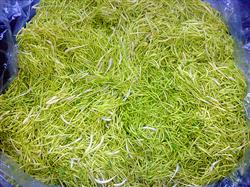
A Detailed Guide to Harvesting and Sun-Drying Honeysuckle
How do you harvest and sun-dry honeysuckle? Here is an introduction. Harvesting and sun-drying honeysuckle can follow the methods below: 1. Harvesting: The harvesting period for honeysuckle is generally in late May, the second flush in mid-July, the third flush around mid-August, and the fourth flush in mid-October. The full bloom of the first flush is relatively concentrated, about 5-7 days, while the second...
-
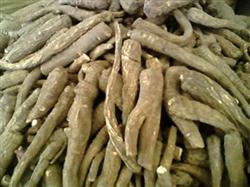
What is the correct harvesting method for Angelica dahurica?
How is Angelica dahurica harvested? Please give an introduction. The harvesting of Angelica dahurica varies because sowing times differ from place to place. With autumn sowing, it is usually harvested from late July to early August of the second year, and it should not be harvested too early or too late. If harvested too early, the plants are still growing, the nutrients accumulated in the roots are insufficient, and the processing recovery rate is low; if harvested too late, new shoots grow...
-
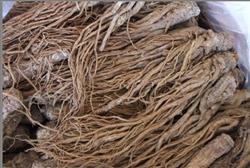
What is the correct harvesting method for Angelica sinensis?
How is Angelica sinensis harvested? Please explain: for autumn direct seeding of Angelica sinensis, it is harvested in the second year; for transplanted plants, it is harvested in the same year, after the plants turn yellow and wither in mid-October. Natural conditions vary from place to place, so the harvest time also differs to some extent. For example, in Minxian, Gansu, it is harvested 3 to 5 days after Frost's Descent; in Sichuan production areas, it is harvested around Frost's Descent; in Yan'an, Shaanxi, it is harvested in late October...
-
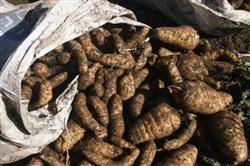
What are the key points to note when harvesting Gastrodia elata? Master these for a smoother harvest
(1) Be careful not to damage the tubers. When digging, carefully scrape away the surface growing medium, remove the fungal wood, and gently take out the Gastrodia elata. Take great care not to bruise the tubers, especially the white tubers and small tubers used for seed. (2) Harvest carefully. Search all around and do not overlook or miss any Gastrodia elata. Because the Armillaria mellea around them grows and develops better...
-
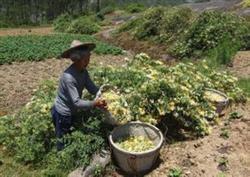
Detailed Explanation of Harvesting and Processing Techniques for Honeysuckle (Jinyinhua) Medicinal Material
1. Flower-picking time: The picking time is from 9 to 12 o'clock in the previous year; it is not suitable to pick when there is dew or on rainy days, but it can also be picked if there is drying equipment. Flowers picked in the morning are blue-white, heavy, easy to dry, have a strong fragrance, a high rate of commercial product output, and good quality. Flowers picked after noon and on cloudy days are poorer in quality and have a low processing rate. From the flower's development process...
-

Detailed Explanation of Harvesting and Processing Methods for Pinellia ternata
I. Harvesting is generally carried out in summer and autumn after the stems and leaves have withered and the plants have fallen over. In the southern provinces, it can be done in July-August. The method is: choose a sunny day, use a hoe to dig a furrow 12-20 cm deep along the rows, dig out the Pinellia ternata tubers one by one, shake off the soil, and remove the coarse skin and fibrous roots from the surface of the medicinal material. II. Processing: Wash the fresh Pinellia ternata clean of mud, grade them into large, medium, and small sizes, put them into burlap sacks separately, first tap them lightly on the ground a few times, then pour them into a vat of clean water and rub them repeatedly, or put the tubers into a bamboo basket and beat them with a wooden stick in running water or use a peeling machine to remove the skin. After washing
-
Harvesting, Processing Methods and Technical Key Points for Pinellia ternata
Those propagated from tubers are harvested in the same year or the following year, while those propagated from seeds can only be harvested in the 3rd to 4th year. Harvesting is generally carried out in summer and autumn after the stems and leaves have withered and fallen over. After digging them out, pack them in baskets, wash off the mud and sand while they are still fresh, put them into gunny sacks and rub off the outer skin, then pour them out and wash the outer skin clean with clear water. Scoop them out and dry them in the sun to obtain Pinellia ternata. Generally, the yield of fresh tubers is 500-750 kg per mu, and the drying ratio is about 30%.
条件筛选