-

Three major Alishan spring tea competitions announced one after another; Meishan Farmers' Association oolong tea fetches a higher price
The Alishan tea region has 3 major tea competitions, organized respectively by the Meishan Township Farmers' Association, the Alishan Farmers' Association, and the Alishan Production Cooperative. This year, affected by climate drought, the competition schedules were postponed along with the harvest time. The earliest to submit tea and the earliest to conduct judging was Alishan
-
Zhejiang Hit by Late Spring Cold Snap, Half of Tea Gardens' Tea Leaves Frozen
Zhejiang Hit by "Late Spring Cold Snap," Half of Tea Garden Leaves Frozen and Damaged
-

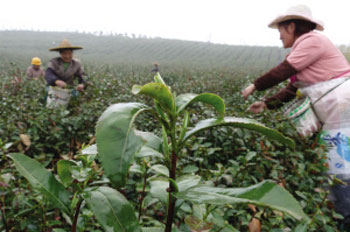
Fresh Picking of Anxi Oolong Spring Tea: Tea Pickers Busy Among the Tea Rows
Anxi Oolong Spring Fresh Picking: Tea Pickers Among the Tea Rows
-
Spring tea helps build wealth through entrepreneurship; small tea leaves achieve big dreams
Small spring tea helps fulfill the dream of starting a business and getting rich
-
Spring Tea in Heping Town, Fujian Helps Realize the Dream of Starting a Business and Getting Rich
Heping Town, Fujian: Tiny Spring Tea Helps Realize the Dream of Starting a Business and Getting Rich
-
Wheat Price Forecast Before Spring Festival: Wheat Prices Steady with a Slight Rise, Flour and Bran Follow Suit
Wheat Price Forecast Before Spring Festival: Wheat Prices Steady with a Slight Rise, Flour and Bran Follow the Trend
-
Detailed Explanation of Key Technical Points for Increasing Spring Tea Yield and Improving Quality
Delaying light pruning: Conventional light pruning of the tea canopy is carried out from December in winter to February of the following year. Practice has shown that doing so has three drawbacks: first, the branches are prone to frost damage after pruning; second, the overwintering buds are cut off, delaying the sprouting time of spring buds; third, the nutrients already accumulated in the branches on the tea canopy surface are cut away, affecting the sprouting vigor of spring buds and the growth of thick strong branches, ultimately affecting spring tea yield and quality. Therefore, the pruning time should be after the frost period, preferably so that the first spring tea can be picked 30 to 40 days after pruning. Advancing topdressing: Conventional topdressing is mostly carried out in early to mid-March, when spring buds
-
After spring tea harvesting, attention should be paid to summer management of the tea garden.
After spring tea harvesting is finished, summer tea garden management work should be done promptly. 1. Fertilize in time. Apply 15-20 kg of urea per mu, or 25 kg of Zhongcha No. 1 fertilizer. Do not apply compound fertilizer with a high proportion of phosphorus and potassium, otherwise it will accelerate the reproductive growth of tea plants. During midsummer, carry out foliar topdressing. 2. Cultivate and weed. After June, apply chemical weed control once every 25 days. Commonly used herbicides include 10% glyphosate and 25% paraquat aqueous solution, etc. In July, deep-plow the tea garden once, which can both
-
How to carry out early-stage spring tea management? A detailed explanation of nine steps
Spring tea is the tea crop with the highest yield and the best quality of the year, fetching high prices and delivering good economic returns. Practice has proven that doing a good job of early-stage spring tea management plays a major role in increasing spring tea yield and improving spring tea quality and profitability. Therefore, it is essential to promptly complete tea garden management before the Spring Festival. 1. Apply additional and early topdressing. The time for applying the bud-forcing fertilizer is generally 15-30 days before the tea plant buds break, that is, before the end of February, applying 25-30 kg of urea per mu or 50-60 kg of ammonium bicarbonate or 50 kg of special compound fertilizer for tea plants.
-
After spring tea is picked, the tea plant branches and stems need even more protection
Whether or not tea plants are managed after the spring tea harvest makes a big difference, because after the spring tea harvest the plant body has already consumed a large amount of nutrients. If management cannot keep up at this time, it will not only affect the yield and quality of summer and autumn tea, but also affect the yield and quality of next year's spring tea. Based on our farm's practical experience, the following key points should be carried out after the spring tea harvest: 1. Reasonable topdressing. According to measurements, producing every 50 kg of dry tea requires absorbing about 2.5-3 kg of nitrogen, 0.9-1.2 kg of phosphorus, and 1.1-1.5 kg of potassium from the soil. Between the tea plants, 30 cm
条件筛选