Zhejiang Hit by Late Spring Cold Snap, Half of Tea Gardens' Tea Leaves Frozen
Original title: "Late Spring Cold Snap" Damages Half of Zhejiang's Tea Gardens
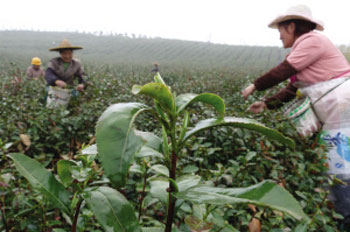
Female tea pickers rush to harvest the first batch of spring tea before the cold air arrives (network illustration, source: Keqiao Daily)
A few days ago, in many tea-producing counties in Zhejiang, there was both snow and frost, and tens of thousands of acres of verdant tea gardens were covered with a layer of white gauze; the beautiful scene flooded social media. But for tea farmers in these areas, it was almost too painful to cry: spring tea was about to be picked, and it was this sudden late spring cold snap that caused immeasurable losses.
A reporter learned from the Zhejiang Provincial Department of Agriculture that in this spring cold spell, more than half of Zhejiang's nearly 3 million mu of tea gardens suffered freeze damage, with the affected area exceeding 1.5 million mu. About 3,700 tons of early tea were damaged, and economic losses are estimated to reach 1.8 billion yuan, with Lishui, Hangzhou, Shaoxing, Huzhou and other places suffering the most severe damage.
After entering March, Zhejiang's weather remained consistently warm, and much spring tea entered the critical period of budding. But within just a few days, this wave of fierce strong cold air caused temperatures to plummet by more than 20°C. On the 10th, snowfall occurred in many places in Zhejiang. Although the rain and snow gradually stopped on the 11th, accompanied by low temperatures, frost occurred in most areas. What spring tea fears most is "frost on flat land, snow on high mountains."
On March 10, the reporter contacted Weng Liang, a tea farmer in Wengjiashan Village, Xihu District, Hangzhou. According to him, because "Longjing No. 43" had basically budded, it was greatly affected by this spring snow. If temperatures continue to drop, the possibility of the buds being frozen and damaged will be greater. That afternoon, the whole family was busy removing snow to prevent frost damage from the continued temperature drop.
"Among West Lake Longjing, the earlier-sprouting 'Longjing No. 43' suffered severe freeze damage, and some early-sprouting population varieties also did not escape." Shang Jiannong, president of the Hangzhou West Lake Longjing Tea Industry Association, told reporters that more than 200,000 mu of tea gardens have suffered freeze damage. Although before the cold wave, tea farmers had rushed to pick some buds, a reduction in this year's West Lake Longjing output is already certain.
It is understood that in Lishui, the worst-hit area, more than 370,000 mu of tea gardens were affected, with economic losses of about 400 million yuan; in Anji County, Huzhou, of more than 170,000 mu of white tea gardens, about 100,000 mu were affected to varying degrees; in Xinchang County, Shaoxing, fortunately the earlier-sprouting "Wuniuzao" had basically finished being picked, but the successively sprouting "Longjing No. 43" was more severely affected by the cold wave.
At present, agricultural technology experts across Zhejiang have gone down to the countryside to guide tea farmers in scientific self-rescue to reduce losses. Experts estimate that spring tea losses before the end of March in Zhejiang will reach more than 30%, and reduced output is already certain. Affected by this, the full-scale picking of spring tea in various places will also be delayed by more than 10 days. (Reporter Zhu Haiyang)