-

What are the disinfection methods for sand used in turtle and soft-shelled turtle incubation
In recent years, with the rise of artificial turtle and soft-shelled turtle farming, how to increase the hatching rate of turtle and soft-shelled turtle eggs and hatchlings has become an urgent matter. Because some turtle and soft-shelled turtle farms still use the traditional old method, using untreated sand as the carrier for incubating eggs, they do not realize that untreated sand contains a large number of pathogens and pests, which often contaminates and ruins the eggs during incubation, and some farms fail because of this. In my 21 years of turtle and soft-shelled turtle farming practice, I have worked out methods for disinfecting sand and improved the hatching rate. Now I will introduce several very practical disinfection methods
-
How to Prevent Sand-Shelled and Soft-Shelled Eggs in Three-Lined Box Turtles
Three-lined box turtles mate and fertilize in March-April each year, and lay and incubate eggs from May to July. A single sexually mature female turtle lays 3-9 eggs per year; the three-lined box turtle has a relatively low egg production among turtles. Improper feeding and management or the influence of other factors can also cause some three-lined box turtles to lay 1-2 eggs, or even a whole clutch, of sand-shelled eggs (with a sandy, non-smooth shell surface) or soft-shelled eggs, affecting the hatch rate and causing certain economic losses to three-lined box turtle farming. 1 Causes of three-lined box turtles laying sand-shelled or soft-shelled eggs a) Lack of eggshell-producing
-
Yellow Sand Soft-shelled Turtle Farming Techniques: Juvenile Turtle Rearing Methods and Turtle Egg Incubation Tips
1. Selection of a New Turtle Pond The area is 1 mu to 5 mu, the water depth is about 1.5 m, a 20 sq m to 50 sq m egg-laying sand bed is built on one side of the pond, a "T"-shaped escape-prevention wall about 0.6 m high is built around the perimeter, and a 20 sq m to 50 sq m basking platform and feeding platform are set up on the water surface.
-
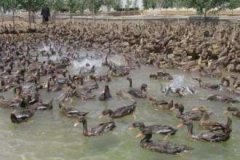
Causes and Treatment of Sand-Shelled Eggs in Laying Ducks
What causes laying ducks to produce sand-shelled eggs? It is generally caused by calcium deficiency, as the main component of the eggshell is calcium. So how do you treat sand-shelled eggs in laying ducks? When the proportion of thin and soft-shelled eggs increases, gradually add 0.1% calcium to the daily ration and observe
-
What is the difference between sand clams and flower clams? Learn to tell them apart easily
Clams are mollusks with oval shells, light brown in color with purple edges, living on the shallow sea floor, and include varieties such as flower clams and sand clams. So what is the difference between sand clams and flower clams? The sand clam is also known as sea mussel, red egg, and Xishi tongue. It belongs to the class Bivalvia, order Veneroida, family Mactridae. Shell
条件筛选