-
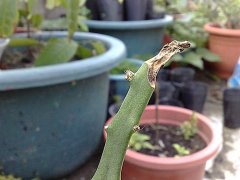
Where is the yellow dragon fruit native to? Suitable rootstocks for grafting and cultivation methods
Yellow dragon fruit, also known as yellow pitaya (Pitahaya Amarilla), is distributed in regions such as Colombia, Ecuador, Peru and Bolivia. Because the fruit is refined, sweet and juicy, it can be called the finest in the dragon fruit world. However, its ripening period is two to three times longer than that of ordinary dragon fruit.
-

What Trees Can Persimmon Rootstock Be Grafted Onto? A Full Guide to Grafting Time and Methods
Persimmon rootstock generally refers to Diospyros lotus, also called black date, soft date, milk date, wild persimmon, etc. It is a fruit tree used both as medicine and food, and can be propagated by sowing or grafting. So what trees can persimmon rootstock be grafted onto? When to graft? How to graft? 1. What trees can persimmon rootstock be
-
How many years until Gisela 6 rootstock bears fruit?
Gisela is native to Germany and was introduced in the 1990s by Director Wang Jiaxi of the Shandong Institute of Pomology. This is a hybrid cherry dwarfing rootstock, known as the Gisela series, including Gisela 5, Gisela 6, Gisela 7, and Gisela 12. So, how many years until Gisela 6 bears fruit? 1. Gisela
-
Key Technical Points and Operation Methods of Vegetable Grafting Explained
Abstract Top-insertion grafting method: Pull the bamboo skewer inserted in the rootstock out, then insert the trimmed scion into the hole, with the scion cotyledons and rootstock cotyledons forming a "cross" shape. Approach grafting method: Insert the scion cut into the rootstock stem cut, the two cuts need to fit tightly together, then use a grafting clip ⟦4 <p class="cintro"><span>Abstract</span>Top-insertion grafting method: Pull the bamboo skewer inserted in the rootstock out, then insert the trimmed scion into the hole, with the scion cotyledons and rootstock cotyledons forming a "cross" shape. Approach grafting method: Insert the scion cut into the rootstock stem cut, the two cuts need to fit tightly together, then use a grafting clip to secure the joint. Cleft grafting method: Insert the trimmed scion into the cleft, keeping the rootstock and scion surfaces level, then use a grafting clip for securing.</p> <p></p> <p><strong>I. Vegetable Grafting Techniques</strong></p><p>1. Top-insertion grafting method</p><p>(1) Removing the rootstock growing point: A blade or bamboo skewer can be used to cut off the true leaves and growing point of the rootstock.</p><p>(2) Cutting the rootstock: A bamboo skewer with the same thickness as the scion hypocotyl and a wedge-shaped tip can be used, then insert it at a downward slant from the main vein of one cotyledon of the rootstock toward the other cotyledon to a depth of 1cm; generally, it is best if the outer epidermis is not pierced and the bamboo skewer is faintly visible.</p><p>(3) Cutting the scion: At 1-1.5cm below the cotyledon node, use a blade to cut it into a wedge-shaped face with a bevel length of 1cm.</p><p>(4) Grafting: Pull the bamboo skewer inserted in the rootstock out, then insert the trimmed scion into the hole, with the scion cotyledons and rootstock cotyledons forming a “cross” shape.</p><p></p><p>2. Approach grafting method</p><p>(1) Removing the rootstock growing point: A blade or bamboo skewer can be used to cut off the true leaves and growing point of the rootstock.</p><p>(2) Cutting the rootstock: At 0.5-1cm below the cotyledons, use a blade to make a downward slanting cut, with the depth needing to reach 1/2 of the stem thickness.</p><p>(3) Cutting the scion: Make an upward slanting cut at the corresponding part of the scion, generally with the depth reaching 1/2 of the stem thickness, and the cut length the same as the rootstock cut.</p><p>(4) Grafting: Insert the scion cut into the rootstock stem cut, the two cuts need to fit tightly together, then use a grafting clip to secure the joint.</p><p>(5) Root cutting: After grafting, plant the rootstock and scion together into a nutrient pot, about 1cm apart, with the joint about 3cm from the soil surface; wait 7 days for the joint to heal, then cut off the scion root; generally after 10-15 days, the grafting clip can be removed.</p><p></p><p>3. Cleft grafting method</p><p>(1) Removing the rootstock growing point: A blade or bamboo skewer can be used to cut off the true leaves and growing point of the rootstock.</p><p>(2) Cutting the rootstock: From between the 2 cotyledons, split the young stem downward, with a length of 1-1.5cm.</p><p>(3) Cutting the scion: Cut the scion young stem into a wedge shape, with a cut surface length of 1-1.5cm.</p><p>(4) Grafting: Insert the trimmed scion into the cleft, keeping the rootstock and scion surfaces level, then use a grafting clip for securing.</p><p></p><p><strong>II. Suitable Grafting Time for Vegetables</strong></p><p>1. Cucurbits: When the cotyledons are fully expanded and when the true leaves appear, this is the suitable grafting period.</p><p>2. Eggplant: When the rootstock has grown 3-4 true leaves and the scion has grown 2-3 true leaves, grafting requires retaining 1 true leaf.</p><p>3. Tomato: When the rootstock has grown 4-5 true leaves and the scion has grown 2-3 true leaves, grafting requires retaining 1 true leaf.</p>
-
Detailed Explanation of Eggplant Grafting Techniques, with Operation Process
Abstract Rootstock introduction: Ping eggplant rootstock, prickly eggplant rootstock, and Torubamu rootstock have relatively high disease resistance and grafting survival rates. Scion selection: Nongyou long eggplant, Hangzhou red eggplant, Xi'an green eggplant, etc. Grafting seedling cultivation: sow the rootstock first, then the scion. Cleft grafting: when the rootstock grows to
-
Cultivation of Rootstock Seedlings of Sichuan Pepper and Management Techniques Before and After Grafting
Sichuan pepper (scientific name: Zanthoxylum bungeanum Maxim.), also known as hui, da jiao, Qin pepper, Shu pepper, Chuan pepper, or mountain pepper. It is a deciduous shrub or small tree of the genus Zanthoxylum in the family Rutaceae, and can be planted as a solitary specimen or used as a protective thorn hedge. Its fruit peel can be used as a seasoning, and aromatic
-
Key Points of Post-Grafting Management Techniques for Top-Grafting and Variety Conversion of Citrus
1. Do well in cutting the rootstock stubs. After using side grafting with exposed buds, the rootstock stubs should be cut or sawed off. This should be done in two steps. First, leave about 15cm of rootstock stub above the graft union. After the new shoots have become lignified, cut the stub flush with the graft union and smooth the cut surface with a knife. 2. Do well in removing sprouts. After top-grafting, because the apical dominance has been removed,
-
Detailed Guide to the Method of Cultivating Mango Grafting Rootstock Seedlings
In monoembryonic mango varieties, a single seed produces only one seedling, while polyembryonic varieties can germinate and grow into multiple seedlings. A monoembryonic seed has only one embryo (a sexual embryo); the embryo is large, and the single seedling it develops into is vigorous. A polyembryonic seed has multiple embryos; the embryos are smaller, and the multiple seedlings they develop into are weaker
-
How to Choose a Nursery Site for Cultivating Sugar Mandarin Grafting Rootstock Seedlings
The nursery site should be chosen in a place with convenient transportation and good conditions for water and electricity supply, somewhat distant from mandarin orchards or separated by a natural barrier, to reduce infection by dangerous pests and diseases. The terrain is required to be flat, with a slope not exceeding 5 degrees, and with no air or water pollution nearby. The soil should preferably be
-
How to Grow Chilies? A Detailed Guide to Overwintering Rootstock Cultivation
Chili overwintering rootstock cultivation means using the old rootstocks of the first crop of chilies to overwinter until cultivation the following year, skipping the usual seedling-raising and sowing steps. It is simple and easy to carry out, can save more than 50% of labor, effectively prevents seedling rot and pest and disease problems, and achieves a 90% survival rate. It can bring the crop to market 40-50 days earlier, and is a
条件筛选