-

Northeast "Strange Rice" succeeds in trial planting in Heilongjiang and begins to be promoted to farmers within the province
Sitting on a pile of plump rice sacks with a beaming smile, Jin Yushi, a farmer from Xiangfang District, Harbin, is very gratified by the bumper harvest of the 8 mu of "Northeast Strange Rice" he planted this year. This year, low temperatures and scant sunshine caused reduced yields in some rice-producing areas of Heilongjiang Province. However, some rice growers who applied new technologies and new varieties still steadily achieved high yields. Among them, rice farmers Jin Yushi, Zhang Zibin and others obtained a good harvest by accepting the suggestions and guidance of scientific and technical personnel, introducing "Northeast Strange Rice" and applying biological technologies such as "three agents and two fertilizers",
-
Introduction to the Characteristics of the Japanese Yellow Sweet Potato, Orange Love Variety
The Japanese Yellow Sweet Potato is a rare sweet potato treasure introduced from Japan by relevant Chinese experts in the spring of 1999. It is a new variety for fresh eating and roasting. This yellow sweet potato sets tubers early and in a concentrated manner, and can be harvested in July. The skin is smooth and yellow, and the flesh is orange-red, making it very attractive. It tastes sweet and fragrant, with an excellent mouthfeel. After cooking, the skin separates from the flesh. Besides being suitable for roasted sweet potatoes and sweet potato preserve processing, it is also good for fresh eating and various cooked foods. This sweet potato has strong disease resistance, high yield, early maturity, and high quality, making it an ideal variety to replace China's Beijing 553 yellow-skinned roasting sweet potato.
-
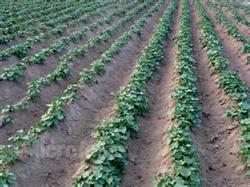
Sweet potato seedbed arrangement matters: master the method for good seedling results
The adventitious buds on sweet potatoes are most numerous at the head end, fewer in the middle, and fewest at the tail end. When arranging seed potatoes flat or at a slant in the seedbed, follow the principle of head end up, tail end down, back side up, belly side down to increase the number of sprouts. If large and small tubers are arranged in the same seedbed, large tubers sprout slowly and produce few but sturdy seedlings, so they can be placed...
条件筛选