-

Control Techniques for Ichthyophthiriasis in Rainbow Trout Farming
1. Symptoms Ichthyophthiriasis is also known as white spot disease. The parasite lodges on the body surface, oral cavity, eyeballs and gills of rainbow trout. Many white spots are visible to the naked eye at the parasitic sites. When the white spots are scraped off and placed on a drop of water on a slide, the white spots can be seen moving along the edge of the water drop. If parasitizing
-
How to raise adult rainbow trout? Detailed explanation of rearing methods
The main rearing methods for adult rainbow trout are as follows: 1. High-density flowing water pond trout culture. This is currently a rearing method commonly used both domestically and abroad. It has the advantages of small land area, saving manpower and material resources, high feed utilization rate, and high yield. 2. Using deep-layer low-temperature water from high-dam reservoirs to raise trout.
-
Detailed Explanation of Water Source and Fish Pond Issues in Rainbow Trout Farms
(1) Water source Rainbow trout must be raised in clear flowing water. Groundwater, river water, mountain stream water and seawater can all be used, but the water supply must be abundant in all four seasons, the water temperature suitable, the dissolved oxygen sufficient, and the water clean and pollution-free. 1. Water quality. When selecting a trout farm site, it should as far as possible
-
Sharing Experience on Water Quality Control in Rainbow Trout Farming
Water quality conditions are an extremely important aspect; the quality of the water directly determines the success or failure of rainbow trout farming production. Rainbow trout is a fish that favors counter-current flow and high oxygen; the stimulus of water flow not only accelerates material metabolism within the body but also carries away waste. Rain
-
What pond conditions are needed for pond farming of adult rainbow trout?
Adult fish farming is the rearing of fingerlings into market-size fish. Generally, adult fish are raised by starting with fish that are a full year old as fingerlings, and in some cases the fish of the current year are raised all the way until market-size fish are harvested from the pond. But no matter which farming method is used, to achieve high yield and high efficiency, sufficient fingerlings must be stocked
-
Artificial Insemination Methods and Technical Points for Rainbow Trout
1. Preparation before insemination: Tools: a white porcelain washbasin can be used as the egg-collection and fertilization basin; in addition, medical gauze, feathers, a microscope, beakers, graduated cylinders and other tools are also needed. Preparation of isotonic solution: sodium chloride 90.4 g, potassium chloride 2.4 g, calcium chloride 2.6 g, dissolved in sequence in
-
What kind of fish is salmon, and what are the 6 differences between it and rainbow trout?
When eating Japanese cuisine, many people must order a serving of salmon. Salmon is different from the freshwater fish we usually see. Generally, when we eat grass carp and crucian carp, we need to cook them before eating, but salmon can be eaten raw, which is
-
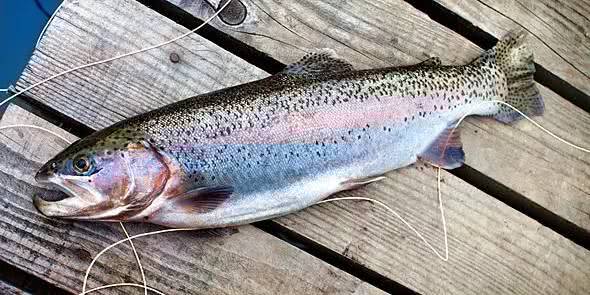
Rainbow trout is not freshwater salmon, stop calling it that
"I am the rainbow trout. Although China is not my homeland, in places with beautiful mountains and clear waters like Huairou in Beijing, Lijiang in Yunnan, and Qingcheng Mountain in Sichuan, you can always see my lively figure. I have high looks and good meat quality, and I can be pan-fried, grilled, stewed, or braised in every way...
-
Key Technical Points and Detailed Daily Management Methods for Rainbow Trout Farming
Rainbow Trout Farming Techniques
-
Detailed Explanation of Key Points of Rainbow Trout Pellet Feeding Technology
Rainbow Trout Pellet Feeding Technology
条件筛选