Rainbow trout is not freshwater salmon, stop calling it that
"I am the rainbow trout. Although China is not my homeland, in places with beautiful mountains and clear waters like Huairou in Beijing, Lijiang in Yunnan, and Qingcheng Mountain in Sichuan, you can always see my lively figure. I have high looks and good meat quality, and I can be pan-fried, grilled, stewed, or braised in every way. However,I heard some people call me freshwater salmon, I just want to say, hehehe..."
The "hooked nose" Oncorhynchus genus
The rainbow trout (Oncorhynchus mykiss) is a fish in the family Salmonidae, genus Oncorhynchus (Pacific salmon), with the English name rainbow trout. It is native to northern North America and the western coast of the Pacific Ocean,most populations live their entire lives in low-temperature freshwater environments, but there are also some subspecies commonly known as "steelhead trout" that live in freshwater and seawater in different seasons, possessingmigratory spawningcharacteristics.
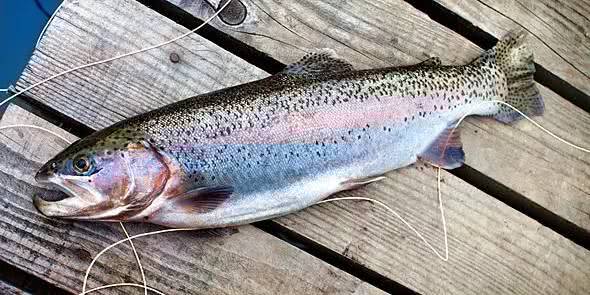
ID photo of rainbow trout (O. mykiss). Image: shutterstock.com
There are many species of fish under the genus Oncorhynchus, most of which have migratory characteristics. The genus name Oncorhynchus comes from the Greek words onkos (hook) and rynchos (nose),meaning "curved nose", because when these fish migrate upstream to spawn during the breeding season, not only does their body color change greatly and the males' backs become humped, but their upper and lower jaws also become hook-shaped.
Therefore this genus is also called "hook-snout salmon genus". "Steelhead trout" can mostly return to the sea to continue living after migratory spawning, but other species in the genus Oncorhynchususually migrate only once in their lifetime, and slowly die after mating and spawning. Migrating salmon bring back large amounts of nutrients from the ocean, completing the cycle of matter and energy in nature, "brushing off their clothes and leaving after the deed, hiding their achievements and fame."
The hooked upper and lower jaws of male sockeye salmon during breeding season are extremely obvious. Yes, those guys often bullied by brown bears in documentaries. Image: theketaarecoming.com
Beautiful patterns when young, high looks when adult
Rainbow trout arecarnivorous fish. In the juvenile stage they mainly feed on zooplankton and aquatic insects, while adults prey on small fish, crustaceans, and terrestrial and aquatic insects. The fish body is spindle-shaped, usually blue-gray or brown-yellow on the back, scattered with small dark brown spots all over, silvery-white on the belly, and juveniles have 10 oval dark spots on the sides of the body.
Juvenile rainbow trout, with beautiful spots on the sides of the body. Image: arkive.org
Juvenile of the rainbow trout subspecies California golden trout (O.m.aguabonita), with even more brilliant body color. Image: arkive.org
In China there often appears a kind of rainbow trout individual called"golden trout", which is actually an albino rainbow trout that has been artificially selected and bred on a larger scale. The body color is bright golden yellow, and adults have red or pink longitudinal bands on the sides of the body.
Juvenile of albino rainbow trout. Image: arkive.org
Adult rainbow trout in streams generally grow to about 40 cm, while individuals inhabiting large lakes and migratory individuals can exceed 80 cm in body length. During the breeding season, the upper and lower jaws of males become curved,and the rainbow-like peach-red longitudinal band on the sides of the body from the gills to the tail becomes even more brilliantly colored, and the name rainbow trout comes from this.
Male rainbow trout in love season, "putting on his formal wear". Image: Erik Hanson
So pretty it doesn't look like a practical option
Most fish in the family Salmonidae have orange or orange-red flesh and roe, and rainbow trout is the same. This color comes from a carotenoid——astaxanthin(Astaxanthin), which salmonids obtain by preying on small crustaceans. Astaxanthin is orange-red in its free state, so it is also called shrimp red pigment. After digestion, the reduced astaxanthin produced is concentrated in muscle cellsmaking salmon flesh appear orange-red。
The orange-red flesh color of Atlantic salmon (salmon). Image: shutterstock.com
Unlike other fish that can only store astaxanthin in the ovaries and body surface, salmonids can also concentrate astaxanthin in muscle cells.Different species of salmon have different abilities to metabolize astaxanthin, so their flesh shows different degrees of red. For example, the sockeye salmon (O. nerka) mentioned above is deep red, Atlantic salmon (Salmo salar) is orange-red, pink salmon (O. gorbuscha) is pink,while rainbow trout shows a light orange-yellow。
Salmon under artificial farming conditions have no opportunity to prey on crustaceans in the natural environment, so in order to increase the color of the flesh, people can onlyreasonably add synthetic canthaxanthin to artificial feed。
Salmon? You can't just call it that whenever you want
The flesh color of rainbow trout is similar to salmon, so many places simply call rainbow trout freshwater salmon or alpine cold-water salmon,and call albino rainbow trout golden trout salmon, which sounds as lofty as an enhanced version of salmon, and they even play up rainbow trout sashimi with "caught live and killed fresh to your heart's content, fresh taste instantly beats chilled fresh". Really have to give these clever (cunning) merchants a round of applause.
The word salmon comes from "Salmon". Early people used the Latin "salmo" (meaning to leap vigorously) to refer to a fish in the North Atlantic. This fish migrated upstream every year to the rivers along the European coast to spawn, and would leap vigorously over waterfalls along the way. Later the great Linnaeus vividly named this fish "salmo salar", which is now the Atlantic salmon of the genus Salmo.
The first people to come into contact with Atlantic salmon were those in Hong Kong, China and Taiwan, China. Since its English name is Atlantic salmon, then just as "strawberry" is actually strawberry, "Salmon" was transliterated into "sanwenyu" through a heavy Cantonese accent.Salmon is not a scientific name, but a general commercial name. Due to the above historical reasons,in the Chinese-language context, salmon refers to Atlantic salmon. The most famous is Norwegian seafood salmon. Depending on the place of origin, there are also similar Atlantic salmon products such as Australian seafood salmon, Scottish seafood salmon, and so on.
Norwegian salmon farm. Image: theketaarecomming.com
In English, "Salmon" also refers to many species in the genus Oncorhynchus (Pacific salmon). That is because European colonists who reached the Americas during the Age of Discovery were surprised to find that along the Pacific coast there were actually many fish species similar in appearance to "Salmon", which also changed body shape and color at different stages and migrated to spawn, so they got lazy and conveniently called this whole bunch of fish "Pacific Salmon". To further distinguish them, they added features such as place of origin and morphology before the general name, which is how the current many species in the genus Oncorhynchus such as Pink salmon, Coho salmon, and Sockeye salmon came to be.
Although their English names all contain "Salmon", in Chinese they are usually translated as XX salmon, such as Chinook salmon being called king salmon, Coho salmon being called silver salmon, and so on. In fact, these Pacific salmon do not need to borrow the name XX salmon to raise their profile, because the price of truly high-quality wild Pacific salmon is far higher than Atlantic salmon, it is just that our country rarely imports them.
Some species of the genus Oncorhynchus (breeding season). Image: arkive.org
Although rainbow trout and the above species all belong to the genus Oncorhynchus, the common English name of rainbow trout is rainbow trout, so in the concept of the common name "Salmon", rainbow trout is excluded. Moreover, the concept corresponding to "Trout" is "trout", referring to a group among the fish of the genus Oncorhynchus (Pacific salmon) and the genus Salmo whose entire life history is completed in freshwater and which has no cross-salinity migratory behavior. Rainbow trout is exactly like this (special cases such as landlocked Atlantic salmon and migratory steelhead trout are varieties based on individual populations with extremely narrow natural distributions, and are not enough to affect commercial varieties formed through artificial selection and breeding). Thereforefarmed rainbow trout absolutely should not be called "freshwater salmon"。
In fact, the term "freshwater salmon" itself is a very strange and ridiculous combination. This is by no means just a translation issue, buta story full of commercial interests. After rainbow trout was introduced into China for farming, the output was very high, supply exceeded demand, and the price was much lower than salmon. Merchants then profited by hyping the concept of "freshwater salmon", and in many tourist attractions they even sold it at prices far higher than salmon. Moreover, albino individuals of rainbow trout are not uncommon after artificial selection and breeding, and the so-called golden trout is no more precious than ordinary rainbow trout.
Artificially selected and farmed albino rainbow trout. Image: wikiwand.com
Can rainbow trout actually be eaten raw?
Since merchants have given it the title "freshwater salmon", then naturally the best way to eat it is sashimi just like salmon, right? Wait,rainbow trout cannot be eaten raw directly!Freshwater fish and shrimp generally cannot be eaten raw. They may carry many kinds of parasites in their bodies, such as Diphyllobothrium latum, lung flukes, Clonorchis sinensis (commonly known as liver fluke), Gnathostoma, and so on. Eating freshwater aquatic products raw carries more or less a risk of infection,and the soy sauce, wasabi paste, and baijiu served alongside are simply not enough to kill these parasites. Neighboring Japan also has the habit of eating salmon raw, such as masu salmon and rainbow trout, which have even become local specialties. Of course, once they become specialties, there is likewise a risk of parasite infection, so some of these salmon are frozen beforehand.
If viewed strictly, not only freshwater fish, but also marine fish that have lived in freshwater or brackish water are not suitable for raw consumption, including even wild salmon during their migratory stage. Wild salmon caught at sea may also be infected with Anisakis and Diphyllobothrium. The good news is that these parasites have complex biological structures,and are intolerant to low-temperature freezing. Marine fish imported through proper channels are usually subjected to low-temperature quick freezing as required (usuallyfrozen at -35°C for 15 hours or at -23°C for one week), so raw consumption is relatively safe. The cages of farmed salmon are also equipped with bird-isolation facilities, blocking the route of parasite transmission through bird droppings, so the safety factor is higher. Wild salmon tastes good, while farmed Atlantic salmon is safer.
How to distinguish salmon from rainbow trout?
Since merchants will pass off rainbow trout as salmon to make sashimi and sell it to diners, such as in some buffet restaurants, conveyor-belt sushi shops, or tourist attractions, what we see is only the finished product, so is it hard to tell whether it is salmon or rainbow trout? In fact, the following steps may help you.
First, look at the flesh color: Salmon is usually bright orange-red, while rainbow trout flesh is duller and its orange is lighter. But high-quality rainbow trout raised at a high level can have flesh color very similar to salmon...
Ordinary rainbow trout sashimi. Image: flikrhivemind.net
Second, look at the slice shape: The texture of rainbow trout is far less fatty and tender than salmon. Thick slices of rainbow trout are too tough to chew, so rainbow trout sashimi is mostly cut very, very thin. Salmon is soft and tender in the mouth, while rainbow trout is more chewy. But what if the merchant is stingy and cuts the salmon thin, and your palate is not sharp enough to taste the difference...
Third: look at the intramuscular fat layer: that is, the white streaks on salmon flesh. The intramuscular fat layer of salmon is usually clear and thick, especially in the salmon belly area, while in rainbow trout it is not obvious. But there are also rainbow trout that have been fattened well...
High-quality rainbow trout sashimi, the intramuscular fat layer is still not obvious. Image: visitgunma.jp
Salmon belly, with an obvious intramuscular fat layer. Image: shutterstock.com
So choosing a reliable restaurant is especially important. Eating rainbow trout raw is risky, after all we are not that man at the top of the food chain.
In fact, rainbow trout is a particularly great fish, suitable for most cooking methods. Rainbow trout has the unique flavor of salmon, and also a relatively high fat content, with a delicate texture and chewy flesh,especially suitable for pan-frying and grilling, and of course steaming, braising in soy sauce, and hot pot are also good. Finally, let's post a few food photos to feast the eyes.
Rainbow trout hot pot. Image: sakuravillage.jp
This article is from a 2016 Dining Table Species Calendar article, from Species Calendar author @Sayu.
If you like him you can also follow
Salzburg's Fish
id: Sharkfood
Sharing the vastness of nature and seductive food with care
Calendar Girl's recommendation
How to eat sashimi without being fooled?
You need more cold facts about sashimi!
40 kinds of fish
Exquisite illustrations + essential knowledge
Reliable information, correct ways to eat
A super practical notebook, arming your knowledge to the teeth
And tuna
Perspective anatomy diagrams
Let you chat with chefs too
Calendar Girl's avatar today
Salmonidae Oncorhynchus