-

Walnut Leaf Webber Pest: Symptom Identification and Control Methods
1. Distribution and damage symptoms. It is a major leaf-eating pest of walnut, distributed in North China, Northwest China and Central-South China. The larvae bite and feed on walnut leaves, and when outbreaks are severe they can strip all the leaves from the entire tree. 2. Morphological characteristics and life habits. It belongs to the order Lepidoptera, family Pyralidae, also known as the wood webworm, and the leaf-webber pyralid.
-
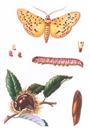
What are the control methods for the peach pyralid moth on Chinese chestnut?
How do you control the peach pyralid moth on Chinese chestnut? Please give guidance. The peach pyralid moth belongs to the order Lepidoptera, family Pyralidae. The larvae bore into and feed on the chestnut kernels, filling the seeds with frass and making them unfit to eat, and causing fruit drop, greatly affecting yield and quality. Its hosts also include peach, plum, and pear fruits, sunflower heads, corn stalks, and so on. Morphology...
-
What is the box tree pyralid, an insect found beside vegetable fields?
As spring warms and flowers bloom, insects begin to become active. During a recent science-and-technology outreach activity in the countryside, it was found that a pest called the box tree pyralid had begun to occur and cause damage on boxwood along the roadsides of the park. The box tree pyralid is one of the common pests on plants such as boxwood, small-leaved box, large-leaved box, littleleaf box, Chinese box, spoonleaf box, Korean box, and holly, and it occurs in Shanghai and other provinces and cities. In Shanghai it has 3 to 4 generations per year, with severe overlapping of generations. It usually becomes active in March in spring, begins pupating in mid-April, begins emerging in late April, and the first-generation lar
-
Control Recommendations for the Overwintering Generation of the Box Tree Pyralid Moth
The box tree pyralid moth (Glyphodes perspectalis) is one of the important leaf-eating pests of forestry plants in this district, mainly damaging Chinese box (Buxus sinica var. parvifolia) and Japanese box (Buxus bodinieri). Since early spring this year, the whole district has carried out 2-3 rounds of comprehensive control against this pest, effectively bringing the damage under control; however, since the damage period of this pest is long and can last until the end of October, continued follow-up monitoring of this pest is still needed. According to monitoring at two sites, the Anting Ginkgo Garden and the Fangtai Flowers and Plants Horticultural Farm, a moth peak appeared under the forecasting lamp in early to mid-September, with the highest moth numbers on September 7-9, averaging 22.3 moths per lamp per day
-
What are the control measures for the box tree pyralid (Diaphania perspectalis)?
Boxwood is a major evergreen ornamental plant in gardens. In recent years, careless introduction of plants has allowed the box tree pyralid (Diaphania perspectalis) to damage two small-leaved boxwood species, Buxus sinica and Buxus bodinieri, from south to north. From the larvae feeding on the leaf mesophyll to spinning silk to make nests and binding leaves together, it severely affects boxwood growth and can even kill the affected plants entirely. Morphological characteristics and occurrence pattern: The adult has a white-brown body and white, semi-transparent wings; the front edge of the forewings is brown, the medial cell has a fine white spot and a curved crescent-shaped white spot, and the outer margin of the hindwings has a brown band. The larval head is black-brown, the trunk is dark green,
条件筛选