-
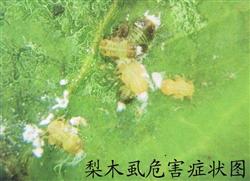
What are the control methods for the tobacco pear psyllid?
How to control the tobacco pear psyllid? The occurrence characteristics of the pear psyllid are many generations. The adult emergence period is long and generations overlap. Especially from late June to early July, the nymphs secrete a large amount of mucus, causing a large number of fallen leaves, which not only seriously affects tree vigor, but also reduces pear fruit quality, and it is difficult to control with general pesticides. Use tob...
-

Identification and Control Methods of the Chinese Parasol Tree Psyllid
Morphology: Adult body length 5.6 to 6.9 mm, yellow-green; head broad horizontally, vertex deeply cleft, frons exposed; compound eyes hemispherical and protruding, brown; antennae yellow; wings colorless and transparent, veins tea-yellow; claws black; dorsum of abdomen pale yellow, with a brown band along the anterior margin of each segment. Egg spindle-shaped, length 0.5 to 0.8 mm, slightly transparent, pale yellow or yellow-brown when newly laid, pale reddish-brown before hatching. Newly hatched nymph rectangular, tea-yellow tinged with green, wing pads slightly visible; mature nymph long oval, length 3.0 to 5.0 mm, darker in color, wing pads clearly visible.
-
What are the control methods for the Chinese parasol tree psyllid?
The Chinese parasol tree (Firmiana simplex) is one of the main urban landscaping tree species in northern China, with a tall, straight trunk, attractive leaf shape, and good shading effect. However, the Chinese parasol tree psyllid causes serious damage, greatly affecting its ornamental effect. After long-term observation, garden workers have gradually worked out the occurrence and development patterns of the Chinese parasol tree psyllid, carried out effective control, and accumulated certain experience, which is introduced below for reference. I. Damage characteristics and symptoms. The Chinese parasol tree psyllid, also known as the Chinese parasol tree split-head psyllid, belongs to the order Homoptera, family Psyllidae. It uses nymphs and adults to suck sap on Chinese parasol tree leaves or young twigs and tender trunks,
条件筛选