-

A Detailed Guide to the Latest Control Methods for Onion Thrips
Onion thrips, also known as tobacco thrips and cotton thrips, mainly damages onions, chives, garlic, cucumbers and solanaceous vegetables in vegetable fields, and is mainly distributed in Northeast China, Beijing, Hebei, Zhejiang, Jiangsu, Guizhou, Guangdong, Guangxi, Hainan, Taiwan, China, Shaanxi and Ningxia
-
Which pesticides are effective for controlling onion thrips?
Onion thrips belongs to the order Thysanoptera, family Thripidae. It mainly damages Allium vegetables such as onions and Chinese chives, and can also damage crops in the Solanaceae family, cucurbits, cotton, tobacco and others. Its host plants number more than 30 species across 18 families, and it is distributed throughout the country. So, what pesticide kills onion thrips? Part One
-
What damage does thrips pest infestation cause to Welsh onion? How to prevent and control it?
Thrips infestation can occur all year round, mainly occurring in open fields in the three seasons of spring, summer and autumn, and occurring more severely in greenhouses in winter. If Welsh onion is attacked by thrips infestation, the impact on the yield and quality of Welsh onion is very great. Let's learn about it together below
-
How to control onion thrips? Mastering these methods is key
Onion thrips occurs throughout the country and is a pest with a wide range of host plants. To control onion thrips, first clean up the dead branches and fallen leaves thoroughly to eliminate the source of the pests. Second, water frequently to kill the nymphs and pupae in the soil. Third, once thrips appear in the field, carry out chemical spraying for control; omethoate, phoxim, fenvalerate and the like can be used. Spraying should be done in the early morning while the dew has not yet dried, to prevent the adult insects from escaping.
-
A Complete Guide to Onion Thrips Damage and Control Methods
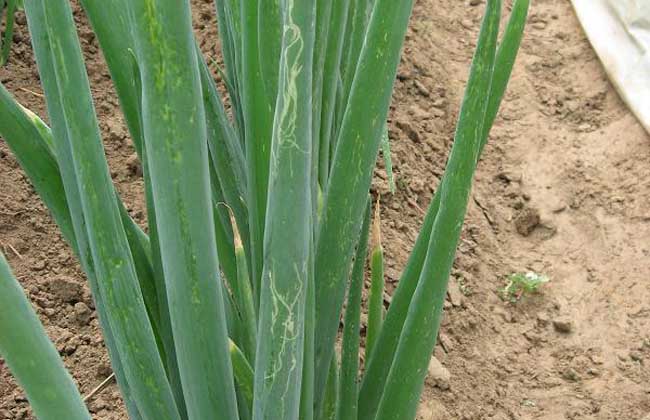
I. Distribution and Damage. Onion thrips, also known as tobacco thrips, cotton thrips, etc., belongs to the order Thysanoptera, family Thripidae. It mainly damages onions, scallions, garlic, Chinese chives, cucurbits, eggplant, Chinese cabbage, potatoes, and so on. Both adults and nymphs use their piercing-sucking mouthparts to suck the sap from tender tips and heart leaves of plants. Damaged scallions develop many fine, elongated grayish-white spots, the leaf tips turn yellow and dry up, and in severe cases the leaves become twisted and withered. II. Morphological Characteristics. Adult. Body length 1-1.3 mm, light yellow to dark brown, etc. Wings slender and transparent,
-
Onion thrips
Damage characteristics: It mainly damages Allium cepa (onion), Welsh onion, water onion, scallion, garlic chives, garlic and other Liliaceae vegetables, as well as tobacco, cotton, etc. Adults and nymphs use their piercing-sucking mouthparts to damage the heart leaves and tender buds of host plants, causing many long yellow-white or gray-white streaks to form on the host leaves, and the leaves become twisted and deformed. Morphological characteristics: Adults are 1.2-1.4 mm long, light yellowish-brown, with yellow-white wings. Life habits: Onion thrips occurs 6-10 generations a year in North China, with the most severe damage in April-May. Adults are very active and can spread with the wind, feeding in the morning and evening or on cloudy days.
-
How to control onion thrips? Practical methods explained in one article
Damage characteristics: It mainly damages Allium vegetables such as Welsh onion, onion, water onion, scallion, Chinese chives, and garlic, as well as tobacco, cotton, and others. Adults and nymphs use their rasping-sucking mouthparts to damage the heart leaves and tender buds of host plants, causing the host leaves to form many long yellow-white or gray-white streaks, and the leaves become twisted and deformed. Morphological characteristics: Adults are 1.2-1.4 mm long, light yellowish brown, with yellow-white wings. Life habits: Onion thrips occurs 6-10 generations per year in North China, with the most severe damage from April to May. Adults are very active and can spread by wind, and feed strongly in the morning and evening or on cloudy days.
-
条件筛选