-

Potato Intercropping Cultivation Models and Key Technical Points
To improve land utilization and increase farmers' income, several intercropping and relay-cropping models with potato as the main crop are introduced here, for the reference of farmer friends and grassroots leaders in adjusting the agricultural structure. 1. Potato-cotton. Potatoes are sprouted in late January and sown in mid-to-late February, using plastic film mulch cultivation. The varieties selected are virus-free potatoes Zheng Yin No. 5 and Zheng Yin No. 7, bred by the Zhengzhou Fruit Research Institute of the Chinese Academy of Agricultural Sciences; for cotton, the large-plant, disease-resistant Biao Za A1 is preferable. Potatoes are planted in double rows on high ridges, with wide rows of 8
-
Several High-Yield Potato Cultivation Models Introduced
In recent years, the Potato Association of Ziyang District, Yiyang City has actively explored high-yield potato cultivation models and carried out contiguous demonstration planting in Xiangpulun Township, Yingfengqiao Town, Changchun Town and other places, forming a complete high-yield cultivation technology system. Spring potato - double-cropping rice cultivation. For spring potato, early-maturing varieties such as "Dongnong 303" are selected, sown from mid-to-late December to early January of the following year, and harvested from late April to early May. For early rice, late-maturing varieties are selected, using sparse sowing for strong seedlings or two-stage seedling raising, and after the potato harvest in early May,
-
Technical Key Points of Lotus Root Field Rotation and Crop Succession Cultivation Models
Lotus root is an important aquatic vegetable in China and also an important export-oriented vegetable for earning foreign exchange. It is widely cultivated in areas south of the Huang-Huai region, especially in the Yangtze River Basin and areas further south. It not only plays an important role in increasing farmers' income and improving agricultural efficiency, but also has important value in improving and beautifying the environment, and in wetland protection and utilization. Centering on lotus root and carrying out good rotation and crop succession is important for fully improving land utilization rate and economic benefits per unit area, reducing disease and pest damage, reducing pesticide use, improving soil and enhancing soil fertility.
-
Research and Analysis of High-Efficiency Lotus Root Cultivation Models: A Case Study of Lotus Fields in Caidian District
Lotus root is one of the pillar agricultural industries of Caidian District, Wuhan City. In 2006, the planting area was 10,000 hectares, the total output was 200,000 t, and the total output value was 320 million yuan, accounting for 18.2% of the district's total agricultural output value. In order to improve the economic benefits of lotus fields, Caidian District promoted several high-efficiency lotus field cultivation models and achieved good results. In 2006, the promoted area of the models in the district reached 7,730 hectares, accounting for 77.3% of the district's lotus root planting area. The main models promoted and applied in recent years are introduced below.
-
Detailed Explanation of Lotus Root Field Rotation and Crop Succession Cultivation Models
Lotus root is an important aquatic vegetable in China and also an important export-oriented cash vegetable. It is widely cultivated in areas south of the Huang-Huai region, especially in the Yangtze River Basin and areas further south. It not only plays an important role in increasing farmers' income and improving agricultural efficiency, but also has important value in improving and beautifying the environment, and in wetland protection and utilization. Centering on lotus root and implementing good rotation and crop succession is important for fully improving land utilization rate and economic benefits per unit area, reducing pest and disease damage, reducing pesticide use, improving soil, and enhancing soil fertility.
-
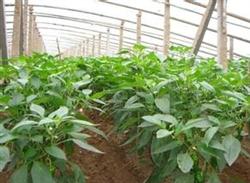
Four cultivation models based mainly on spring radish and chili pepper
Winter-spring chili pepper is currently the most important production season for chili pepper cultivation in solar greenhouses. Generally planted in mid-November, it can be harvested and marketed in early January of the following year, continuing until the next summer. The main cultivation techniques are explained as follows: 1. Build a greenhouse. For new energy-saving solar greenhouses, the structure and environment of the original solar greenhouse...
条件筛选