-

Research and Analysis of High-Efficiency Lotus Root Cultivation Models: A Case Study of Lotus Fields in Caidian District
Lotus root is one of the pillar agricultural industries of Caidian District, Wuhan City. In 2006, the planting area was 10,000 hectares, the total output was 200,000 t, and the total output value was 320 million yuan, accounting for 18.2% of the district's total agricultural output value. In order to improve the economic benefits of lotus fields, Caidian District promoted several high-efficiency lotus field cultivation models and achieved good results. In 2006, the promoted area of the models in the district reached 7,730 hectares, accounting for 77.3% of the district's lotus root planting area. The main models promoted and applied in recent years are introduced below.
-
Detailed Explanation of Lotus Root Field Rotation and Crop Succession Cultivation Models
Lotus root is an important aquatic vegetable in China and also an important export-oriented cash vegetable. It is widely cultivated in areas south of the Huang-Huai region, especially in the Yangtze River Basin and areas further south. It not only plays an important role in increasing farmers' income and improving agricultural efficiency, but also has important value in improving and beautifying the environment, and in wetland protection and utilization. Centering on lotus root and implementing good rotation and crop succession is important for fully improving land utilization rate and economic benefits per unit area, reducing pest and disease damage, reducing pesticide use, improving soil, and enhancing soil fertility.
-
Detailed Explanation of the Five Major Characteristics of the Rice-Rapeseed Combined Planting Model
Rapeseed is an important oil crop in the Yangtze River Basin. Traditional rapeseed cultivation involves raising seedlings and transplanting them. Because raising seedlings and transplanting rapeseed in paddy fields requires large inputs of labor and materials, with low yields and low returns, and crops are easily lost when unsuitable weather occurs, this affects farmers' enthusiasm for planting rapeseed. Changing traditional seedling transplanting to no-till broadcast direct seeding with rice straw mulching simplifies the production process and achieves the goal of cost saving and efficiency improvement. Compared with traditional seedling transplanting, the rice-rapeseed combined model has the following characteristics: First, no-till broadcast direct-seeded rapeseed, per
-
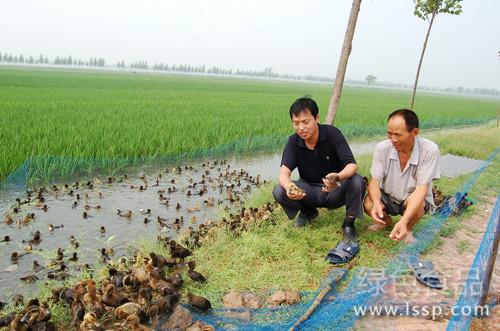
Rice Harvest and Fat Ducks: Key Technical Points of the Rice-Duck Symbiosis Model
Rice Harvest and Fat Ducks: Key Technical Points of the Rice-Duck Symbiosis Model
-
Detailed Explanation of the No-Till Intercropping Model for Shallow-Water Lotus Root
Traditional one-crop-per-year cultivation of shallow-water lotus root fields has limited the improvement of economic returns because of the low utilization rates of land, temperature and light resources. In recent years, Suining County, Hunan Province, has vigorously promoted no-till three-dimensional planting models for shallow-water lotus root; generally each technique can increase returns by 300 yuan per mu, and the highest can reach 1,600 yuan. The 6 three-dimensional planting models are introduced below. Shallow-water lotus root - pak choi: after the shallow-water lotus root field has been drained for 3-5 days, evenly broadcast 0.5-0.6 kg per mu of cabbage seeds such as Siyue Man and Zao Shu No. 5; at the 3-leaf stage of the pak choi
-
Wheat-cotton-mung bean three-crop-per-year, three-harvest planting model
For the cotton variety, select a marker hybrid insect-resistant cotton with a loose plant type, chicken-claw-shaped leaves, good ventilation and light penetration, and strong boll-setting ability. For the wheat variety, select the high-yield, disease-resistant variety Han 4564. For the mung bean variety, select Zhonglu 1. Choose a plot with good water and fertility conditions for the planting pattern, harvest the autumn crops in time to clear the stubble, and sow while there is soil moisture; if there is no moisture, irrigate the land to create moisture. Apply more than 4 cubic meters of high-quality farmyard manure, 25 kg of diammonium phosphate, 20 kg of potash fertilizer, and 15 kg of urea per mu. Plow deeply to 25 cm and harrow 3-4 times. Make beds 200 cm wide, with a bed ridge width of 60 cm and a bed surface width of 1
-
Moderate to slightly light occurrence of the second generation of rice stem borers in Suijiang County in 2007
Rice stem borers in our county include the yellow stem borer (Scirpophaga incertulas), the striped stem borer (Chilo suppressalis), and the giant stem borer (Sesamia inferens). In the riverside area, 3 generations occur per year; in the mid-mountain area, 2 generations occur per year. At present, the first generation in the riverside area has ended, and the second generation is beginning to occur successively. According to observations at our station's Fengchi pest and disease monitoring point, this year's second-generation moth flight began on June 10, 1 day earlier than last year and 2 days later than normal years, with the peak day on June 18, 1 day later than last year and 8 days earlier than the historical average; by June 25, a cumulative total of 234 moths had been trapped, with the yellow stem borer, striped stem borer, and giant stem borer accounting for 94.9
-
What are some modern agricultural technologies? These three treasures are products of technological development
The Taiwan Agricultural Research Institute's fruit and vegetable cultivation greenhouse uses a double-net and insect-proof walkway design to reduce pest problems inside the greenhouse, and by adjusting crop cultivation row and plant spacing to reserve space for small agricultural machinery to move through, the number of plants cultivated per unit area not only does not decrease, but can also be coordinated with agricultural machinery for
-
How to grow potted lavender and what to watch out for: water in moderation
Lavender is now widely grown by people. Lavender can be grown not only in fields but also in pots at home. Lavender has a very wide range of uses and is deeply loved by people. So how do you grow potted lavender? Lavender's growing method is different from other flowers.
-
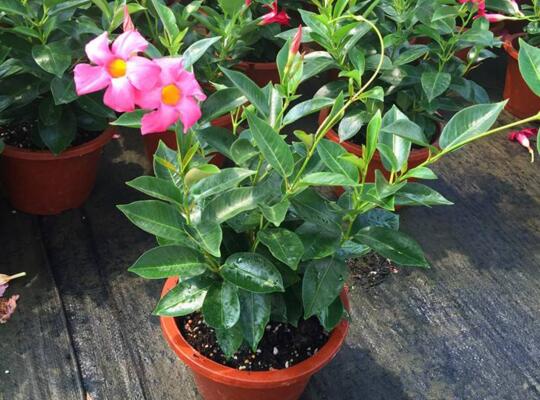
How to grow potted Mandevilla? Growing methods and precautions, temperature should be moderate
Mandevilla, native to tropical America, is loved by many people in China for its fragrant blooms and brilliant flower colors. However, compared with other plants, Mandevilla is not an easy plant to grow well
条件筛选