-
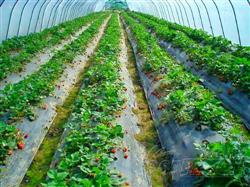
Detailed Explanation of Pollution-Free Cultivation Techniques for Strawberries in Plastic Greenhouses
(1) Variety selection: Choose varieties with early flower bud differentiation, shallow dormancy, and good cold resistance in low-temperature seasons, such as Chunxiang, Fengxiang, Lihong, Mingbao, Jingbao, Nyoho, and Hokowase. (2) Cultivating strong seedlings: 1. Carefully select mother plants. In March-April of the current year, select plants from the strawberry production greenhouse with vigorous growth, good inflorescence fruiting, few deformed fruits, well-developed root systems, and no pests or diseases as mother plants. Plant them in a dedicated seedling nursery to cultivate and propagate runner seedlings. Apply 2000-3000 kg of organic fertilizer and 10 kg of compound fertilizer per mu in the nursery. Make beds 2 m wide, with a planting row spacing of 1 m and a plant spacing of 0.3-0.4 m. After they establish, apply nitrogen fertilizer as early as possible, keep the soil moist, and remove all inflorescences that appear to promote runner growth.
-

Detailed Explanation of Key Cultivation Techniques for Kate Apricot in Simple Plastic Greenhouses
The protected cultivation of Kate apricot in simple plastic greenhouses reaches maturity 30 to 40 days earlier than open-field cultivation, and economic benefits increase by 15 to 20 times. 1. Structure of the simple plastic greenhouse. The greenhouse built is a north-south arched greenhouse, with a span of 10 m, a length of 60 m, a ridge height of 2.5 m, and a shoulder height of 1.5 m. Reinforced concrete columns are used as uprights, and bamboo poles are used for the arches and suspension beams. There are 5 rows of uprights in total, with 2.5 m between the main upright rows. The spacing between uprights in the edge rows is 1 m, and the spacing between uprights in the middle 3 rows is 3 m. Above the middle 3 rows of uprights, a suspension beam is installed separately
-
Detailed explanation of plastic greenhouse cultivation techniques for large-fruited sweet carambola
Large-fruited sweet carambola is a tropical and subtropical evergreen fruit tree that grows fast, bears fruit early, flowers and fruits multiple times a year, and produces excellent fruit that is crisp and juicy, making it deeply loved by people. However, for a long time, carambola cultivation has been managed extensively, with low per-unit yield, poor quality, and relatively weak market competitiveness and economic benefits. Therefore, in April 2001, our institute began cultivating large-fruited sweet carambola in plastic greenhouses, with an area of 0.43 hm2. Fruit was set in the same year of planting. The yield per hectare was 5700 kg in the first year, 27000 kg in the second year, and 6
-
Summary of Experimental Trials on Delayed Cultivation Techniques for Hongxue Peach in Plastic Greenhouses
Hongxue peach is an extremely late-maturing peach variety. When cultivated in the open field in our county, the fruit is difficult to ripen due to late-autumn rainfall and frost. Therefore, starting in 2001, we conducted delayed cultivation trials in plastic greenhouses using technical measures such as early promotion followed by later control, delayed flowering, bagging to protect against rain, and covering the greenhouse to regulate temperature, prevent frost, and protect leaves. The results showed that facility-grown Hongxue peach bore fruit in the second year after planting, entered full production in the third year, could delay fruit ripening by about 20 days, and markedly improved fruit maturity and the rate of high-quality fruit.
条件筛选