-

Orchid Knowledge Introduction: A Comprehensive Guide to Orchids
Roots: The roots of terrestrial orchids form a clustered fibrous root system, fleshy, occasionally producing segmented branch roots from the fibers, and orchid roots generally have no root hairs. Generally, the roots of Cymbidium goeringii (Spring Orchid) are relatively thin, about 0.4 cm in diameter; those of Cymbidium faberi (Faber's Cymbidium) about 0.5 cm; while those of Cymbidium ensifolium (Four-season Orchid), Cymbidium qiubeiense (Autumn Orchid), Cymbidium kanran (Cold Orchid), and Cymbidium sinense (Chinese Cymbidium) are slightly thicker and longer than the above. Orchid roots store abundant water and nutrients. According to root structure...
-
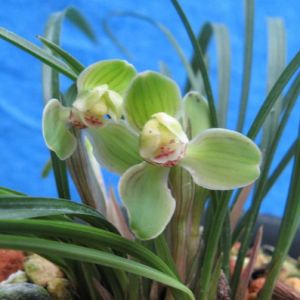
Before introducing orchids, you need to learn the relevant knowledge first
In 2003, Zhoushan orchid enthusiast Shi Zengkang collected a new plum-petal variety himself, Qiandao Longmei (Thousand Island Dragon Plum). When it was first brought down from the mountain, there were two flowers, one dragon and one phoenix, and the dragon plum was the better one, but for various reasons this flower has always been few in number and has rarely appeared. This variety is a small-plant, small-flower type, and the plant and flower are very compact and lovely.
-
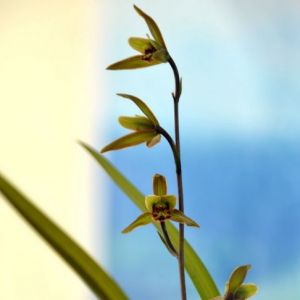
Growing and care knowledge for three flowers: lily, narcissus, and cold orchid
In 2000, selected and bred by orchid enthusiasts in Lipu County, Guangxi from wild-collected plants, large roots and fine leaves. Cultivated by Brother Wei, an orchid enthusiast from Lipu. To date, thirteen plants large and small. The flower resembles lily petals. Short rounded tongue, cat-ear-shaped sepals. The red marking on the tongue is even more prominent, a rare good flower. As everyone knows, things are beautiful because they are rare, and only then do they have collectible value. I am very optimistic about the flower form. The only shortcoming is the speckled color, the color transition is not fully achieved, and yet...
-
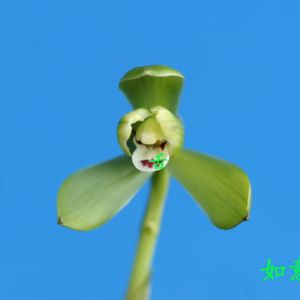
Detailed Explanation of the Basic Theoretical Knowledge of Chinese Orchid Tongue Shapes
Chinese orchids have the following several common tongue shapes: 1. Liuhai tongue (bang fringe tongue): the drooping part of the tongue blade closely resembles the front bang in a woman's hairstyle. This type of tongue is mostly paired with plum-form narcissus floral art. 2. Large round tongue: the tongue is short, round, broad and large, and the width of the tongue petal is equal to or greater than the diameter of the central palace. The large round tongue is generally paired with lotus-petal floral art. 3. Ruyi tongue: there are large and small Ruyi tongues....
-
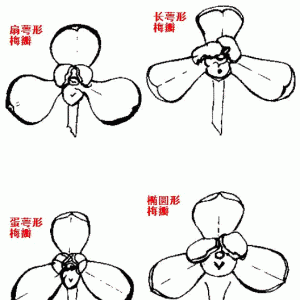
Detailed Explanation of Orchid Petal Shape Characteristics and Appreciation Knowledge
Petal shape refers to the shape of the petals. Orchids generally have five major petal shapes: plum petal, lotus petal, narcissus petal, plain-heart petal, and strange petal. 1. Plum petal: The sepals are short and round, shaped like plum blossom petals, the column petals form a hood, and the lip petal is flat and straight, hard and not curling backward. Song Mei is the most typical representative variety, and there are about 50 commonly seen varieties. 2. Lotus petal: The sepals are thick and broad...
-

Basic Knowledge of Growing Phalaenopsis in Sphagnum Moss
In growing Phalaenopsis, sphagnum moss serves only to anchor the plant and retain moisture. When growing Phalaenopsis in sphagnum moss, opinions differ on whether the moss in the pot should be loose or firm. If the moss is loose, the water content in the pot is higher, and the moss is more prone to rot and souring. If the moss is firm, the water content in the pot is lower, ...
-
-
-
-
条件筛选