-
-

Feeding peanut kernels to female rabbits can increase milk production
Feeding peanut kernels to female rabbits can increase milk production
-
Introduction to the Longwangmao Cultivar, a First-Grade Elite Kernel Apricot Variety
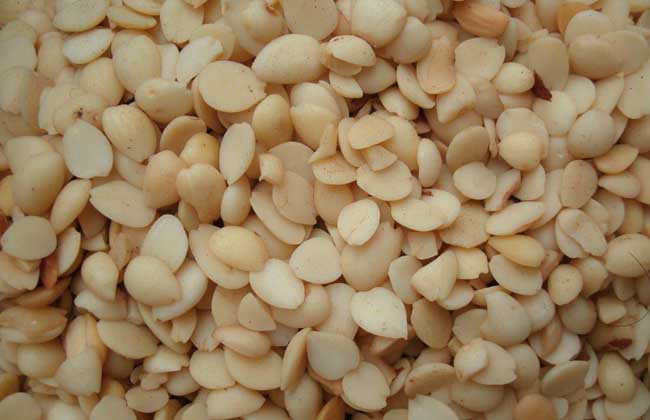
Longwangmao is currently the only first-grade cultivar among the main kernel apricot varieties grown commercially in China, and is known internationally as "Dragon Emperor Large Almond." The fruit is oblate, with an average single-fruit weight of 18 g and a maximum of 24 g; the skin is orange-yellow and the flesh is thin; the stone is free. The pit yield is 17.5%, and the dry pit weight is 2.3 g. The kernel yield is 37.6%, and the average dry kernel weight is 0.8-0.84 g. The kernels are flat and plump, conical with a flat base; the kernel skin is brownish-yellow, and the kernel flesh is milky white, aromatic and crisp, with a slight bitterness. 5-
-
Comprehensive Analysis of Key Technical Points for Establishing an Apricot Orchard for Kernel Production
Apricot trees are fruit trees that love sunlight, tolerate drought, and fear waterlogging and frost. Therefore, the orchard should be established in a sunny and high, dry location, and must not be established on shady slopes, waterlogged lowlands, or valley bottoms where cold air easily settles. Apricot trees are long-lived fruit trees; generally, even 100- to 200-year-old trees still bear abundantly, so the planned spacing between plants and rows should be relatively large. However, considering the need for early high yields, temporary trees can be set up at the time of orchard establishment, and gradually thinned out or transplanted as the trees age. The spacing for permanent rows can be designed at 4 m x 6 m, and for temporarily densified orchards at 2 m x 3 m, with temporary trees dealt with promptly by around 10 years of age. When planning, soil and fertilizer-water conditions must also be considered.
-
Detailed Explanation of High-Yield and High-Quality Cultivation Techniques for Kernel Apricots
I. Orchard Site Selection. Kernel apricot trees can grow and bear fruit in areas with an altitude of 100-1800 m, a frost-free period of 100-220 days, an extreme minimum temperature below -34.7°C, an extreme maximum temperature above 43.3°C, and annual rainfall ≥35 mm (referring to conditions without irrigation). However, because apricot trees bloom early, planting is generally not suitable in areas where frost damage occurs frequently and severely during the flowering period. The orchard site should be selected in areas with no pollution of soil, air, or water. It requires a soil layer thickness of more than 50 cm, soil organic matter content
-
What issues should be noted in the efficient cultivation of kernel apricots?
Kernel apricot is one of the main dried fruits in northern China, with excellent economic returns. In recent years, due to the development of almonds, the comparative benefit of kernel apricots has somewhat declined. To improve the production efficiency of kernel apricots, comprehensive measures should be adopted. 1) Develop in suitable sites. Kernel apricots are drought-tolerant, tolerant of poor soil, and widely adaptable, but for efficient production, orchards must be established in locations with deep soil layers, fertile soil, and sheltered, south-facing slopes. Because kernel apricots bloom early and are susceptible to late frost damage, avoid establishing orchards on mountain ridges, wind gaps, and low-lying areas. 2) Pay attention to configuring pollinizer trees.
-
Detailed Explanation of Key Technical Points for Kernel Apricot Cultivation and Management
I. Technical Introduction 1. Variety selection: Main cultivars: Longwangmao, Yiwolfeng, Baiyubian, Chaoren, Fenghong, Youren, Yuanren, etc. Baiyubian is an excellent pollinator variety for kernel apricots, with relatively strong cold resistance; Yiwolfeng is extremely high-yielding; the other three varieties are resistant to frost and tolerant of low temperatures. 2. Seedling raising: Kernel apricot seedlings can be divided into two stages: rootstock seedling cultivation and grafted seedling cultivation. (1) Rootstock seedling cultivation. Select fields with sufficient sunlight, loose soil, and irrigation conditions as the seedling-raising site, and prepare the land and apply fertilizer in a timely manner. (2) Grafting. Kernel apricot seedling grafting is divided into bud
-
Do not use cottonseed hulls with a high content of cottonseed kernels directly for cultivating oyster mushrooms
Cottonseed hulls consist of the hulls left after the kernels are removed from cottonseed, the short cotton lint attached to the hulls, and a small amount of broken cottonseed kernels. Cottonseed hulls are rich in nitrogen, phosphorus, potassium, cellulose and lignin, with a carbon-to-nitrogen ratio of 79-85:1, are slightly alkaline, loose outside and dense inside, have good air permeability and strong water retention, and are a top-grade material for edible mushroom cultivation. However, cottonseed hulls contain toxic substances, and after sterilization under high pressure or normal pressure they release aldehydes, ketones and acids, and these toxic substances inhibit mycelial growth, delay pinning, and cause undesirable outcomes such as small mushrooms and poor mushroom quality.
-
Apricot kernel cultivar Weixuan No. 1 is suitable for cultivation in cold regions
Weixuan No. 1 apricot kernel was bred by the Forestry Bureau of Weichang County and approved by the Hebei Provincial Forest Tree Improved Variety Approval Committee in 2007. 1. Cultivar characteristics. The tree has a relatively strong central leader, an open tree posture, and a natural round-headed tree shape. The branches have strong sprouting ability, and fruiting is mainly on short fruit spurs, though axillary flower buds can also bear fruit. Generally, it flowers and bears fruit 3 years after planting; a 5-year-old tree produces 25 kg of fruit per tree and 7.5 kg of kernels per tree, and enters full bearing period at 7-8 years. The fruit averages 13.6 g in weight (when the skin is green), is broadly ovate, with a greenish-yellow ground color and red on the sunny side.
-
Gansu Tianshui kernel-apricot cultivation technology passes appraisal
Recently, the project "Development of Wasteland Resources in Tianshui City -- Demonstration of High-Yield Cultivation Technology for 100,000 mu of Kernel Apricot," jointly undertaken and implemented by the Tianshui Municipal Fruit Tree Research Institute and the horticulture departments of various counties and districts, passed the achievement appraisal of the Provincial Science and Technology Department. Experts believe that the project uses "four types of wasteland" for kernel-apricot base construction, which not only saves cultivated land but also plays an important role in reducing soil erosion and windbreak and sand fixation, and its results have reached the advanced level of similar projects in China. Up to now, the city has built 20 mu of improved-variety kernel-apricot scion orchards, established 647 mu of improved-variety seedling bases, propagated 8.31 million improved-variety seedlings, and reached 116,700 mu of production bases, with an annual output of 682,300 kg and an output value of 27.292 million yuan.
条件筛选