-

Gansu Tianshui kernel-apricot cultivation technology passes appraisal
Recently, the project "Development of Wasteland Resources in Tianshui City -- Demonstration of High-Yield Cultivation Technology for 100,000 mu of Kernel Apricot," jointly undertaken and implemented by the Tianshui Municipal Fruit Tree Research Institute and the horticulture departments of various counties and districts, passed the achievement appraisal of the Provincial Science and Technology Department. Experts believe that the project uses "four types of wasteland" for kernel-apricot base construction, which not only saves cultivated land but also plays an important role in reducing soil erosion and windbreak and sand fixation, and its results have reached the advanced level of similar projects in China. Up to now, the city has built 20 mu of improved-variety kernel-apricot scion orchards, established 647 mu of improved-variety seedling bases, propagated 8.31 million improved-variety seedlings, and reached 116,700 mu of production bases, with an annual output of 682,300 kg and an output value of 27.292 million yuan.
-
A Complete Guide to the Key Technical Points for Establishing an Apricot Orchard for Kernel Production
Apricot trees are fruit trees that love sunlight, tolerate drought, and fear waterlogging and frost, so an orchard should be established on a sunny, high, and dry site; it must not be established on shady slopes, waterlogged lowlands, or valley bottoms where cold air easily settles. Apricot trees are long-lived fruit trees; generally even 100- to 200-year-old trees still bear heavily, so the planned row and plant spacing should be somewhat large. However, to meet the need for early high yields, temporary trees can be set up when the orchard is established, and gradually thinned out or transplanted as the trees age. The row and plant spacing for the permanent rows can be designed at 4 m x 6 m, and for temporarily densified orchards at 2 m x 3 m; by around 10 years of age the temporary trees should be dealt with in time.
-
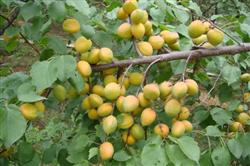
A Detailed Explanation of the Growth and Fruiting Habits of Kernel Apricot and the Key Points of Pruning Techniques
I. Growth and fruiting habits of kernel apricot: 1. Weak branching ability: After planting, kernel apricot produces a few long branches, and once these long branches enter the fruiting stage, they rarely branch, often showing insufficient branch quantity under natural growth. 2. High germination rate: Whether the long branches of kernel apricot are left unpruned or cut back, the vast majority of buds can germinate, ...
条件筛选