-

Key Points for Integrated Control of Powdery Mildew on Schisandra chinensis
1. Field symptoms Powdery mildew mainly damages the leaves of Schisandra chinensis, and in severe cases the fruit, petioles and stems are also affected. In the early stage of leaf infection, small white powdery mildew spots appear, gradually expanding and merging into patches, and the mildew layer thickens, like a layer of flour scattered on the leaf surface. On the underside of the mildew spots, small chlorotic spots initially form, expanding into irregular patches as the disease develops. In the late stage of the disease, black particles are produced in the mildew layer, causing moldy staining and fruit drop, reducing yield while also lowering quality. 2. Disease occurrence The powdery mildew pathogen of Schisandra chinensis belongs to the genus Erysiphe in the Ascomycota, and the conidia are mostly cylindrical, with a few being cylindrical-columnar, elliptical or long-oval. In the Fengcheng area, the pathogen overwinters as cleistothecia on diseased plant residues, and in May to June of the second year produces ascospores and conidia for infection, with July to August being the peak period of disease occurrence. The disease can occur at temperatures of 20-28°C, with 25-26°C being the most suitable. The disease is severe in mountainous areas above 1000 m in altitude; it is severe where management is poor, nitrogen fertilizer is applied excessively, and planting is too dense; 1-2 year old Schisandra chinensis plants are lightly affected, while those over 3 years old are severely affected.
-
Occurrence Patterns and Integrated Control Methods of Pests and Diseases in Goji Berry
Goji berry is a deciduous shrub of the genus Lycium in the Solanaceae family. Its fruit is called goji berry (Lycii Fructus), and its root bark is called Digupi (Lycii Cortex); both can be used as medicine. The tender stems and leaves are eaten as vegetables. It is distributed throughout China, mostly in the wild. The related species Lycium barbarum (Ningxia goji) is mostly cultivated; its fruit is called Xi goji or Gan goji and is used medicinally, mainly produced in Ningxia, Gansu and Inner Mongolia. Goji berry suffers from pests and diseases at every stage of growth, causing great economic losses to production. The occurrence and control methods of goji berry pests and diseases are introduced as follows: 1 Diseases 1.1 Black fruit disease (anthracnose) Main
-
Occurrence and Integrated Control Methods of Gummosis in Goji Berry
Brown lesions appeared on the branches and trunks after 15 d, along with a grayish-white mold layer, while no disease developed from the other inoculated fungi. This result is consistent with the findings of the Ningxia Academy of Agricultural Sciences. Based on the field symptom characteristics and isolation results, it is considered that Clonostachys is the pathogenic fungus causing gummosis, while Alternaria and Fusarium are saprophytic fungi of secondary infection. 3 Disease occurrence patterns 3.1 Overwintering of the pathogen and transmission routes In November, diseased goji branches and trunks with lesions were placed on the field surface and in soil at 20 m-30 cm underground respectively, then retrieved in April of the following year for isolation and culture.
-
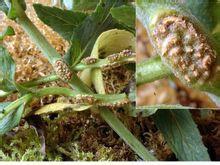
What to Do When Mint Gets Rust Disease? A Detailed Guide to Integrated Control Techniques
Mint is a medicinal plant renowned both in China and abroad, with the whole herb used as medicine. It is produced in Jiangsu. In recent years, with the adjustment of the rural planting structure and market demand, the planting area of mint in various parts of Jiangsu has expanded somewhat, but during its growth and development, it often suffers severe damage from rust disease, which not only causes serious yield reduction but also affects...
条件筛选