-

Methods and Technical Key Points for Imitation Wild Soft-shelled Turtle Farming
When it comes to the soft-shelled turtle, perhaps many people are quite familiar with it. Its appearance looks very similar to that of a tortoise, but there are still differences between them. As people's living standards continue to rise, the soft-shelled turtle has made its way into ordinary households by the thousands, so the soft-shelled turtle
-
Sharing Experience on Imitation Wild Field Cultivation of Bamboo Fungus
Bamboo fungus (Phallus indusiatus) is a traditional specialty of our country, with crisp and tender flesh, excellent taste, rich nutrition, and health-promoting effects. In the past, bamboo fungus cultivation used bamboo and wood as the culture substrate, with a long cycle and low yield. In recent years, through continuous domestication and breeding of strains, new strains of grass-growing bamboo fungus suitable for growing on wild grass
-
-
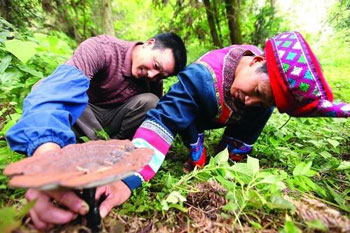
Understory imitation-wild Ganoderma cultivation fulfills the dream of escaping poverty
Understory imitation-wild Ganoderma, the immortal herb, fulfills the dream of escaping poverty
-
Detailed Explanation of Key Techniques for Imitation Wild Cultivation of Gastrodia elata
Imitation wild cultivation of Gastrodia elata means imitating the wild growing environment of Gastrodia elata for artificial cultivation, which both maintains the quality of wild Gastrodia elata and increases yield. The specific methods are as follows. 1. Selection of seed tubers: Use collected wild Gastrodia elata tubers as seed tubers, or use seedling tubers bred through sexual propagation techniques for crossbreeding as seed tubers. The seed tubers are required to be yellow in appearance, free of scars, free of black spots, conical in shape, and uniform in size. Degenerated Gastrodia elata that has been planted for many years cannot be used as seed tubers. 2. Selection and cultivation of fungal wood: The fungal wood should be selected with appropriate
-
Key Technical Points for Imitation-Wild High-Quality Cultivation of Oyster Mushrooms in Winter and Early Spring
Oyster mushrooms produced using imitation-wild cultivation techniques not only taste as fresh and delicious as wild ones, but also truly achieve ecological, high-quality, and high-yield production. Even in the cold winter and low-temperature early spring seasons, high-quality oyster mushrooms that are thick, fleshy, fresh, and tender can be produced in a relatively enclosed shade shed by making full use of ground temperature. This method increases yield by more than 60% compared with conventional cultivation methods, and by more than 40% compared with cultivation methods such as mushroom walls, with a biological conversion rate of more than 220%. 1. Mycelium culture. Use high-pressure or atmospheric-pressure sterilization, inoculate conventionally, and culture until physiologically mature mycelium is obtained.
-
Key Technical Points for Imitation-Wild Ganoderma lucidum Mushroom Bag Cultivation
The mushroom bag preparation and mycelial incubation for imitation-wild cultivation of Ganoderma lucidum are basically the same as conventional methods. The key point is to carry out the fruiting body management under suitable outdoor conditions, so as to simulate as closely as possible the environmental conditions for the growth and development of wild Ganoderma lucidum and produce higher-quality Ganoderma lucidum. The fruiting method for imitation-wild cultivation can adopt either the mushroom wall style or the raised bed style. Mushroom wall imitation-wild cultivation can be carried out in plastic greenhouses. The plastic greenhouse can be built in woodland that is sheltered from the wind, faces the sun, has good ventilation and suitable shade density, or climbing plants such as chayote and loofah can be planted around the greenhouse, with
-
Detailed Explanation of the Imitation Crab Meat Processing Technology
Imitation crab meat is a convenience food made primarily from Alaska pollock (walleye pollock) with the taste of fresh sea crab. At present, the technology and equipment for imitation crab meat in Shandong Province were introduced from Japan. As an aquatic convenience food, imitation crab meat has broad prospects for development. At present, the product is mainly exported to Japan and the United States. 1. Process flow: frozen surimi -> thawing -> ingredient mixing -> chopping and grinding -> steaming and roasting -> strip rolling and shaping -> sterilization -> cooling -> vacuum packaging -> rapid low-temperature freezing -> boxing -> cold storage 2. Process operation procedures:
-

Chinese Paladin 3 blows up Douyin: This young woman's imitation of Long Kui rivals Liu Shishi's, each with her own strengths
"Chinese Paladin 3" blows up Douyin, a young woman goes viral for imitating Long Kui, each with her own strengths compared to Liu Shishi! "Chinese Paladin 3" is the TV drama this editor loves watching the most, it feels like no matter how many times I watch it, I never get tired of it! In this drama, it's not just the main characters' performances that leave a deep impression, even the supporting roles left a deep impression on many people. Among the female characters, my favorite is Long Kui, this "little pitiful Kui" character never gets old no matter how many times I watch!
-

Detailed Explanation of Key Points in Imitation Wild Soft-shelled Turtle Farming Techniques
Imitation Wild Soft-shelled Turtle Farming Techniques
条件筛选