Understory imitation-wild Ganoderma cultivation fulfills the dream of escaping poverty
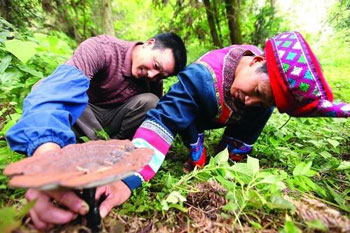
With baskets on their backs, Qin Dehong and the villagers head into the mountains to search for and pick mature Ganoderma.
Qin Dehong shows the wild Ganoderma he harvested to the camera.
Mature imitation-wild Ganoderma is covered with spore powder.
In the 1990s, the TV drama "The Legend of New Madame White Snake" became a hit across the country. In this newly adapted mythological legend, many scenes from the original work were retained. For example, the story of Madame White Snake venturing alone into the Kunlun Mountains to steal the immortal herb to save Xu Xian. The magical immortal herb in this story is Ganoderma.
Since ancient times, Ganoderma has been regarded as a symbol of good fortune, wealth, beauty and longevity. In many folk works, it is also depicted as the "golden key" to bringing the dead back to life and achieving immortality. Wild Ganoderma is hard to find, and the quality of cultivated Ganoderma varies greatly. How can this market full of potential be opened up?
In Dajing Yao Ethnic Township, Lingchuan County, villagers have embarked on the "broad road" to prosperity through understory imitation-wild Ganoderma cultivation.
Recently, the reporter went deep into the mountains to visit Ganoderma grower Qin Dehong.
Visiting the Ganoderma grower in the mountains
Dajing Yao Ethnic Township, hidden deep at the western foot of Haiyang Mountain, is more like an isolated paradise.
It takes nearly 3 hours to get from the city to the Dajing mountains. In order to make it up the mountain in time to pick Ganoderma, early in the morning, the reporter, led by Dajing Yao Ethnic Township head Li Lichun, drove to this "paradise."
Although the terrain is remote, when it comes to Dajing, many people are probably familiar with it. A few years ago, "Dajing Mingquan," packaged and launched by a local enterprise, made many tea lovers flock to this place. Good mountains produce good water, and good water brews good tea. For a time, the abundant negative-ion air and the sweet-tasting mountain spring water all became Dajing's "golden calling cards."
Now, one more item must be added to these "golden calling cards": understory imitation-wild Ganoderma. Starting in 2008, some villagers in the township, relying on mountains with an average altitude of 1500 m, began trial cultivation of imitation-wild Ganoderma in 310,000 mu of virgin mountain forest. Qin Dehong is one of these Ganoderma growers.
Qin Dehong is the village Party secretary of the Leyu Village Committee in Dajing Yao Ethnic Township. Surrounded by mountains and lush with greenery, the Leyu Village Committee area is so far the village committee with the largest area of imitation-wild Ganoderma cultivation in Dajing.
Seeing us arrive, Qin Dehong warmly brought out mountain spring water, melons and fruit, and invited us to sit down. After a short rest, Qin Dehong put a basket on his back and took us into the mountains to pick Ganoderma.
Following Qin Dehong's steps, we plunged straight into the deep mountains. After more than 1 hour of climbing, Qin Dehong stepped to one side, pushed aside a clump of weeds, and a Ganoderma was revealed, with a cap as large as a palm, edged in golden yellow, and grayish-white at the bottom. Leaning in to smell it, there was also a scent similar to dried mushrooms. "Look, this is Ganoderma spore powder, the most essential thing. This one is already ready to pick," Qin Dehong said to us, pointing to the dark red powder particles on the Ganoderma. After saying that, he carefully pulled this Ganoderma up by the roots and put it into the basket.
By noon, Qin Dehong had already picked quite a few Ganoderma for his basket. Following him, we returned to his home. Qin Dehong then explained to us the whole story of understory imitation-wild Ganoderma cultivation.
Because it is located in a high-cold mountainous area, Dajing has less than 1 mu of arable land per person. For a long time, villagers living deep in the mountains relied on cutting timber to earn a little living expense. The villagers' per capita annual income was less than 1000 yuan.
At the end of 2007, villagers heard people outside the township say that conditions in the mountains were very suitable for growing Ganoderma. So those who were bolder began trial cultivation. Qin Dehong was not the first person to "eat crab," but he was quick-witted and had a determination to get to the bottom of every problem, and he soon also began growing Ganoderma.
Looking across the country, many mountainous areas are developing the Ganoderma industry. How can they grow something distinctive and capture the market? Under the guidance of experts, the villagers took a distinctive path. "The average altitude in the mountains reaches 1500 m, and pine, fir and cypress trees are all lush. It can be said that there are very good conditions for understory imitation-wild Ganoderma cultivation. The Ganoderma varieties we now grow include three types: one-year, three-year and five-year. The production cycle is relatively flexible. Every year in June and July, a large number of out-of-town merchants come into the mountains one after another to place orders with us and purchase Ganoderma. Our Ganoderma sells well in Beijing, Tianjin, Shanghai, Guangdong and Fujian," Qin Dehong said.
The "immortal herb" fulfills the villagers' "dream of escaping poverty"
A spacious wooden house, a small courtyard planted with roses, an old Chinese toon tree with resin flowing in front of the door, and a girl with sparkling eyes riding a bicycle in the yard and singing leisurely... This is not an idyllic painting, but a daily scene at Qin Dehong's home.
A few years ago, like other villagers, Qin Dehong also "lived off the mountain," relying on cutting timber to make a living. But after growing Ganoderma, Qin Dehong's life changed greatly.
The first change was that he became busy. Qin Dehong said that because he had never grown Ganoderma before, he was somewhat nervous at first, but seeing that someone in the village was growing it, he gave it a try. Qin Dehong said that understory imitation-wild Ganoderma, as the name suggests, requires creating an ecological environment very close to the wild, so that Ganoderma can absorb the natural nutrients in the deep mountains. The cultivation steps are roughly several: collecting spore powder, disinfecting the pollination carrier, pollination, maintenance and relocation.
First, pick suitable Ganoderma and collect the spore powder. Second, choose a suitable cultivation medium; generally, pine, cypress and fir are preferred. Third, disinfect these wood segments at high temperature to prevent bacteria carried in the wood from affecting Ganoderma development. After pollination, when the Ganoderma grows to a certain extent, bury the wood segments with the fungus sticks under the forest.
It sounds simple, but in actual operation all kinds of problems came up. Qin Dehong said that because at the beginning they had not purchased a modern steam sterilization boiler, all disinfection steps relied on manual labor. "At that time, we burned a fire by hand and put the wood into an iron pot to disinfect it. The fire could not go out for three days and three nights, and my wife and I took turns keeping watch there. The smoke was so choking that people could hardly breathe," Qin Dehong said. "Fortunately, my trial cultivation was basically successful in the first year, and I also earned a little money. Then I bought a steam sterilization boiler." Following Qin Dehong's finger, right next to the side room of the wooden house, a modern boiler Qin Dehong had purchased, about 3 m tall, was releasing steam to disinfect wood.
There were also times when growing Ganoderma failed. When Qin Dehong first started growing it, there were also cases where spore powder was spread but no Ganoderma grew, or the Ganoderma developed poorly. When such situations occurred, he would immediately go online or call experts in the county seat to ask for advice. Gradually, he also accumulated some experience and became virtually half an "expert."
"Look, isn't this Ganoderma of mine very big?" After saying that, Qin Dehong, as if by magic, took out a "Ganoderma king." This Ganoderma was plump in shape and dark in color, and the most wonderful thing was that its diameter actually reached 40 cm. "A while ago there was an even bigger one. A boss took a fancy to it. I said I wouldn't sell it, but I could not withstand his 'soft and hard pestering,' so I sold it in the end, and at a very high price," Qin Dehong said proudly.