-
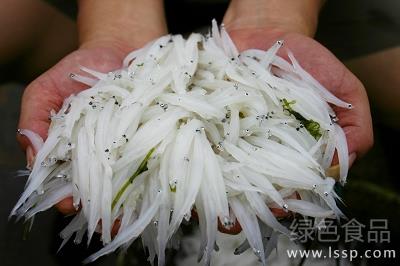
Master Its Living Habits and Learn the Techniques for Breeding Large Icefish Fry and Fingerlings
Master Its Living Habits and Learn the Techniques for Breeding Large Icefish Fry and Fingerlings
-

-

Detailed Explanation of the Large Icefish Processing Technology Series (Part One)
Large icefish, also known as noodlefish, was originally widely distributed in the main stream and affiliated lakes of the middle and lower reaches of the Yangtze River. Its flesh is tender and delicious, rich in nutrients, and eating it carries a special fresh cucumber aroma. Large icefish generally has a body length of about 20 cm, with no bones or spines. It is a small, precious fish species with high economic value and is highly popular in domestic and international markets. Two processing methods for large icefish are introduced here: I. Processing of quick-frozen large icefish. 1. Preservation and transportation of raw fish. Large icefish has a small body and thin skin, making it extremely prone to spoilage.
-
White Sauce Icefish: Recipe and Cooking Techniques Explained
1. Ingredients: 250 g fresh icefish, 2 g chopped scallion, 5 g ginger juice, 25 g flour, 15 g water chestnut flour, 30 g milk, 150 g clear chicken broth. 2. Method: Remove the eyes from the icefish, wash and pat dry, then coat evenly with flour. Thicken the water chestnut flour with milk to make a slurry. Place the icefish in oil heated to 60 percent hot and blanch for 10 seconds, then remove. Set the wok over high heat, sprinkle in the chopped scallion, add a little Shaoxing rice wine and clear chicken broth, then add the icefish and seasonings. Bring to a boil, then simmer over low heat for 10 minutes. Add the milk and water chestnut slurry to thicken, give it a big toss, and slide it onto a plate to serve.
-
Artificial propagation techniques for large icefish: Practical experience from Hongshan Reservoir
Hongshan Reservoir is located in the lower reaches of the Laoha River in the northeast of Chifeng City. It is a large plain-type reservoir integrating flood control, irrigation and aquaculture, with a catchment area of 24,500 sq km and a total storage capacity of 2.56 billion cubic meters. The reservoir's fish-farming area ranges from 80,000 mu to 130,000 mu between the dry season and the wet season. The reservoir introduced fertilized eggs of large icefish in 1995, and the catch reached 2.5 kg/mu in 1998. In the following 2 years the yield declined somewhat, but in recent years, thanks to relatively well-developed propagation management measures, the resource has gradually recovered.
-
Detailed explanation of large icefish processing technology, mastering the key operation points
Large icefish, also called noodle fish, was originally widely distributed in the main stream and affiliated lakes of the middle and lower reaches of the Yangtze River. Its flesh is tender and delicious, rich in nutrients, and eating it gives a special fresh cucumber-like aroma. Large icefish generally has a body length of about 20 cm, with no bones or spines, and is a small valuable fish with very high economic value, deeply welcomed in domestic and international markets. From 1985 to the early 1990s, the reservoir transplantation and propagation of large icefish was carried out comprehensively across our country and achieved success. Its distribution area is continuously expanding, and output is increasing day by day. How to do a good job in
-
Large icefish
(Salangidae) Protosalanx hyalocranius [Local names] Mianwu fish, Miaozhang fish, mud fish. [Morphological characteristics] The individual is small, with the body length of an ordinary individual about 15 cm. The body is slender. The head is flat on the top and bottom. The snout is pointed and triangular. The lower jaw is longer than the upper jaw. The distance from the origin of the dorsal fin to the base of the caudal fin is greater than that to the base of the pectoral fin. The body is transparent. There is a row of black pigment spots on each side of the ventral surface. When sexually mature, the anal fin of the male becomes fan-shaped, with a row of scales at its base, and the pectoral fins are large and pointed. [Origin, production season] It occurs in both seawater and freshwater, and is distributed
-
Detailed Explanation of Key Technical Points for Stocking Icefish in Reservoirs
For the selection of stocking sites, choose as far as possible reservoir bays that are at a certain distance from the shore, with a water depth of about 2 m, a hard mud-sand or gravel substrate, and relatively abundant small prey organisms such as insects, and select several stocking sites at the same time for multi-point stocking, so as to avoid failure caused by improper stocking at a single point. Method for stocking fish eggs: when the fertilized eggs arrive at the destination, first place the nylon bag containing the fertilized eggs into the water, and when the water temperature inside the bag and the reservoir water temperature are basically the same (temperature difference less than 3°C), slowly and evenly scatter the fertilized eggs into the water; each release point should have a certain range
-
Detailed Explanation of Key Techniques for Broodstock Breeding in Icefish Aquaculture
1. Source of broodstock. Sexually mature individuals caught during the breeding season of large icefish can be used for artificial breeding; individuals raised to sexual maturity can be used for artificial breeding; individuals that have not reached sexual maturity must not be used for artificial breeding. 2. Capture of broodstock. The capture of large icefish should be carried out during the peak spawning period; in areas north of the Yellow River, capture can begin in early December, and in areas south of the Yellow River, capture can begin in mid-December. The capture nets can be gill nets (mesh size 2a of 1.5-2.4 cm) or under-ice seine nets.
-
Processing Methods and Techniques for Dry-Salted Icefish (Large Icefish)
The processing technique for dry-salted crystal icefish is simple and convenient for storage, and because this processing method preserves the inherent flavor of icefish, it is more welcomed by consumers than salt-dried products. 1. Processing workflow: raw materials → cleaning → alum water soaking → secondary drying → stacking and cooling → packaging → storage. 2. Key operational points: (1) Raw material handling: First remove mixed fish, shrimp and other impurities, pour the icefish into a wooden barrel pre-filled with half a barrel of clean water, add a few drops of edible oil, stir by hand for 2 min
条件筛选