-
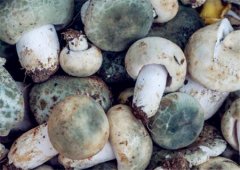
Can Green-headed Russula Be Eaten Raw? A Detailed Guide to Cultivation Methods and Prices
The green-headed russula, like the double ninth mushroom, is a purely wild mushroom species, because the growth of the green-headed russula depends on the nutrients of termite nests and has extremely high environmental requirements, so it cannot yet be cultivated individually. The green-headed russula grows in summer and autumn each year, and generally yields more after rain. Green head
-

What to do when pinheads grow on the spawn blocks after inoculating straw mushrooms
2-3 days after inoculating straw mushrooms, many white pinheads grow on the spawn blocks exposed above the compost, causing the spawn to age and affecting the spawn's mycelial germination, or the mycelium grows but does not colonize the compost. The cause is that the spawn is stimulated by strong light, causing some hyphae to knot prematurely and form pinheads. Control method: when inoculating, do not leave the spawn exposed; it should be sown 2-3 cm deep into the compost, and a straw mulch should be used to shade and keep warm, preventing stimulation by strong light.
-
What to Do When Oyster Mushroom Pinheads Die? Cause Analysis and Control Methods
In oyster mushroom production, due to unsuitable mushroom house environmental conditions and compost, as well as improper management or severe weather and other reasons, pinheads on the mushroom bed often shrink, turn yellow, and eventually die; sometimes pinheads on the bed surface die in batches, seriously affecting yield and economic benefits. For this, the author conducted extensive observational research and summarized the causes of mushroom death and control methods, presented as follows: 1 Continuous high temperatures In autumn mushroom production in northern regions, temperatures go from high to low, which is suitable for the growth and development of oyster mushroom fruiting bodies
-
What are the control methods for arrowhead brown spot?
1. Symptoms Arrowhead brown spot mainly damages leaves and leaf stalks. Leaf spots are dark brown and slightly round, later turning grayish-white in the center, with a clear boundary between diseased and healthy tissue. When the disease is severe, the spots are densely packed and merge into patches, causing the leaves to turn yellow and wither. Leaf stalk spots are nearly spindle-shaped, with the diseased area slightly sunken. When the spots expand around the stalk and merge, the leaf stalk breaks and falls over. When humid, a faintly visible thin white mold layer grows on the surface of the diseased area. 2. Transmission route and disease pattern This disease is caused by infection by the fungus Pseudocercospora sagittariae, a member of the Deuteromycotina. The pathogen overwinters as mycelium or conidiomata on corms or diseased residues,
-
Detailed Explanation of Arrowhead Seed Retention Methods and Technical Key Points
Before collecting seeds, a seed retention field must be selected. Choose a high-yielding field plot with pure varieties, robust growth, light pests and diseases, and few bolting and flowering plants for seed retention, and harvest when the aboveground parts have completely withered. After harvesting, select corms that conform to the characteristics of this variety, are relatively large, heavy, and have relatively curved terminal buds as seeds. Curved terminal buds are conducive to nutrient accumulation and are not easy to sprout. The selected seed corms should have their terminal buds broken off, with a small part of the upper corm attached. That is, pour the arrowhead terminal buds into a 600-fold solution of 50% carbendazim and soak for 20-25 minutes, then remove
-
What are the control methods for arrowhead leaf spot disease?
1. Symptoms This disease mainly damages leaves and leaf stalks. The leaf spots are yellowish-brown to brown, polygonal, elliptical or irregular in shape, slightly zonate, surrounded by a yellow-green or green-brown halo; the spots sometimes merge with one another into large lesions, and in severe cases the leaves turn yellow and wither. On leaf stalks, the disease often produces short, streak-like brown spots, and under high humidity a gray mold grows on the surface of the spots. 2. Transmission route and disease pattern This disease is caused by infection by the fungus Cercospora sagittariae of the subphylum Deuteromycotina. The pathogen mainly overwinters as mycelium and conidiomata on diseased plant residues
-
What are the main varieties of arrowhead? Introduction to common varieties
(1) Shagu is a local variety of Guangdong. The plant height is 70-80 cm, and the spread is 60-70 cm. The corm is oval, 5 cm high, and 4 cm in transverse diameter; both skin and flesh are yellowish white. Each one weighs 40-60 g. It contains a lot of starch, has only slight bitterness, and tastes good. It does not store or transport well. From planting to first harvest is 110-120 days. In February, corms are used for raising seedlings; in July-August they are planted; from December to February of the following year they are harvested. The yield per mu is 1000 kg. (2) Bairou Cigu has a plant height of 70-75 cm and a spread of 80 cm.
-
Arrowhead Cigu Swallowtail Grass White Water Chestnut
Scientific name: Sagittaria sagittifolia. Aliases: Cigu, Swallowtail Grass, White Water Chestnut. Family and genus: Alismataceae, Sagittaria. Category: perennial emergent aquatic plant. Morphological characteristics: up to 12cm tall, with underground rhizomes, the tip forming a corm, the corm surface covered with membranous scales. The tip has a relatively long terminal bud. Leaves are borne at the base, emerge from the water in a truncate form, the leaf blade is arrow-shaped, entire, the petiole is relatively long and hollow. Submerged leaves are linear, the flower stem is upright,
-
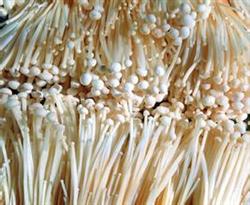
"Five Measures" for Effectively Controlling Black Head Disease in Enoki Mushrooms
Black head disease, also known as bacterial brown blotch disease, is caused by a Pseudomonas bacterium belonging to the phylum Schizomycophyta and the class Schizomycetes. The pathogen is rod-shaped, forms white colonies, and shows a negative reaction to Gram staining. 1. Conditions for occurrence: The internal cause of this disease is the variety's lack of disease resistance, while the external causes are high temperature, high humidity, or spraying unclean...
条件筛选